

Winter energy bills can take a huge bite out of a tight budget, especially for older adults and families with young children. LIHEAP, the Low Income Home Energy Assistance Program, is the main federal program that helps with those bills. It can also step in fast when your power or gas is about to be shut off.
Money for the 2026–27 winter is already reaching the states. In October 2026, HHS released $3.6 billion, but every state’s funds are limited and many close applications once the money runs out. This guide explains what LIHEAP pays for, who qualifies, how to apply in five steps, what to do if you get a shutoff notice, and how to make the help go further.
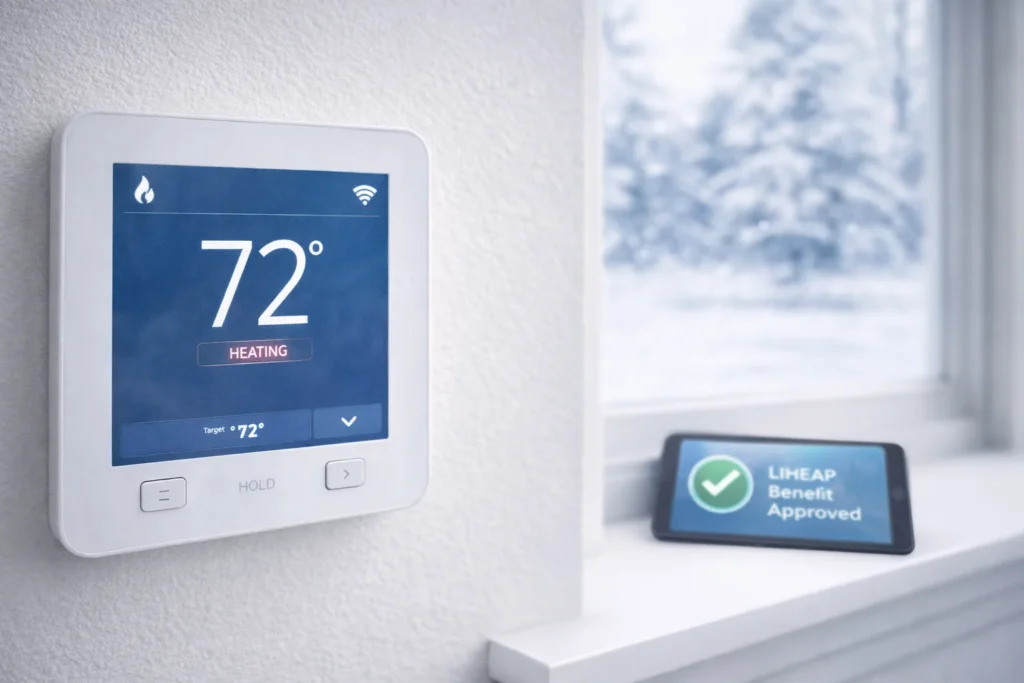
What LIHEAP can pay for
- Help with heating or cooling bills. This is usually a one-time payment each season, sent straight to your utility or fuel company.
- Emergency (crisis) help if you have a shutoff notice, have already been disconnected, or are running out of heating oil or propane. By law, states must act on crisis cases within 48 hours, or 18 hours if the situation is life-threatening.
- Weatherization and repairs in many states, such as fixing a broken furnace or adding insulation so your bills stay lower in the future.
LIHEAP doesn’t pay you in cash, and in most states it won’t cover your whole bill. Think of it as a cushion that keeps the heat on while you catch up. The amount you get usually depends on your income, the size of your household, the type of fuel you use, and how much of your income goes to energy.
Do you qualify?
Each state sets its own income limit, within federal bounds. States can’t set the limit higher than 150% of the federal poverty guidelines or 60% of the state median income, whichever is higher, and can’t set it lower than 110% of the poverty guidelines. In many states, if you already get SNAP, SSI, or TANF, you may qualify automatically or have a simpler application.
Because the limits are set by each state, two families with the same income can get different answers in different states. The easiest way to find out is to ask your local LIHEAP office or call the National Energy Assistance Referral line at 1-866-674-6327.
To check quickly on your own, find your state’s LIHEAP income chart (most agencies post it on their website), look up your household size, and compare it with your household’s total income before taxes. Count everyone who lives with you and shares the energy bill. If you’re close to the line, apply anyway: some states subtract certain expenses, such as medical costs, before comparing.
Who usually gets priority: households with an older adult, a person with a disability, or a young child, and households that spend a large share of their income on energy.
How to apply in 5 steps
- Find your local agency. In most places it’s a community action agency or your county social services office. HHS has a state-by-state contact map.
- Ask when applications open. Many states start taking heating applications in October or November, and some give older adults and people with disabilities an earlier window.
- Gather your documents (see the checklist below).
- Apply online, by mail, or in person, depending on your state. If you have a shutoff notice, say so right away. That moves you to the crisis track.
- Watch for the decision. Regular applications often take 30 to 60 days. If you’re denied, the letter explains how to appeal.
Document checklist
- Photo ID for the person applying
- Social Security numbers for household members (if they have one)
- Proof of income for everyone in the household for the past 30 days (some states ask for longer)
- Your most recent heating and electric bills, with the account numbers visible
- Any shutoff or disconnection notice
- Your lease or mortgage statement, if your state asks for it
Tip: take clear photos of everything on your phone before you start. If the agency asks for a missing page, you can send it the same day instead of starting over.
What to do if you get a shutoff notice
A disconnection notice is stressful, but it usually gives you some time. Use it in this order:
- Call your utility the same day. Tell them you’re applying for energy assistance and ask for a payment arrangement. Many utilities hold off on disconnection while an assistance application is pending.
- Ask about medical protections. In many states, a doctor’s certificate saying someone in the home has a serious medical condition can delay a shutoff.
- Apply for LIHEAP crisis help and bring the notice with you. This is the fastest track the program has.
- Call 211 if LIHEAP funds in your area have run out. They can point you to local charities and utility hardship funds that may still have money.
Example: how LIHEAP fits with your other bills
Teresa is 67 and lives alone on $1,450 a month from Social Security. In January her gas bill jumps to $280, almost 20% of her income. She applies for LIHEAP in November and is approved for a one-time heating benefit, which her state pays directly to the gas company as a credit. She also signs up for her utility’s budget billing plan, which spreads winter costs over 12 months. Together, the two keep her bill manageable through March. When her new Social Security amount for 2027 starts, she reports it if her LIHEAP office asks. A small increase rarely changes eligibility, but it’s good to keep the records accurate.
How to make your benefit go further
- Ask about weatherization. The federal Weatherization Assistance Program is often run by the same local agency as LIHEAP. It can pay for insulation, sealing drafts, or furnace repairs that lower your bills every winter.
- Sign up for budget billing so the high winter months don’t hit all at once.
- Ask about arrears programs. Some utilities forgive part of an old balance if you make steady payments on new bills.
- Seal the easy leaks yourself. Weatherstripping around doors and plastic film on drafty windows are cheap and can make a room noticeably warmer.
Why applying early matters this year
LIHEAP has a fixed budget, and only a minority of eligible households get help each year. Once a state’s funds are spent, it stops taking applications. For the federal fiscal year that started October 1, 2026, HHS sent states 90% of the annual amount up front under a temporary funding law. The rest depends on Congress. The administration’s 2027 budget again proposed eliminating LIHEAP, though Congress kept and even increased the program’s funding the last time that was proposed (American Public Power Association). Applying as soon as your state opens is the safest choice.
Other help to ask about
- Your utility company: ask about hardship programs, payment plans, and winter shutoff protections. Many states don’t allow shutoffs during the coldest months.
- SNAP households: high utility costs can increase your SNAP benefit through the shelter deduction. See our SNAP guide.
- Renters with a voucher: if your landlord is responsible for heat and it isn’t working, that’s an inspection issue. See our Section 8 guide.
- Your whole budget: if heating bills are pushing other bills behind, list everything and rank it by priority. Our guide on making a budget on a tight income walks you through it.
Quick answers
Do I have to pay LIHEAP back?
No. It’s a grant, not a loan, and it doesn’t count as income for other benefits like SNAP.
Can renters apply if heat is included in the rent?
Some states allow it, often with a smaller benefit. Ask your local agency.
Do I need to reapply every year?
Yes. Eligibility is checked each season, so mark your calendar for next fall.
Sources
- U.S. Department of Health and Human Services, Office of Community Services, LIHEAP Funding Releases
- American Public Power Association, HHS Releases $3.6 Billion in FY 2027 LIHEAP Funding (October 13, 2026)
- National Council on Aging, How Do I Apply for LIHEAP?
About this guide: Telyf is an independent publication. We are not affiliated with any government agency, and this article is general information, not legal or financial advice. Rules can vary by state and change over time, so confirm the details with the official agency before making decisions.
About the Author

Vinícius Andrade writes about the practical side of personal growth — employee benefits, career moves, personal finance, and everyday wellbeing. He turns dense rules and jargon into steps anyone can act on, so readers spend less time decoding fine print and more time making decisions that actually improve their lives.
