

If you get SNAP and you’re between 18 and 64, the rules about work changed in a big way. Many people who never had to report hours before, including adults in their late 50s and early 60s and parents of teenagers, now have to show at least 80 hours of work or training a month. If they don’t, their benefits stop after three months.
At the same time, benefit amounts went up on October 1, 2026. A family of four can now get up to $1,023 a month. This guide explains who has to meet the new rule, how to check if you’re exempt, how to prove your hours, and how to estimate your own benefit with a simple example.
What changed, in plain English
SNAP has had a work rule for “able-bodied adults without dependents” (often shortened to ABAWD) for decades. The One Big Beautiful Bill Act, signed on July 4, 2025, made that rule apply to many more people. According to the USDA implementation memo:
- Older adults are now included. The rule used to stop at age 54. It now covers people up to age 64.
- Parents of teenagers are no longer automatically exempt. The exemption now only applies if there is a child under 14 in your SNAP household. Before, any child under 18 counted.
- Three exemptions were removed: veterans, people experiencing homelessness, and young adults (24 or younger) who aged out of foster care.
- A new exemption was added for American Indians, Urban Indians, and California Indians, as defined in federal law.
The changes took effect when the law was signed. States had to start applying them at every new application and recertification, so most people found out at their next renewal. If you haven’t recertified since mid-2025, expect the new rules to be applied the next time you do.
Am I affected? A quick self-check
Go through these questions in order. The first “yes” usually means the 3-month time limit does not apply to you:
- Are you under 18, or 65 or older?
- Does a child under 14 live in your SNAP household?
- Are you pregnant?
- Has a doctor or other qualified professional said you are physically or mentally unable to work?
- Do you care for someone who cannot take care of themselves?
- Are you already working at least 30 hours a week, getting unemployment benefits, enrolled in school at least half time, or in a drug or alcohol treatment program?
- Are you an American Indian, Urban Indian, or California Indian?
If you answered “no” to all of them, plan on meeting the 80-hour rule. Your state SNAP office makes the final decision, so if you think you qualify for an exemption, tell your caseworker and ask what proof they need. A short note from a doctor or clinic, a school enrollment letter, or a letter from a treatment program is often enough, but every state has its own forms.
What counts toward the 80 hours
You can reach 80 hours a month (about 20 hours a week) with:
- Paid work, including part-time or gig work you can document
- A SNAP Employment and Training (E&T) program or another approved work or training program
- Workfare, where your state offers it
- Any combination of the above
Example: Linda is 58, lives alone, and works 15 hours a week at a pharmacy. That is about 65 hours a month, 15 short. Before the change she was exempt because of her age. Now she needs to make up the difference, for example by joining her state’s E&T program for a few hours a week. If she does nothing, she can only get SNAP for 3 months in a 36-month period.
Hours don’t have to be spread evenly. A person who works 30 hours one week and 10 the next can still reach 80 hours in the month. What matters is the monthly total and having proof of it.
How to prove your hours
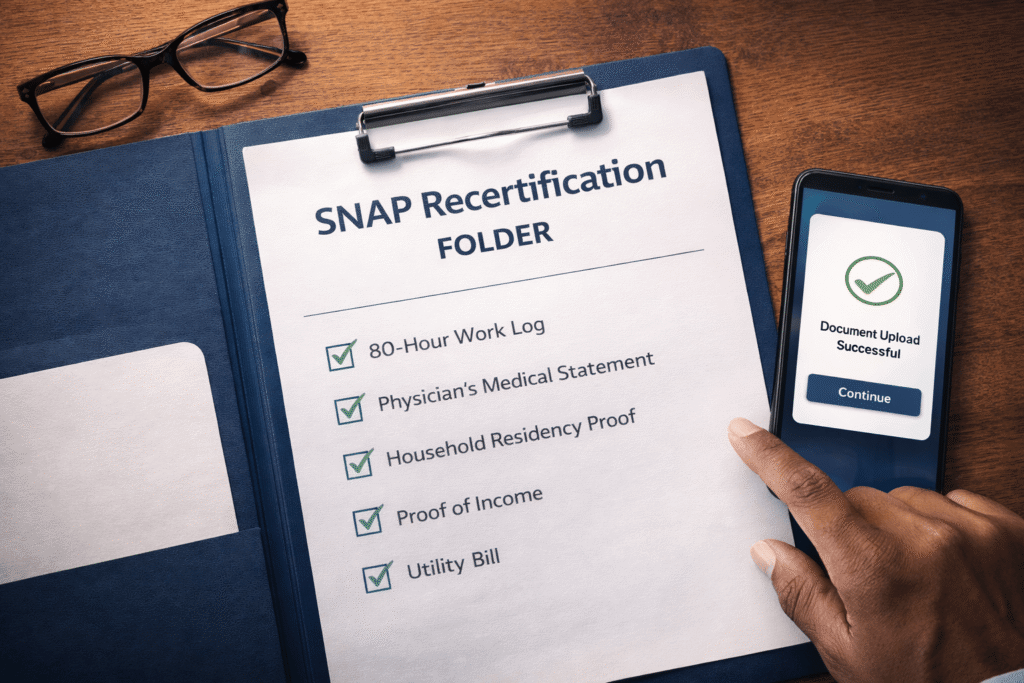
Meeting the requirement and proving it are two different things. Caseworkers can only count hours they can verify, so build the habit of keeping records from the first month:
- Keep every pay stub. If your employer pays electronically, download or screenshot the pay statement each payday.
- For gig or app-based work, save the weekly earnings and hours summary from the app. If the app shows only trips or deliveries, keep a simple log with dates and start and end times.
- For E&T or training, ask the program for a monthly attendance record. Most programs report directly to the SNAP office, but having your own copy helps if something goes missing.
- If you miss hours for a short-term reason, such as an illness, a family emergency, or a transportation breakdown, tell the SNAP office right away. Federal rules allow “good cause” in some situations, so hours you would have worked may still count.
What happens if you lose benefits
Losing SNAP under the time limit doesn’t mean you’re out for three years. You can regain eligibility by meeting the work requirement, for example by working or training 80 hours within a 30-day period, and then reapplying. If you later lose that job or program through no fault of your own, you may qualify for one extra stretch of three consecutive months of benefits within the same 36-month period.
States also have a limited number of discretionary exemptions they can grant to people in hard situations. They don’t have to use them, but it never hurts to ask your caseworker if one is available.
Waivers: why your county might be different
States can ask USDA to pause the time limit in areas with high unemployment. Under the new law, an area needs an unemployment rate above 10% to qualify, which is a much higher bar than before (Alaska and Hawaii have their own rules). USDA’s waiver memo ended most older waivers in November 2025, but a court case allowed some of them to stay in place until their original end dates (Ballotpedia has a summary). Your local SNAP office can tell you if a waiver covers your area.
How much SNAP can you get? (October 2026 to September 2027)
These are the official figures for the 48 contiguous states and Washington, D.C., from USDA’s FY 2027 adjustment memo. Alaska, Hawaii, Guam, and the U.S. Virgin Islands have higher amounts.
| Household size | Maximum monthly benefit | Gross income limit (per month) | Net income limit (per month) |
| 1 | $306 | $1,729 | $1,330 |
| 2 | $562 | $2,345 | $1,804 |
| 3 | $808 | $2,960 | $2,277 |
| 4 | $1,023 | $3,575 | $2,750 |
| 5 | $1,217 | $4,191 | $3,224 |
| 6 | $1,463 | $4,806 | $3,697 |
| 7 | $1,616 | $5,421 | $4,170 |
| 8 | $1,841 | $6,037 | $4,644 |
One- and two-person households that qualify get at least $25 a month. Some states use higher gross income limits, so check your state’s rules if you are close to the line. Households with a member who is 60 or older or has a disability don’t have to meet the gross income limit, only the net one.
How to estimate your benefit in 4 steps
SNAP assumes your household spends about 30% of its net income on food, and covers the rest up to the maximum. Here is a simplified version of the math for a family of three earning $2,400 a month from work:
- Start with gross income: $2,400. This is under the $2,960 limit for three people, so they pass the first test.
- Subtract 20% of earned income: $2,400 − $480 = $1,920.
- Subtract the standard deduction ($217 for a household of three): $1,920 − $217 = $1,703. That is their net income, under the $2,277 limit.
- Take 30% of net income and subtract it from the maximum: 30% of $1,703 is about $511. $808 − $511 = about $297 a month.
This example leaves out the deductions for rent and utilities, child care, child support, and (for older or disabled members) medical costs. Most families qualify for at least one of them, and each one makes the benefit bigger. The shelter deduction is often the biggest: if your rent or mortgage plus utilities is more than half of your income after the other deductions, part of the extra cost is subtracted too. That’s why it pays to report every one of these costs when you apply and to keep copies of your lease and utility bills.
3 mistakes that cost people their benefits
- Not reporting hours on time. Meeting the 80 hours is not enough. Your state also has to receive proof, such as pay stubs or an E&T attendance record, by its deadline.
- Assuming an old exemption still applies. If you were exempt as a veteran, as someone without a home, or because of a 15-year-old child, that exemption may have ended at your last recertification.
- Skipping mail from the SNAP office. Time-limit notices often arrive weeks before benefits stop, and they explain how to fix the problem.
If you also receive Medicaid, a similar work rule is coming to Medicaid in January 2027. Our guide to keeping your Medicaid coverage explains it. If your SNAP household is struggling with utility bills this winter, see our guide to LIHEAP heating assistance. To make your food dollars go further, see how to eat healthy on a tight budget.

How to apply or ask questions
SNAP is run by each state, so the application, the forms, and the office you deal with all depend on where you live. Use USDA’s SNAP state directory to find your state’s office and online application. Most states let you apply online, by phone, or in person, and you can submit an application with just your name, address, and signature to lock in your start date, then send the rest of your documents later.
Sources
- U.S. Department of Agriculture, OBBB ABAWD Exceptions – Implementation Memorandum (October 3, 2025)
- U.S. Department of Agriculture, OBBB ABAWD Waivers – Implementation Memorandum
- U.S. Department of Agriculture, SNAP Fiscal Year 2027 Cost-of-Living Adjustments (August 21, 2026)
About this guide: Telyf is an independent publication. We are not affiliated with any government agency, and this article is general information, not legal or financial advice. Rules can vary by state and change over time, so confirm the details with the official agency before making decisions.
About the Author

Vinícius Andrade writes about the practical side of personal growth — employee benefits, career moves, personal finance, and everyday wellbeing. He turns dense rules and jargon into steps anyone can act on, so readers spend less time decoding fine print and more time making decisions that actually improve their lives.
