

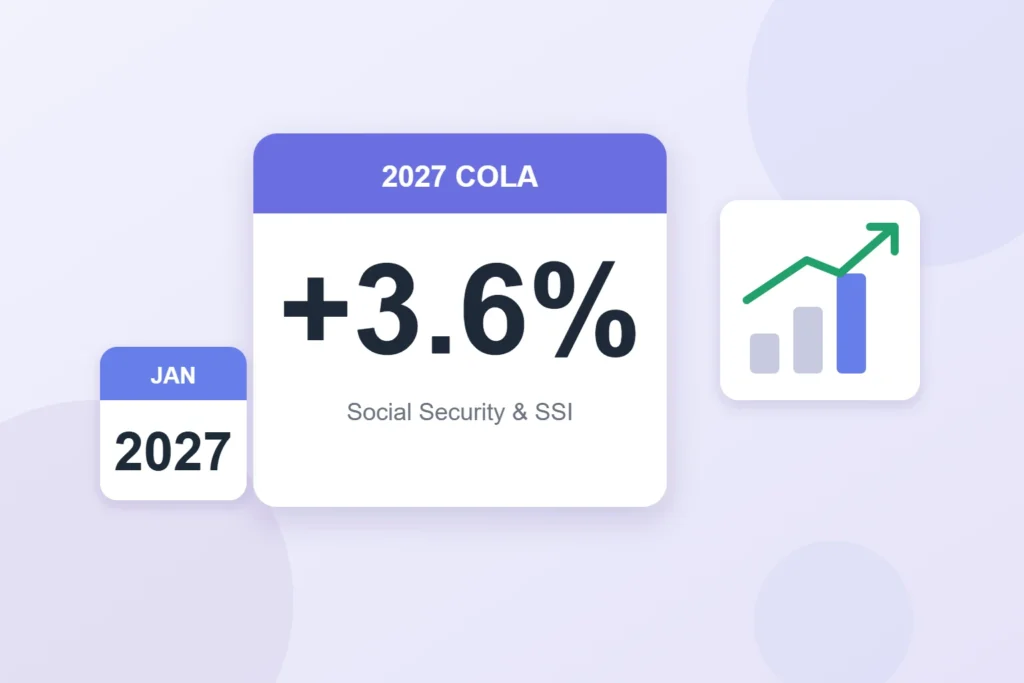
Social Security and SSI benefits will go up 3.6% in 2027, the largest increase in four years. The Social Security Administration (SSA) announced it on October 14, 2026. SSI recipients will see the new amount in the payment that arrives on December 31, 2026, and everyone else will see it in their January 2027 payment. For the average retired worker, that’s about $75 more a month.
The headline number is simple, but what actually lands in your bank account depends on a few other things: Medicare premiums, whether you also get SSI, and whether you still work. This guide shows you how to estimate your own new check, the key 2027 numbers, when each payment arrives, and what to check once the increase kicks in.
How to estimate your new check
The cost-of-living adjustment (COLA) is applied to your benefit before Medicare premiums or other deductions are taken out. A quick way to estimate it is to multiply your current gross benefit by 1.036.
- $1,200 a month becomes about $1,243
- $1,800 a month becomes about $1,865
- $2,500 a month becomes about $2,590
Your exact new amount will be in your COLA notice (see below). The amount that actually reaches your bank account can be smaller than you expect, because Medicare Part B premiums usually go up in January too, and they come out of the same check. CMS publishes the 2027 premium separately.
Example: Joan’s gross benefit is $1,800, and her Part B premium is taken out of it. Her COLA adds about $65. If the Part B premium went up by $10 in January, her deposit would grow by about $55, not $65. For most people who already have Part B deducted from their check, a “hold harmless” rule makes sure the premium increase can’t be bigger than the COLA increase, so the deposit doesn’t go down.
If you get both Social Security and SSI
This is where many people get confused. SSI counts your Social Security as income, so when Social Security goes up, SSI goes down by almost the same amount. At the same time, the maximum SSI payment goes up. The result is that your total usually grows by about the increase in the SSI maximum, not by 3.6% of your Social Security.
Example: Ann gets $600 from Social Security and the rest from SSI, with no other income. In 2026, SSI ignores the first $20, so it counts $580 and pays her $994 − $580 = $414. Her total is $1,014. In 2027, her Social Security rises to about $621, SSI counts $601 and pays $1,029 − $601 = $428. Her new total is about $1,049, which is $35 more, exactly the increase in the SSI maximum. States that add their own supplement may change these numbers slightly.
The key 2027 numbers next to 2026
These figures come from SSA’s official 2027 COLA fact sheet.
| 2026 | 2027 | |
| Average retired worker benefit | $2,095 | $2,170 |
| Average for an aged couple (both receiving) | $3,238 | $3,355 |
| Average disabled worker benefit | $1,642 | $1,701 |
| SSI federal payment, individual | $994 | $1,029 |
| SSI federal payment, couple | $1,491 | $1,544 |
| Earnings limit if under full retirement age | $24,480/year | $25,560/year |
| Earnings limit in the year you reach full retirement age | $65,160/year | $67,920/year |
| Disability work limit (SGA, non-blind) | $1,690/month | $1,770/month |
| Maximum earnings taxed for Social Security | $184,500 | $192,300 |
The “averages” are SSA’s estimates for January 2027, before and after the increase.
If you work while collecting benefits
The earnings test only applies before you reach full retirement age. If you’re under that age all year, SSA holds back $1 for every $2 you earn above $25,560. In the year you reach full retirement age, it holds back $1 for every $3 above $67,920, counting only the months before your birthday month. After that, there’s no limit.

Example: Robert is 63, gets $1,500 a month, and expects to earn $31,560 from a part-time job in 2027. That’s $6,000 over the limit, so SSA will withhold $3,000 for the year. It usually does this by skipping his first two full monthly checks ($3,000 ÷ $1,500). The money isn’t lost. When he reaches full retirement age, SSA recalculates his benefit to give him credit for the months it withheld. If you expect to go over the limit, tell SSA early so you don’t end up owing money later.
If you get disability benefits (SSDI), the rule is different. What matters is the SGA limit in the table, $1,770 a month in 2027. Earning above it on a regular basis can affect your eligibility, so talk to SSA before taking on more work.
When the money arrives
Your payment day depends on your birth date and when you started getting benefits:
| Your situation | Payment day | January 2027 |
| SSI | The 1st of the month (earlier if the 1st is a weekend or holiday) | Thursday, Dec 31, 2026 |
| Birthday on the 1st–10th | Second Wednesday | January 13 |
| Birthday on the 11th–20th | Third Wednesday | January 20 |
| Birthday on the 21st–31st | Fourth Wednesday | January 27 |
| Started before May 1997, or get both Social Security and SSI | The 3rd of the month (earlier if weekend or holiday) | Check SSA’s calendar |
SSI recipients sometimes see two payments in one month and none in the next. For example, January’s SSI payment arrives on December 31. That’s not a bonus, just a calendar shift. Budget it for January. SSA’s official payment calendar has every date for the year.
How to see your new amount online
SSA sends everyone a short notice with the exact new amount. The fastest way to see it is online:
- Go to my Social Security and sign in or create an account. SSA uses Login.gov or ID.me to confirm your identity, so have a photo ID and your phone nearby.
- Choose paperless notices by November 18 if you want to see the COLA notice online instead of waiting for mail.
- Turn on text or email alerts so you know when a new message arrives in your Message Center.
- Check the Message Center starting in late November. Your notice will show your 2027 benefit and, if it’s deducted, your Medicare premium.
If you don’t use an online account, you’ll get a one-page notice by mail in December.
4 things to check after the COLA
- Other benefits that count your income. A higher Social Security check can slightly reduce SNAP or change your rent if you have a housing voucher. Report the new amount when asked. See our guides to SNAP and Section 8 vouchers.
- Medicare Savings Programs and Extra Help. If you’re close to the income limit, check whether you still qualify. These limits are usually updated in the first months of the year.
- Tax withholding. If you have federal tax taken out of your benefit, the withholding percentage stays the same, but the dollar amount will rise a little.
- COLA scams. Every year, scammers call or text about “claiming” your increase. The COLA is automatic. SSA will never ask you to pay a fee, buy gift cards, or confirm your bank details to receive it.
- Your prescription costs. Part D plans change every year. Compare plans during open enrollment and see our guide on saving money on prescription drugs, including the 2026 out-of-pocket cap.
Sources
- Social Security Administration, Social Security Announces 3.6 Percent Benefit Increase for 2027 (October 14, 2026)
- Social Security Administration, 2027 Social Security Changes (COLA fact sheet)
- Social Security Administration, Schedule of Social Security Payments
About this guide: Telyf is an independent publication. We are not affiliated with any government agency, and this article is general information, not legal or financial advice. Rules can vary by state and change over time, so confirm the details with the official agency before making decisions.
About the Author

Vinícius Andrade writes about the practical side of personal growth — employee benefits, career moves, personal finance, and everyday wellbeing. He turns dense rules and jargon into steps anyone can act on, so readers spend less time decoding fine print and more time making decisions that actually improve their lives.
