

When money is tight, food is often the first part of the budget to get squeezed, and healthy eating can feel like a luxury. It doesn’t have to be. Some of the most nutritious foods in the grocery store are also among the cheapest: beans, eggs, oats, rice, frozen vegetables, and seasonal fruit. The key is planning, not spending more.
This guide shows what a realistic grocery budget looks like, a step-by-step plan for shopping and cooking on a budget, a list of low-cost healthy staples, a sample week of meals, and the programs that can stretch your food money further.
What does a healthy, low-cost food budget look like?
The U.S. Department of Agriculture’s Thrifty Food Plan estimates the cost of a nutritious, budget-conscious diet prepared at home. It’s also the basis for SNAP benefits. In June 2026, the national average monthly cost was:
| Household | Thrifty Food Plan, monthly cost (June 2026) |
| Family of four (couple age 20 to 50, two children age 6 to 11) | $1,023.20 |
| Man, age 20 to 50 | $318.50 |
| Woman, age 20 to 50 | $253.40 |
Your costs will vary by location and needs, but these numbers are a useful reality check. For a family of four, that’s about $236 a week, or roughly $2.80 per person per meal.
Step 1: Build meals around a healthy plate
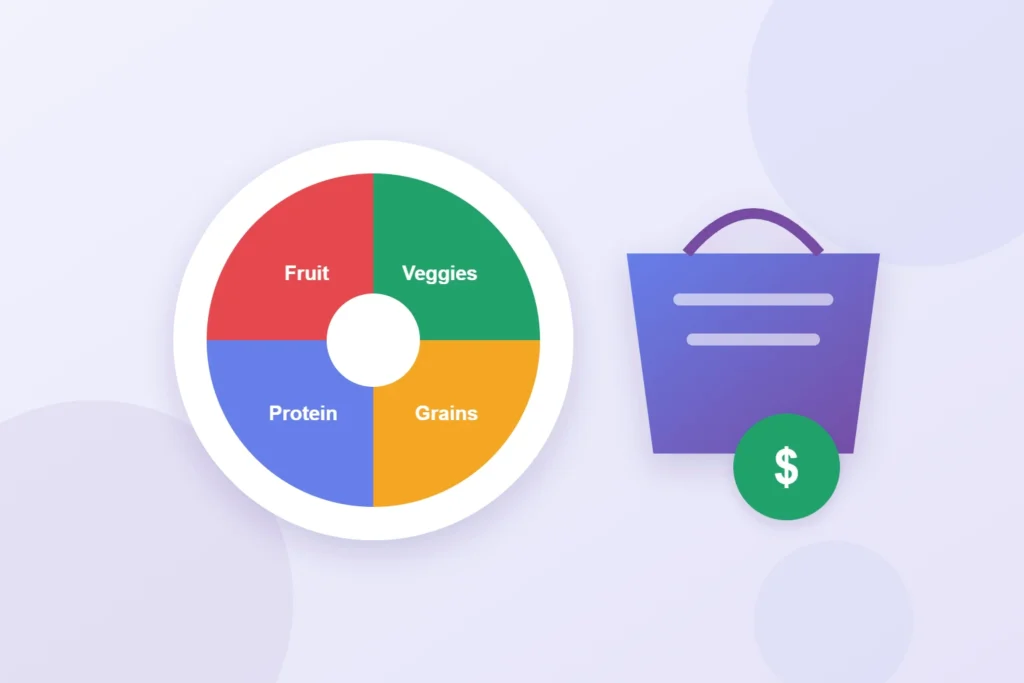
USDA’s MyPlate is a simple guide for balanced meals: fill about half your plate with fruits and vegetables, and split the rest between grains (ideally whole grains) and protein, with dairy or a calcium-rich alternative on the side. Planning meals this way also controls cost, because vegetables, beans, and grains are cheaper per serving than most meat.
Step 2: Plan before you shop
- Check what you already have in the fridge, freezer, and pantry.
- Look at the store’s weekly sales online or in the flyer, and plan meals around what’s discounted.
- Plan 5 dinners, not 7. Leave room for leftovers and one “use up what’s left” night.
- Write a list and stick to it. Impulse buys are where budgets break.
- Eat before you shop. Shopping hungry makes everything look necessary.
USDA’s free Shop Simple with MyPlate tool can help you find local savings and budget-friendly recipes on your phone or computer.
Step 3: Shop smart
- Compare unit prices (the price per ounce or per pound on the shelf tag), not package prices.
- Choose store brands. They’re usually cheaper and often made to similar standards.
- Buy frozen and canned produce. Frozen vegetables and fruit are picked ripe and keep for months. Choose canned vegetables labeled “no salt added” and fruit packed in juice or water.
- Buy whole foods and do the prep yourself. A whole chicken, a block of cheese, or a head of lettuce costs less than cut, shredded, or bagged versions.
- Buy staples in larger sizes only if you’ll use them before they go bad.
- Shop the perimeter, then the basics. Fresh produce, eggs, and dairy first; then dry beans, rice, oats, and pasta.
Low-cost, healthy staples to keep on hand
| Food group | Budget-friendly choices |
| Protein | Dry or canned beans, lentils, eggs, canned tuna or salmon, peanut butter, chicken thighs, frozen fish |
| Grains | Oats, brown or white rice, whole-wheat pasta, corn tortillas, whole-grain bread |
| Vegetables | Frozen mixed vegetables, carrots, cabbage, onions, potatoes, sweet potatoes, canned tomatoes |
| Fruit | Bananas, apples, oranges, seasonal fruit, frozen berries, canned fruit in juice |
| Dairy | Milk, plain yogurt (add your own fruit), block cheese |
A sample budget week for a family
| Day | Dinner | Why it saves |
| Monday | Black bean and rice bowls with salsa and frozen corn | Beans and rice are among the cheapest proteins and grains |
| Tuesday | Baked chicken thighs, roasted potatoes, and carrots | Thighs cost less than breasts; cook extra for Wednesday |
| Wednesday | Chicken and vegetable soup with leftover chicken | Uses leftovers and frozen vegetables |
| Thursday | Veggie omelets or breakfast-for-dinner with toast and fruit | Eggs are a fast, low-cost protein |
| Friday | Whole-wheat pasta with tomato sauce, lentils, and spinach | Lentils stretch the sauce and add protein |
| Weekend | Leftovers night plus a homemade pizza on tortillas or flatbread | Clears the fridge and replaces takeout |
Breakfasts can rotate between oatmeal with banana, eggs, and yogurt with fruit. Lunches can be leftovers or sandwiches with a piece of fruit.
Step 4: Cook once, eat twice
- Cook a big pot of beans, rice, or soup on the weekend and use it in several meals.
- Freeze extra portions in labeled containers for busy nights.
- Turn leftovers into new meals: roast vegetables become an omelet filling, chicken becomes tacos.
- Use the oldest food first so less goes in the trash.
Example: cutting a grocery bill without eating worse
The Johnsons, a family of four, were spending about $1,250 a month on groceries plus $200 on takeout. They started planning five dinners a week around store sales, switched to store brands, replaced two takeout nights with “breakfast for dinner” and tortilla pizza, and bought frozen vegetables instead of fresh ones that often spoiled. Within two months, groceries were closer to $1,050 and takeout was down to about $80 a month. That’s roughly $320 a month back in their budget, and they’re eating more vegetables than before.
Cheap, healthy snack ideas
- Apples or bananas with peanut butter
- Plain yogurt with frozen berries
- Hard-boiled eggs
- Carrot sticks or cucumber slices with hummus
- Air-popped popcorn
- A handful of peanuts or sunflower seeds
Buying snacks in bulk and portioning them at home is far cheaper than single-serving packs.
Programs that stretch your food budget
- SNAP helps eligible households buy groceries. See our guide on keeping your SNAP benefits.
- WIC provides healthy foods for pregnant women, new mothers, and children under 5 who qualify.
- School meals: ask your child’s school about free or reduced-price breakfast and lunch.
- Food banks and pantries provide free groceries, often including fresh produce. Calling 211 can connect you with local options.
4 mistakes that waste food money
- Buying fresh produce you won’t use in time. Mix fresh with frozen.
- Paying for convenience on items you could prep in minutes.
- Thinking “healthy” means expensive specialty products. Basic foods do the job.
- Skipping a plan. Most overspending happens in the store, not at home.
Food is usually the most flexible part of a budget. Our guide on making a budget on a tight income shows how to fit groceries into the rest of your bills.
Sources
- U.S. Department of Agriculture, MyPlate: Healthy Eating on a Budget
- U.S. Department of Agriculture, Official USDA Thrifty Food Plan: U.S. Average, June 2026
About this guide: Telyf is an independent publication. This article is general information, not medical advice. Talk to a doctor or other qualified health professional before changing your routine, starting a new exercise program or making decisions about medications. In an emergency, call 911.
About the Author

Vinícius Andrade writes about the practical side of personal growth — employee benefits, career moves, personal finance, and everyday wellbeing. He turns dense rules and jargon into steps anyone can act on, so readers spend less time decoding fine print and more time making decisions that actually improve their lives.
