

Losing your job is stressful, and the days right after a layoff come with a pile of deadlines that are easy to miss: unemployment claims, health coverage elections, retirement account decisions, and severance paperwork. Missing one of them can cost you real money.
This checklist puts everything in order, from what to do on your last day to the decisions you should make in the first 60 days. It also includes an example budget and the rules that protect you, so you can focus on your next job instead of untangling paperwork later.
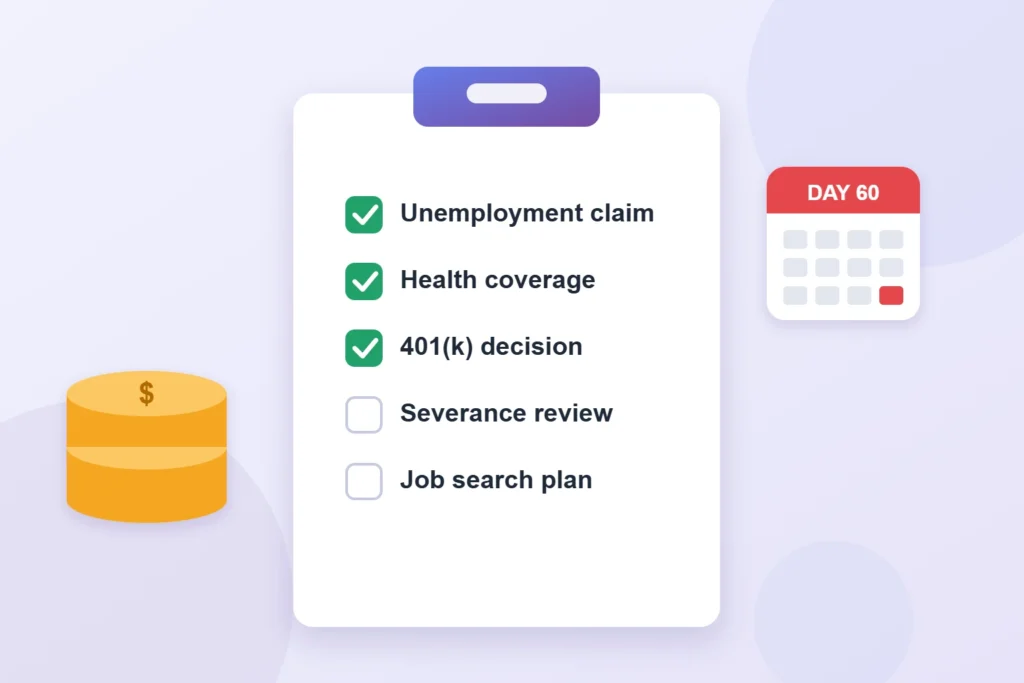
On your last day: 5 things to get before you leave
- Written notice of the layoff with your last day of work. Your state unemployment office may ask for it.
- Details of your final paycheck: when it will be paid and whether it includes unused vacation. Final pay deadlines and vacation payout rules depend on your state.
- The severance agreement, if one is offered. Don’t sign it on the spot. Take it home and read it (more on that below).
- Information about your benefits: when your health coverage ends, and how to reach the retirement plan administrator.
- Personal contacts and copies of your own work samples that you’re allowed to keep, such as performance reviews and awards. Don’t take confidential company files.
In the first week: file for unemployment
Apply for unemployment insurance as soon as possible, ideally the same week. Benefits usually start from the week you file, not the day you lost your job. Each state runs its own program. You can find yours through the Department of Labor’s unemployment benefits finder.
- How much: each state uses its own formula, generally a portion of your past wages, up to a weekly maximum.
- How long: many states pay up to 26 weeks, but some pay less.
- What you must do: most states require you to certify every week or every two weeks and to show you are looking for work. Keep a simple log of every application.
- Severance: in some states, severance or vacation pay can delay or reduce your benefits. File anyway and let the state decide.
In the first 30 to 60 days: choose your health coverage
You have three main options. Don’t let the deadlines pass.
| Option | Deadline to act | What to know |
| COBRA (keep your employer’s plan) | Usually 60 days to elect after you get the notice | Same coverage, but you may pay up to 102% of the full premium. It usually lasts up to 18 months. Applies to employers with 20+ employees. |
| Marketplace plan (HealthCare.gov or your state) | 60 days from losing coverage | Your lower income may qualify you for premium tax credits, which can make it much cheaper than COBRA. |
| Medicaid | Apply any time | If your income drops low enough, you may qualify. See our Medicaid guide. |
A useful detail: COBRA coverage is retroactive. If you elect it within the 60 days and pay the premiums, coverage reaches back to the day your old plan ended. Compare prices before deciding. If you choose COBRA and later drop it outside open enrollment, you generally can’t switch to a Marketplace plan until the next open enrollment period.
Decide what to do with your 401(k)
You don’t have to do anything right away, and in most cases you shouldn’t cash out. Your main choices:
- Leave it in the old plan, if the plan allows it (usually when the balance is above a set minimum).
- Roll it into an IRA or a new employer’s plan with a direct rollover, where the money goes straight from one account to the other. This avoids the mandatory 20% tax withholding.
- Cash it out. The money is taxed as income, and if you are under 59½ you usually also pay a 10% penalty. One exception, often called the “rule of 55,” lets you take money from that employer’s plan without the penalty if you left the job in or after the year you turned 55.
Review your severance agreement
A severance agreement usually trades a payment for your promise not to sue the company. Before signing:
- Check what you would give up, and whether there are non-compete or confidentiality clauses.
- If you are 40 or older, federal law usually gives you 21 days to consider the agreement (45 days in a group layoff) and 7 days to change your mind after signing.
- It’s often possible to negotiate: more weeks of pay, extended health coverage, a neutral reference, or keeping your laptop.
- For large or complicated agreements, a short consultation with an employment lawyer can pay for itself.
Did you get advance notice? Under the federal WARN Act, employers with 100 or more employees generally must give 60 days’ notice before a plant closing or mass layoff. If they don’t, affected workers may be owed up to 60 days of back pay and benefits. Some states have stricter rules. The Department of Labor’s WARN Act guide explains who is covered.
Example: building a layoff budget
Jordan earned $4,200 a month after taxes and was laid off with four weeks of severance. His monthly costs are $1,450 rent, $310 car payment and insurance, $500 food, $220 utilities and phone, and $180 other bills, for a total of $2,660.
- His state unemployment benefit works out to about $1,700 a month.
- He compares health options: COBRA would cost $640 a month, while a Marketplace plan with his lower expected income costs about $150.
- With the Marketplace plan, his monthly gap is about $1,110 ($2,660 + $150 − $1,700).
- His severance (about $4,200 after taxes) plus $5,000 in savings cover that gap for roughly eight months.
Having that number lets Jordan job hunt calmly instead of taking the first offer out of panic. If money is tight, check whether you qualify for food help. Our SNAP guide explains the income limits. If you have federal student loans, an income-driven plan can lower your payment while your income is down; see how to choose a student loan repayment plan.
Start your job search the smart way
- Update your resume for software screening with our guide to resumes that get past applicant tracking systems.
- Use the salary range in job postings to negotiate your next offer. See how to negotiate using pay transparency laws.
- Visit your local American Job Center for free help, and ask whether you qualify for training as a “dislocated worker.”
- Be careful: laid-off workers are a favorite target for fake job offers. Read how to spot remote job scams before you share personal information.
Sources
- U.S. Department of Labor, elaws: Worker Adjustment and Retraining Notification Act (WARN)
- U.S. Department of Labor, An Employee’s Guide to Health Benefits Under COBRA
- U.S. Department of Labor, CareerOneStop: Find Unemployment Benefits
About this guide: Telyf is an independent publication. We are not affiliated with any government agency, and this article is general information, not legal or financial advice. Rules can vary by state and change over time, so confirm the details with the official agency before making decisions.
About the Author

Vinícius Andrade writes about the practical side of personal growth — employee benefits, career moves, personal finance, and everyday wellbeing. He turns dense rules and jargon into steps anyone can act on, so readers spend less time decoding fine print and more time making decisions that actually improve their lives.
