

Credit card debt is one of the most expensive kinds of debt there is. In August 2026, the average interest rate on credit card accounts that were charged interest was 22.36%, according to Federal Reserve data. At that rate, a balance that only gets minimum payments can take decades to pay off and cost more in interest than the original purchases.
The way out is a plan. This guide shows you how to list your debts, compares the two most popular payoff methods (avalanche and snowball) with real numbers, explains when a balance transfer or credit counseling makes sense, and lists the traps that keep people in debt.
Step 1: Stop the balance from growing
You can’t pay off a balance that keeps getting bigger. Before choosing a method:
- Pause new charges on the cards you’re paying off. Use a debit card or cash for everyday spending while you work through the plan.
- Set up autopay for every minimum payment, so you never add late fees or a penalty interest rate.
- Build a small cushion of $500 to $1,000 if you don’t have one. Without it, the next surprise bill goes right back on a card. Our guide to building an emergency fund shows how to start small.
Step 2: List every debt
Make a simple list with four columns for each card: the balance, the interest rate (APR), the minimum payment, and the due date. You’ll find all of this on your statement or in your card’s app. Then decide how much you can pay in total each month. Our guide on making a budget on a tight income can help you find that number.
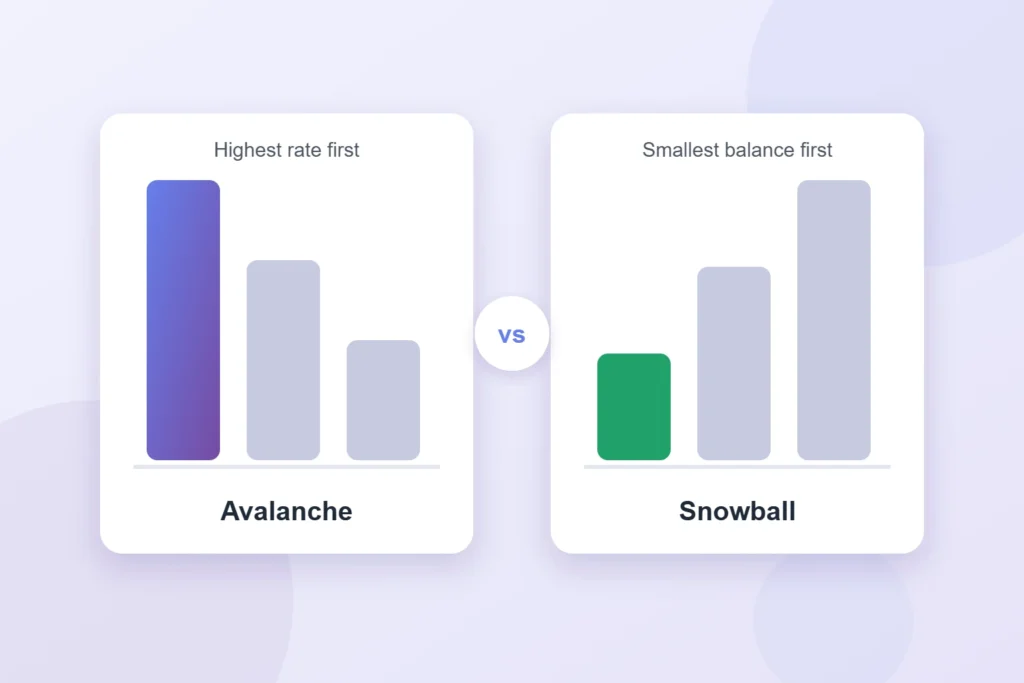
Step 3: Choose avalanche or snowball
Both methods work the same basic way: pay the minimum on every card, and put every extra dollar toward one target card. When that card is paid off, roll its whole payment onto the next one. The only difference is the order.
| Avalanche | Snowball | |
| Which card you target first | The highest interest rate | The smallest balance |
| Main advantage | Lowest total interest and usually the fastest payoff | Quick wins that keep you motivated |
| Main drawback | The first payoff can take a while | Usually costs more in interest |
| Best for | People who stick to a plan once it’s set | People who need early progress to stay on track |
Example: the same debt, three ways
Luis has $10,700 in credit card debt on three cards and can put $600 a month toward them:
| Card | Balance | APR | Minimum payment |
| Store card | $1,200 | 19.99% | $35 |
| Card B | $3,500 | 24.99% | $110 |
| Card C | $6,000 | 29.99% | $210 |
He pays the $355 in minimums every month and has $245 extra for his target card. Here’s how each approach plays out (our calculations, assuming no new charges and no rate changes):
| Approach | Order | Debt-free in | Total interest paid |
| Avalanche | Card C, then B, then store card | 23 months | About $3,015 |
| Snowball | Store card, then B, then C | 24 months | About $3,376 |
| Minimum payments only | No plan | About 22 years | About $20,900 |
Two lessons stand out. First, having any plan matters far more than which plan you pick: both methods save more than $17,000 compared with paying minimums only. Card minimums shrink as the balance falls, which is what stretches a minimums-only payoff out for decades. Second, the avalanche saves Luis about $360 and one month. With the snowball, though, he pays off the store card in just five months, a quick win that helps many people keep going. Pick the method you’ll actually stick with.
Step 4: Lower the interest rate if you can
Every point of interest you cut means more of your payment goes to the balance:
- Call your card issuer. The FTC suggests asking for a lower rate or a payment plan. If you’ve paid on time, you may get a lower APR. If you’re struggling, ask about a hardship program.
- Consider a 0% balance transfer card if your credit is good. Most charge a transfer fee of about 3% to 5% and offer 0% for a limited time, often 12 to 21 months. Example: moving Luis’s $6,000 Card C balance to an 18-month 0% offer with a 3% fee costs $180 upfront, and paying $344 a month clears it before the promotion ends. The catch: any balance left when the promotion ends starts charging the regular rate, and new purchases on the card may not get the 0% rate.
- Look at a personal loan to consolidate, but only if the rate is clearly lower than your cards and you won’t run the cards back up.
Step 5: Get help if you’re overwhelmed
If the minimum payments alone don’t fit your budget, a nonprofit credit counselor can help. Agencies that belong to the National Foundation for Credit Counseling (NFCC) offer budget reviews and, for people who qualify, a debt management plan. In a plan, the agency works with your card issuers to try to lower interest rates and waive some fees, and you make one monthly payment to the agency, which pays your creditors. The FTC notes that these plans often take 48 months or more, and you’ll usually need to close the cards in the plan.
Before choosing any company, ask about fees in writing and be cautious with anyone who promises to fix everything quickly or wants payment before doing any work.
Be careful with debt settlement
Debt settlement companies negotiate to pay less than you owe, often after telling you to stop paying your cards. That approach can seriously damage your credit, lead to late fees and collection calls, and doesn’t guarantee a settlement. Forgiven debt can also count as taxable income: creditors generally send a Form 1099-C when they cancel $600 or more. Talk to a nonprofit counselor before you go this route.
6 traps that keep people in debt
- Paying only the minimum. As the example shows, it can turn a few thousand dollars into decades of payments.
- Closing all your cards right away. Paid-off cards with no annual fee can stay open to help your credit utilization. Just keep them out of your wallet if they tempt you. See our guide on how to improve your credit score.
- Swapping cards for buy now, pay later. It’s still debt. See our guide on using buy now, pay later safely.
- Using a balance transfer without a payoff plan for when the 0% rate ends.
- Raiding retirement savings. Early withdrawals usually come with taxes and penalties, and they shrink the money you’ll need later.
- Not celebrating progress. Mark each paid-off card. Motivation is part of the plan.
Once your cards are paid off, keep “paying” the same amount every month, but to yourself: first into an emergency fund, then into retirement savings. If you’re 50 or older, see our guide on catching up on retirement savings.
Sources
- Federal Reserve Bank of St. Louis (FRED), Commercial Bank Interest Rate on Credit Card Plans, Accounts Assessed Interest
- Federal Trade Commission, How To Get Out of Debt
- National Foundation for Credit Counseling, NFCC
About this guide: Telyf is an independent publication. We are not affiliated with any government agency, and this article is general information, not legal or financial advice. Rules can vary by state and change over time, so confirm the details with the official agency before making decisions.
About the Author

Vinícius Andrade writes about the practical side of personal growth — employee benefits, career moves, personal finance, and everyday wellbeing. He turns dense rules and jargon into steps anyone can act on, so readers spend less time decoding fine print and more time making decisions that actually improve their lives.
