

Remote work opened up real opportunities, and it also opened the door to a wave of fake jobs. According to the Federal Trade Commission, reported losses to job and employment agency scams jumped from $90 million in 2020 to $501 million in 2024, and the number of reports tripled over the same period. Many victims were people actively looking for work, sometimes right after a layoff.
The scams are getting more convincing: real company names, professional-looking websites, and “recruiters” who chat with you for days. This guide shows how the most common schemes work, the red flags that give them away, a quick way to check any offer, and exactly what to do if you have already shared money or personal information.
How the most common remote job scams work
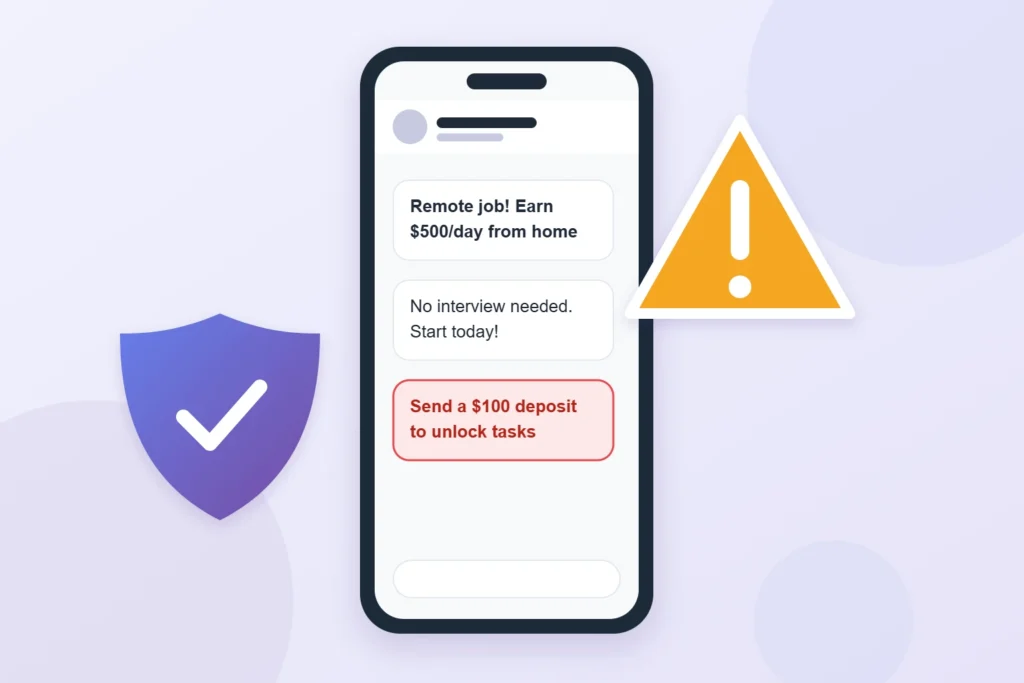
- Task scams. A text or WhatsApp message offers easy online work, such as “optimizing apps,” “boosting products,” or rating content. At first you see small payouts in an online account. Then you are told to deposit your own money, often in cryptocurrency, to “unlock” the next set of tasks or withdraw your earnings. That money is gone. The FTC says task scams made up nearly 40% of job scam reports in 2024.
- Fake check scams. You are “hired” and sent a check to buy equipment from a specific vendor. You deposit it, send money to the vendor, and days later the check bounces. You owe the bank the full amount.
- Identity theft “onboarding.” After a quick chat-only interview, you are asked for your Social Security number, a photo of your ID, and bank details “for payroll” before you have a real offer.
- Pay-to-work schemes. You are asked to pay for training, a starter kit, a certification, or “placement” before you can start.
- Reshipping jobs. You receive packages at home and forward them. The goods were bought with stolen cards, and you may be helping a crime without knowing it.
7 red flags of a fake job offer
- They found you out of nowhere, by text, WhatsApp, or Telegram, for a job you never applied to.
- The interview happens only by chat, with no video or phone call, and you’re “hired” almost right away.
- The pay is too good for simple work, like $300 a day for liking posts or rating products.
- You are asked to pay anything: fees, equipment, training, or a deposit to access your earnings.
- They send you a check and ask you to send part of the money somewhere else.
- The email comes from a free address (like Gmail) or a domain that is slightly different from the real company’s.
- They push you to hurry or to keep the job secret, and they ask for your SSN or bank details before a written offer.
One rule covers most of them: a real employer pays you, never the other way around.
Real job or scam? A quick comparison
| Real employers | Scammers |
| Post jobs on their own careers site | Reach out with unsolicited texts or chat messages |
| Interview by phone or video, often more than once | “Interview” only by chat, then hire on the spot |
| Send a written offer before asking for tax and payroll forms | Ask for your SSN and bank info right away |
| Provide equipment or reimburse you through payroll | Send checks and ask you to forward money |
| Never charge you to work | Ask for fees, deposits, or crypto |
How to check any job offer in 5 steps
- Find the job on the company’s own website. Type the company’s address yourself instead of using a link from the message. If the role isn’t listed there, be suspicious.
- Check the recruiter. Look for the person on LinkedIn, and make sure their email uses the company’s real domain.
- Call the company using a phone number from its official website, and ask whether the job and the recruiter are real.
- Search the company name plus “scam” or the exact wording of the message. Many scripts are reused word for word.
- Never move money for a job: no deposits, no buying gift cards, and no sending part of a check back.
Example: spotting the scam in real time
Kayla, who was laid off two weeks earlier, gets a text: “Hi, I’m Emily from a staffing agency. We found your resume online. Remote position, 1 to 2 hours a day, $250 to $500 daily. Reply YES for details.” She never applied to this agency. When she replies, “Emily” moves the chat to WhatsApp, describes “product optimization tasks,” and shows screenshots of other workers’ earnings.
Checking against the red flags, Kayla counts four in a few minutes: unsolicited contact, a vague job, unrealistic pay, and a move to a chat app. She searches the agency’s name and finds identical messages reported by others. She blocks the number and reports it. Cost to her: five minutes.
Where to find real remote jobs
- Employers’ own careers pages. Many large companies list remote and hybrid roles and let you filter by location.
- Government job boards. USAJOBS lists federal positions, including remote ones, and most state governments have their own job portals.
- Your state’s job bank and American Job Center. Postings there are screened, and staff can help you check an offer that seems off.
- Well-known job sites, as long as you apply through the employer’s real website whenever possible and treat any message that moves you to a chat app as a warning sign.
Legitimate remote jobs usually look like regular jobs: a clear description, a named employer, a normal interview process, and pay that matches the market for the role.
What to do if you’ve already been scammed
- Stop all contact and payments. Scammers often come back promising to “recover” your money for a fee. That’s a second scam.
- Call your bank or card company right away. Ask them to stop or reverse any transfers. Cryptocurrency payments are very hard to recover, so act fast.
- If you shared your SSN or ID, go to IdentityTheft.gov for a recovery plan, and consider freezing your credit with the three credit bureaus. Freezes are free.
- Report it to the FTC at ReportFraud.ftc.gov and to the FBI’s Internet Crime Complaint Center at ic3.gov. Also report the fake posting to the job site where you found it.
- If you deposited a fake check, tell your bank immediately, even if the money seems to have “cleared.”
Looking for real work instead? Start with our guides to writing a resume that gets past applicant tracking systems and getting hired without a degree. If you were recently laid off, our layoff checklist covers unemployment, health coverage, and more.
Sources
- Federal Trade Commission, New FTC Data Show a Big Jump in Reported Losses to Fraud to $12.5 Billion in 2024 (March 2025)
- Federal Trade Commission, New FTC Data Show Skyrocketing Consumer Reports About Game-Like Online Job Scams (December 2024)
- Federal Trade Commission, Job Scams
About this guide: Telyf is an independent publication. We are not affiliated with any government agency, and this article is general information, not legal or financial advice. Rules can vary by state and change over time, so confirm the details with the official agency before making decisions.
About the Author

Vinícius Andrade writes about the practical side of personal growth — employee benefits, career moves, personal finance, and everyday wellbeing. He turns dense rules and jargon into steps anyone can act on, so readers spend less time decoding fine print and more time making decisions that actually improve their lives.
