

“I don’t have time” is the most common reason adults give for not exercising. But the federal recommendation for adults works out to about 22 minutes a day, and it doesn’t have to happen all at once. With a little planning, most people can fit it around work, family, and everything else.
This guide explains exactly how much activity adults need, how to tell if you’re working hard enough, three sample weekly schedules for different lifestyles, and practical tricks to sneak movement into a busy day.
How much exercise do adults need?
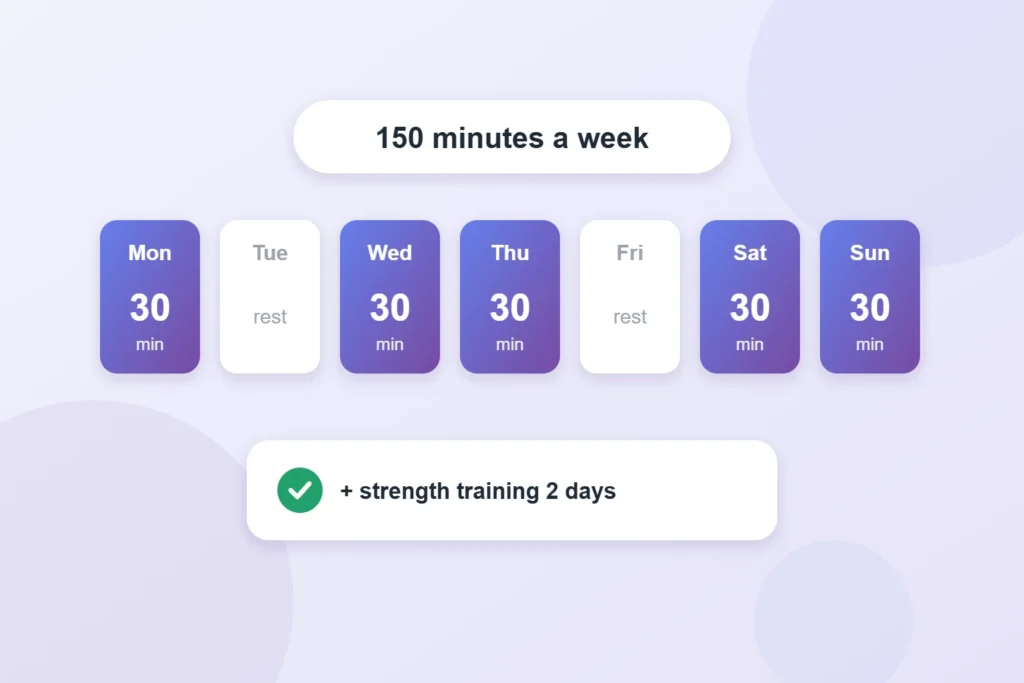
According to the CDC and the Physical Activity Guidelines for Americans, adults need each week:
- 150 minutes of moderate-intensity aerobic activity, such as brisk walking, or
- 75 minutes of vigorous-intensity activity, such as jogging or running, or an equivalent mix of the two, plus
- muscle-strengthening activities on at least 2 days that work all the major muscle groups.
Two details make this much easier than it sounds. First, the 150 minutes can be broken up across the week, for example 30 minutes on 5 days. Second, the CDC notes that some physical activity is better than none. If you’re starting from zero, any increase counts.
How to tell moderate from vigorous
You don’t need a fitness tracker. A simple “talk test” works for most people:
| Intensity | How it feels | Examples |
| Light | You can talk and sing easily | Strolling, light housework |
| Moderate | You can talk, but not sing | Brisk walking, biking on flat ground, raking leaves, water aerobics |
| Vigorous | You can only say a few words before pausing for breath | Jogging, running, swimming laps, fast cycling, hiking uphill |
One minute of vigorous activity counts about the same as two minutes of moderate activity. That’s why 75 vigorous minutes equals 150 moderate minutes.
Three sample weeks for three kinds of schedules
1. The steady routine (30 minutes, 5 days)
| Day | Activity | Minutes |
| Mon, Wed, Thu | Brisk walk before or after work | 30 each |
| Tue, Fri | Strength training at home | 20 to 30 each |
| Sat, Sun | Bike ride, dancing, or a long walk | 30 each |
That’s 150 aerobic minutes from five 30-minute walks or rides, plus two strength days.
2. The “no free 30 minutes” schedule (10-minute bursts)
- 10 minutes: brisk walk on your lunch break
- 10 minutes: park farther away or get off the bus one stop early, then walk briskly
- 10 minutes: walk after dinner
Three 10-minute bursts on five days add up to 150 minutes. Add two 15- to 20-minute strength sessions on days that are lighter.
3. The weekend-heavy schedule
- Saturday: 50-minute hike or bike ride
- Sunday: 50-minute brisk walk or swim
- Two weekdays: 25-minute walk
- Two weekdays: short strength session
Spreading activity across at least three days is generally better than packing it all into one, both for your body and for building the habit.
Example: a parent with a full-time job
Danielle works 8:30 to 5:00, picks up her kids at 5:30, and has about 20 free minutes most evenings. Here’s how she reaches 150 minutes:
- She walks briskly for 15 minutes at lunch, Monday to Friday: 75 minutes.
- On Tuesday and Thursday, she walks laps around the field during her kids’ 30-minute soccer practice: 60 minutes.
- On Saturday, the family goes on a 20-minute bike ride: 20 minutes.
- On Monday and Wednesday nights, she does a 15-minute strength routine after the kids are in bed.
Total: 155 aerobic minutes plus two strength sessions, without a gym and without waking up at 5 a.m.
8 ways to sneak in more movement
- Schedule it like a meeting. Put walks on your calendar with a reminder.
- Walk while you talk. Take phone calls on foot whenever you can.
- Use the stairs for a few floors instead of the elevator.
- Make chores count. Brisk yard work, mopping, and carrying laundry up and down stairs can be moderate activity.
- Turn waiting time into walking time at kids’ practices, appointments, and pick-up lines.
- Find a buddy. A standing walk with a friend or coworker is harder to skip. It also helps with loneliness; see how to beat loneliness.
- Keep shoes ready by the door or in your car.
- Track it simply. A paper calendar where you write minutes each day works as well as an app.
What counts toward your 150 minutes?
More than most people think. Any activity that gets you to at least a moderate intensity counts, as long as you could talk but not sing while doing it:
- Getting around: brisk walking to work, the store, or the bus stop; biking for errands.
- Around the house: vigorous cleaning, mowing with a push mower, raking, shoveling snow, carrying groceries upstairs.
- Fun: dancing in the kitchen, playing tag or soccer with kids, swimming, a pickup basketball game.
- Classes and videos: free online workout videos, water aerobics, or a community center class.
Slow strolling and light chores are still good for you and better than sitting, but they usually don’t reach moderate intensity, so count them as a bonus.
How to make it stick
- Start smaller than you think. A plan you can keep on your worst week beats an ambitious plan you drop after ten days.
- Pick a time, not just a goal. “Walk at 12:15 on weekdays” works better than “walk more.”
- Have a backup. If it rains, swap the outdoor walk for a 15-minute indoor video or stair laps.
- Track weekly, not daily. Missing Monday is fine if you make it up on Saturday.
Getting started safely
- Start where you are. If you’re inactive now, begin with 10 minutes a day and add 5 minutes each week.
- Talk to a doctor first if you have a chronic condition, a disability, or you’ve been inactive and plan to start vigorous activity.
- Wear comfortable, supportive shoes and drink water, especially in hot weather.
- Stop and get help if you feel chest pain, severe shortness of breath, or dizziness.
Don’t skip the strength days
Many people focus only on walking or cardio. The two weekly strength days matter just as much, especially after 40, because they protect your muscles, bones, and balance. Our guide on how to start strength training after 40 has a beginner plan you can do at home.
Regular activity also helps many people sleep better and handle stress. See our guides on how to sleep better and how to manage stress.
Sources
- Centers for Disease Control and Prevention, Adult Activity: An Overview
- Centers for Disease Control and Prevention, Adding Physical Activity as an Adult
- U.S. Department of Health and Human Services, Physical Activity Guidelines for Americans, 2nd edition
About this guide: Telyf is an independent publication. This article is general information, not medical advice. Talk to a doctor or other qualified health professional before changing your routine, starting a new exercise program or making decisions about medications. In an emergency, call 911.
About the Author

Vinícius Andrade writes about the practical side of personal growth — employee benefits, career moves, personal finance, and everyday wellbeing. He turns dense rules and jargon into steps anyone can act on, so readers spend less time decoding fine print and more time making decisions that actually improve their lives.
