

By 2026, the global wellness industry has undergone a fundamental shift from “comfort-seeking” to “Stress Mastery.” The foundational principle of this era is Hormesis—the biological phenomenon where a controlled, low-dose exposure to a stressor triggers a disproportionately large, beneficial adaptation response. In a world of climate-controlled offices and sedentary lifestyles, the 2026 professional recognizes that absolute comfort is a technical state of biological decay.
The “Recovery Economy” has emerged to bridge this gap, providing the infrastructure for managed biological challenges. We no longer view a cold plunge or a sauna session as a luxury, but as a mandatory Allostatic Reset. By 2026, the goal of wellness is to expand the “Hormetic Zone”—the range of stress within which the body can adapt and thrive—thereby increasing systemic resilience against the chronic stressors of modern life.
This is a technical pivot toward Proactive Resilience. Rather than waiting for the body to break under the pressure of work and environment, 2026 health protocols utilize hormetic levers to “harden” the organism. Through heat, cold, hypoxia, and fasting, we are technically re-coding our cells to be more efficient, more durable, and more resistant to the oxidative damage that drives aging.
In 2026, we have realized that the body is an antifragile system; it does not just tolerate stress, it technically requires it to maintain structural and functional integrity.
Molecular Mechanics: NRF2, FOXO3, and the Hormetic Curve
The technical magic of hormesis happens at the cellular level through the activation of Survival Genes. When the body is exposed to an acute stressor (like intense heat), it triggers the NRF2 pathway, the master regulator of the antioxidant response. This isn’t just a temporary boost; it is a permanent upgrade to the cell’s internal defense systems. In 2026, we measure this via the Hormetic Efficiency (HE), which tracks the relationship between the stressor intensity (x) and the biological benefit (y):

This biphasic response curve demonstrates that while high doses of stress are toxic, the “low-dose” region technically upregulates mitochondrial function and DNA repair mechanisms. Specifically, 2026 longevity protocols target the FOXO3 gene—a longevity marker that is “switched on” during periods of controlled metabolic stress, such as intermittent fasting or thermal exposure. By strategically pulsing these stressors, we are essentially training our mitochondria to be more resilient.
The 2026 Protocol: Fire, Ice, and Pressure
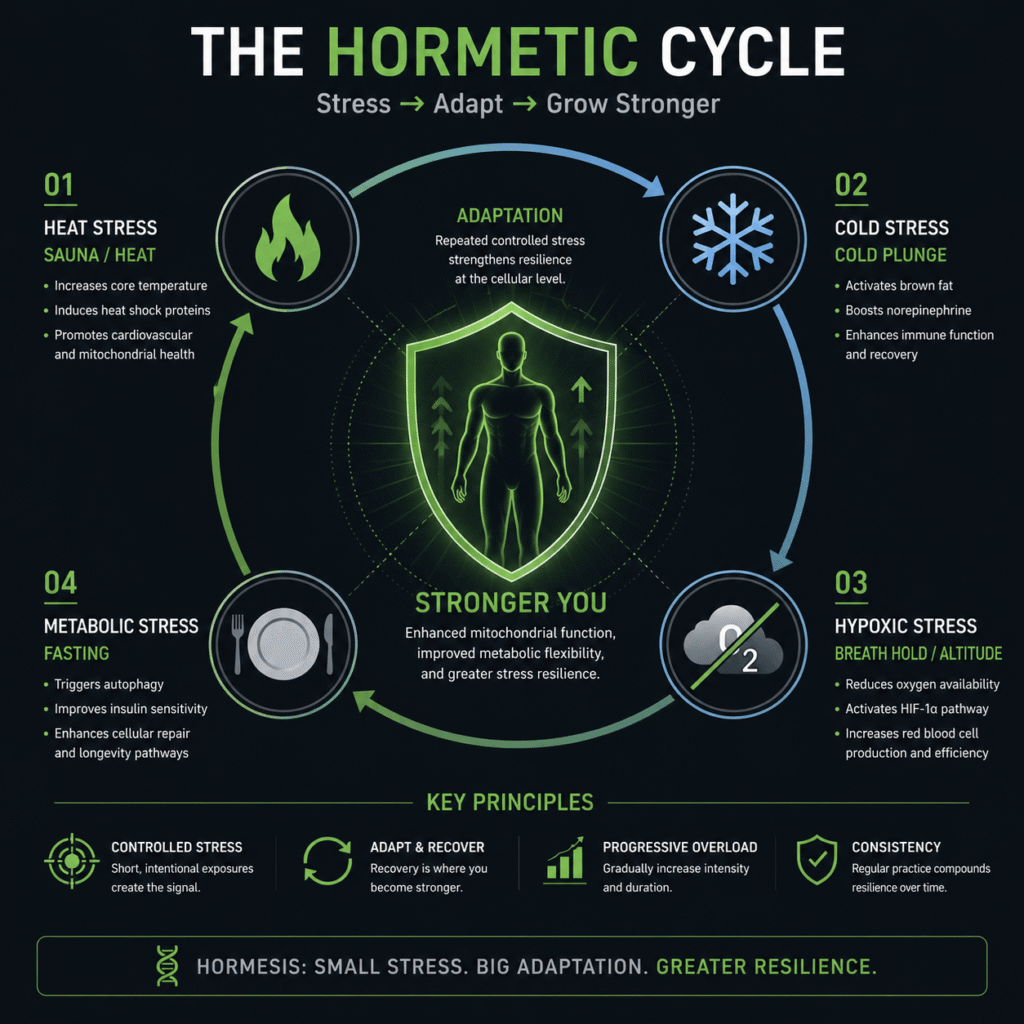
Mastering hormesis in 2026 requires a structured technical approach to avoid “Over-Hormesis,” where the stressor exceeds the body’s current capacity to recover. Modern bio-optimization studios now provide guided “Fire & Ice” tracks that use real-time heart rate variability (HRV) data to dictate the exact duration of exposure needed for optimal adaptation. The standard 2026 Hormetic Protocol consists of four primary phases:
- Phase 1: Thermal Shock (The Fire): 20 minutes in a 90°C sauna to trigger Heat Shock Proteins (HSPs), which repair misfolded proteins and protect against neurodegeneration.
- Phase 2: Cryo-Immersion (The Ice): 3 minutes in 3°C water to activate Brown Adipose Tissue (BAT) and trigger a massive release of norepinephrine for mental clarity.
- Phase 3: Intermittent Hypoxia: Using specialized masks to briefly reduce oxygen levels, which technically stimulates the production of new red blood cells and enhances mitochondrial density.
- Phase 4: Metabolic Pulsing: Strategic 16-to-24-hour fasting windows to induce Autophagy—the body’s technical process of cellular “recycling.”
The Recovery Economy: ROI of Resilience
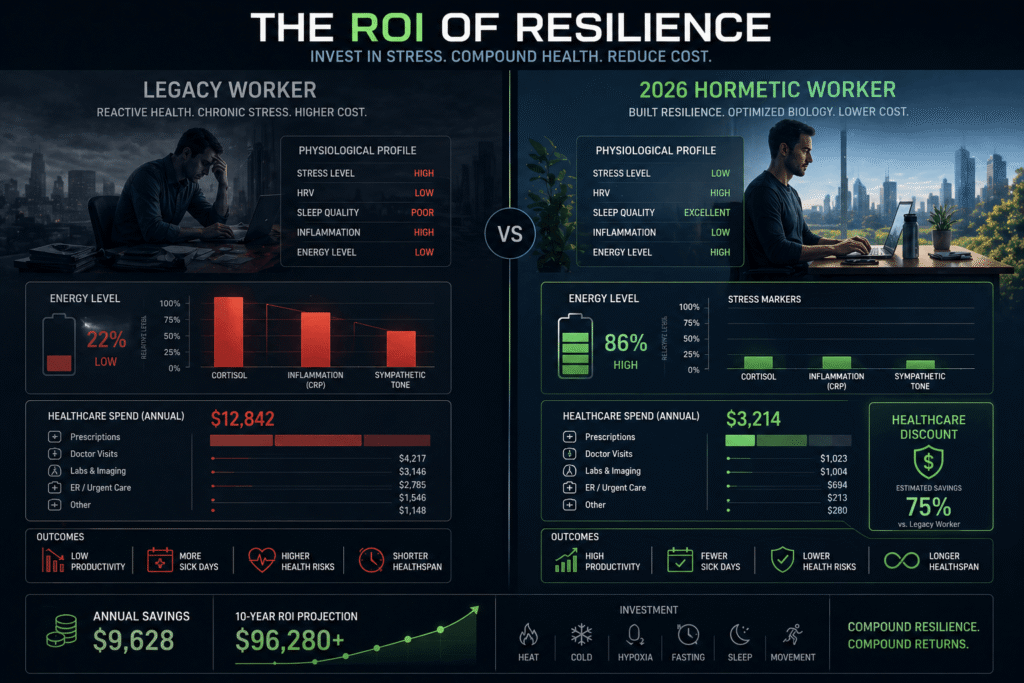
The financial sector has taken notice of the 2026 Recovery ROI. Corporations now invest heavily in “Resilience Hubs” for their employees, recognizing that a resilient worker has 30% fewer sick days and a significantly higher cognitive bandwidth. In 2026, the recovery economy isn’t just about feeling better; it is about the technical commodification of biological durability.
Insurance providers have integrated this into their actuarial models. If a policyholder can demonstrate a consistent history of hormetic exposure (verified via wearable data), they are technically classified as a lower risk for chronic inflammatory diseases. This has created a direct financial incentive for “Living in the Hormetic Zone,” where the cost of your sauna membership is essentially subsidized by your insurance discounts.
| Stressor | Target Intensity | Recommended Frequency | Primary Technical Benefit |
| Heat (Sauna) | 85°C – 95°C | 4-7x per week | Cardiovascular / HSP activation |
| Cold (Plunge) | 2°C – 5°C | 3-5x per week | Metabolic / Mitochondrial health |
| Hypoxia | 10% – 12% O2 | 2x per week | RBC production / Neuro-resilience |
| Fasting | 16:8 or 24h | Daily / Weekly | Autophagy / Insulin sensitivity |
FAQ: Mastering Controlled Biological Stress
What is the risk of “Over-Hormesis” in 2026?
Over-hormesis occurs when the stressor is so intense or prolonged that the body cannot initiate the repair response before the next challenge. In 2026, we use HRV (Heart Rate Variability) as the primary guardrail. If your morning HRV is 20% below your baseline, you are technically in a “Recovery Deficit” and should skip the hormetic challenge for that day.
Does cold exposure kill muscle gains in 2026?
Technically, yes, if done immediately after hypertrophy training. The 2026 consensus is to wait at least 4 to 6 hours after lifting weights before doing a cold plunge. This allows the necessary “anabolic inflammation” to occur before the cold exposure triggers its systemic anti-inflammatory effect.
How do biosensors measure the “Hormetic Dose”?
2026 wearables track Thermal Strain and Autonomic Recovery. They calculate a “Dose Score” based on your core temperature change and how quickly your heart rate returns to baseline after the stressor. This ensures you are getting enough stress to trigger the adaptation, but not enough to cause systemic exhaustion.
Is hormesis safe for the elderly in 2026?
Yes, but the “dose” is adjusted. In 2026, “Geriatric Hormesis” focuses on lower-intensity thermal therapy (infrared saunas) and light cold exposure to maintain muscle mass and cognitive function without taxing the cardiovascular system too severely.
Can I achieve hormesis through exercise alone?
Exercise is the original hormetic stressor. However, in 2026, we distinguish between Biomechanical Hormesis (exercise) and Environmental Hormesis (temperature/oxygen). For total vital mastery, the technical goal is to layer these stressors—for example, doing a zone 2 cardio session followed by a sauna.
What is the future of residential hormesis?
By 2026, high-end “Sanctuary Homes” come with integrated Hormetic Chambers. These are all-in-one units that can modulate temperature, oxygen concentration, and atmospheric pressure, allowing the resident to cycle through their hormetic protocols without leaving their living room.
About the Author

Vinícius Andrade writes about the practical side of personal growth — employee benefits, career moves, personal finance, and everyday wellbeing. He turns dense rules and jargon into steps anyone can act on, so readers spend less time decoding fine print and more time making decisions that actually improve their lives.
