

The traditional three-stage life—Learn, Work, Retire—is officially obsolete. In 2026, professionals are pivoting toward a “Multi-Stage” model characterized by periodic pauses, lifelong upskilling, and “Phased Retirement” contracts that leverage the wisdom of the 60+ workforce.

The professional landscape of 2026 has officially witnessed the collapse of the traditional “three-stage” life model. For over a century, the social contract was built on a linear progression: learn in your youth, work in your middle years, and retire in your sixties. However, in an era where longevity science and rapid technological shifts have converged, this model is not only obsolete but financially and psychologically unsustainable. Today, we are navigating a multi-stage life, characterized by flexible transitions, frequent “un-learning” periods, and the integration of work and rejuvenation across the entire lifespan.
This shift is driven by the fact that the “100-year life” is becoming a statistical reality for the global workforce. When life expectancy extends toward a century, the math of a 30-year career supporting a 40-year retirement simply does not work. In 2026, the most successful professionals are those who have decoupled their age from their career stage, recognizing that a 60-year professional journey requires a new kind of “career architecture.” This involves moving away from the “climb-until-you-drop” mentality and toward a more circular approach where education and career breaks are distributed at various intervals.
Furthermore, the 2026 job market has matured to value experienced adaptability. The old stigma surrounding “job-hopping” or taking a mid-life sabbatical has been replaced by an appreciation for the “non-linear” candidate. Companies now realize that a professional who has pivoted multiple times has developed a high degree of cognitive flexibility, making them more resilient to the next wave of AI-driven disruption. The multi-stage life is not just a personal choice; it is the fundamental survival strategy for the 21st-century professional.
Longevity Science and the 60-Year Career
Extending the career arc in 2026 is as much a biological challenge as it is a professional one. We are no longer just talking about “working longer”; we are talking about maintaining peak cognitive and physical performance for six decades. The integration of longevity science into the workplace has allowed professionals to treat their health as their most valuable “human capital.” In 2026, the elite professional isn’t just managing their inbox; they are managing their biological age through data-driven interventions.
The shift toward longevity-focused careers is supported by a new corporate wellness paradigm. Forward-thinking companies are now offering “longevity stipends” that cover everything from continuous glucose monitoring to advanced cognitive training. This is not out of altruism, but because a healthy, experienced veteran is often more productive and strategic than a high-burnout junior. For the professional, this means that the middle-age plateau has effectively been erased, replaced by a prolonged “peak” that can last well into one’s seventies.
To maintain this professional stamina in 2026, four key factors of longevity must be technically managed as part of your career strategy:
- Biohacking for Focus: Utilizing personalized nutrition and sleep optimization to maintain the neural plasticity required for rapid upskilling.
- Preventive Precision Medicine: Regular screenings and biological audits to catch “health-drag” before it impacts professional output.
- Chronic Stress Management: Implementing “nervous system regulation” as a daily technical skill to prevent the cortisol-driven burnout of the past.
- Cognitive Health Maintenance: Engaging in multi-modal learning and cross-training to prevent the “skill-stagnation” that often accompanies aging in a single field.
The “Unretirement” Economy: Purpose Over Leisure
In 2026, the concept of a “hard stop” at age 65 has been replaced by the “Unretirement” movement. This isn’t necessarily about working because you have to, but about working because you choose to. The psychological toll of sudden inactivity is now well-documented, leading many 2026 professionals to seek “bridge roles” or fractional positions that provide social connection and mental stimulation. Leisure is no longer the ultimate goal; meaningful contribution across all stages of life is the new standard of success.
This new economy is fueled by a surplus of “wisdom workers”—individuals who have mastered their craft and are now transitioning into roles as mentors, strategic advisors, or social entrepreneurs. In 2026, the “retirement age” is increasingly viewed as a “Launchpad Stage,” where individuals use their accumulated capital and networks to solve complex problems that require a long-term perspective. This transition is technically supported by the Internal Talent Marketplaces we discussed previously, which now explicitly match senior talent with high-impact “advisory gigs.”
Retirement in 2026 is no longer an exit from the workforce; it is a strategic transition into a phase of “maximum leverage,” where experience is applied to the most complex and rewarding challenges without the constraints of a traditional 9-to-5.
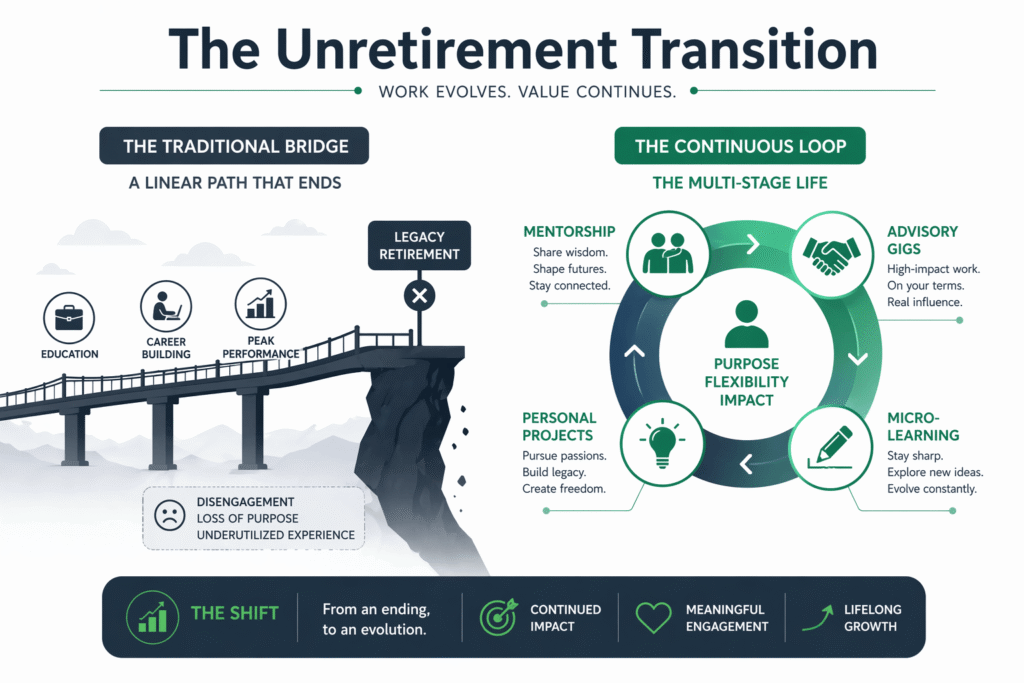
For the individual, the unretirement strategy requires a shift in financial engineering. In the multi-stage life, you aren’t just saving for a “finish line.” You are building a portfolio of assets—both financial and intellectual—that allow you to fund periods of “rest and reinvent” throughout your life. In 2026, having the “liquidity” to take a year off at age 45 to learn a new domain is considered a more successful financial outcome than having a massive nest egg at 70 that you are too exhausted to enjoy.
Skill Liquidity: The Technical Requirement for Longevity
Longevity in the 2026 workforce requires a high degree of “Skill Liquidity.” This is the ability to rapidly dissolve old expertise that is no longer in demand and crystallize new competencies. Because the “half-life” of a technical skill is now measured in single-digit years, the multi-stage professional must be a perpetual student. In 2026, your “credentials” are not a static diploma from 20 years ago; they are a real-time activity stream of micro-certifications and project artifacts.
This continuous learning model has given rise to the “Education-Work Loop.” Instead of one massive block of schooling at the beginning of life, the 2026 professional engages in “Just-in-Time” learning. When a new AI orchestration model or a new global compliance standard emerges, the professional pauses their output to absorb the new information. This “iterative education” ensures that their market value does not depreciate with age, but rather compounds as they layer new technical skills on top of decades of deep institutional wisdom.
The 2026 market is particularly rewarding for those who practice “Interdisciplinary Layering.” A software engineer who adds “Bio-Ethical Compliance” to their skill set at age 50 becomes a unique asset in the growing biotech sector. This ability to “stack” disparate skills is the technical secret to professional longevity. It moves the worker from being a commodity to being a “unique solution,” making them immune to the age-related layoffs that used to characterize the later stages of a linear career.
Intergenerational Synergy: Managing the 5-Generation Workplace
For the first time in history, the 2026 workplace commonly features five generations working side-by-side. This diversity is the ultimate engine of organizational “Intergenerational Synergy.” While the younger “Alpha” and “Gen Z” workers bring a native fluency in AI orchestration and decentralized systems, the “Boomer” and “Gen X” veterans bring the emotional intelligence, ethical judgment, and complex problem-solving skills that only come from decades of experience.
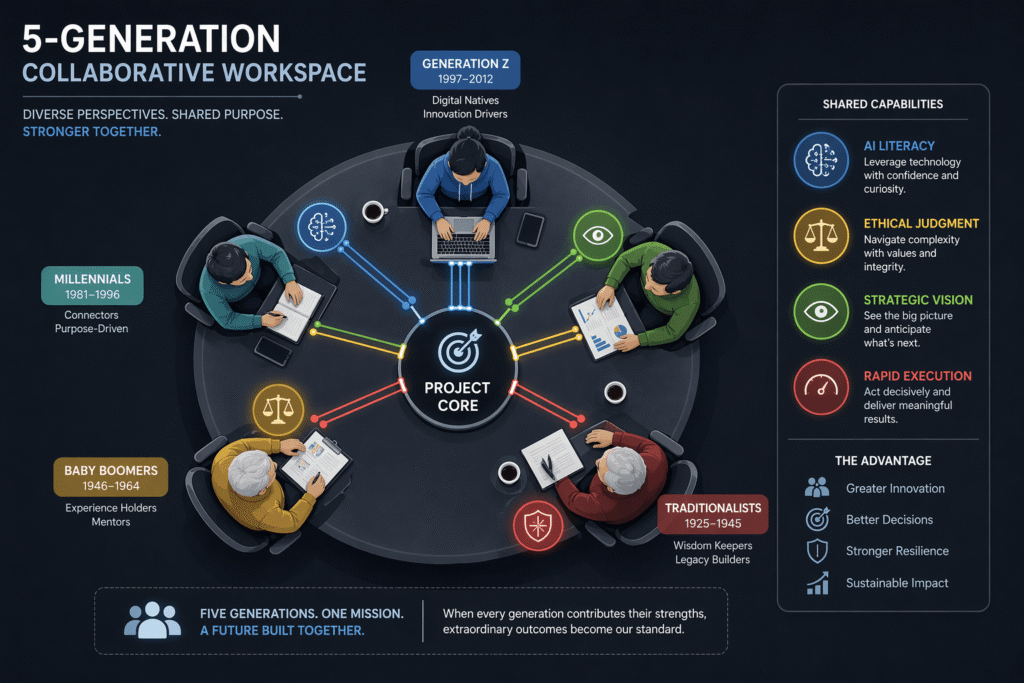
This synergy is technically managed through “Reverse Mentorship” programs and collaborative project structures. In these 2026 environments, the “Senior” title no longer implies a top-down hierarchy. Instead, it signals a role of “Architectural Oversight.” The veteran provides the strategic guardrails, while the junior manages the high-speed execution. This mutual exchange of value is what allows the 2026 corporation to stay agile while maintaining its structural integrity, proving that age diversity is a high-ROI asset.
FAQ: Navigating the 100-Year Life Arc
When is the best time to take a “career hiatus” in the multi-stage model?
In 2026, there is no “perfect” time, but many professionals utilize the “7-Year Cycle.” Every seven years, they take a 3-to-6 month “Rest and Reinvent” period. This is technically used to audit their current “Skill Stack” and identify the next domain of high-value growth. This prevents the “burnout-at-50” phenomenon and ensures that the professional remains a high-value asset for the duration of their 60-year career.
How do I fund my education if I’m returning to “student mode” in my 40s?
Many 2026 professionals use “Career Savings Accounts” (CSAs), which function similarly to a 401(k) but are designed for mid-career education. Additionally, many companies now offer “Educational Leave” as a benefit, recognizing that a refreshed, upskilled employee is cheaper than a new hire. You can also leverage the “Internal Talent Marketplace” to find projects that pay you to learn—effectively an apprenticeship for senior talent.
How do I maintain mental health during such a long career?
The key in 2026 is “Pacing, not Racing.” Mental health is technically managed through “asynchronous work models” and “radical boundary setting.” By utilizing the “AI Orchestration” skills we’ve discussed, you can offload repetitive tasks, allowing your brain to focus on high-level strategy. This reduces the “cognitive load” that typically leads to the mental fatigue once associated with older workers.
How can I transition into “Fractional Leadership” as I get older?
The transition should be planned five years in advance. Start by building your “Digital Portfolio” and documenting “Transformation Artifacts” from your full-time role. In 2026, fractional roles are awarded based on proof of impact. By the time you are ready to “unretire” into a fractional model, you should have a verified track record of solving the specific problems that PMEs (Small and Medium Enterprises) are currently facing.
What is the role of AI as a “Co-pilot” for older workers in 2026?
AI is the great “Skill Equalizer.” For an older worker, AI can handle the “high-speed technical execution” (like coding or data scraping) that they might find tedious, while the worker provides the “Human-in-the-Loop” judgment. In 2026, an experienced leader paired with a high-tier AI agent is the most powerful “unit of productivity” in the global economy, effectively neutralizing any age-related technical gap.
How do I combat “Ageism” in the 2026 hiring market?
The best defense against ageism is a “Verified Output Portfolio.” When your digital presence shows recent, high-impact project artifacts and current micro-credentials, your age becomes a secondary data point. In 2026, “age” is only a liability if it is synonymous with “stagnation.” If your profile shows active growth and a “Skills-First” mentality, the market will view your years of experience as a premium, not a cost.
About the Author

Vinícius Andrade writes about the practical side of personal growth — employee benefits, career moves, personal finance, and everyday wellbeing. He turns dense rules and jargon into steps anyone can act on, so readers spend less time decoding fine print and more time making decisions that actually improve their lives.
