The introduction of Form 1099-DA in 2026 has fundamentally changed how cryptocurrency and NFTs are taxed, moving digital assets into the same transparent reporting framework as traditional stocks and bonds.
For years, the digital asset market in the United States operated under a “self-reporting” honor system. Investors were responsible for tracking every trade, swap, and sale across multiple platforms, often leading to significant errors or underreporting. However, as of January 2026, that era is over. The IRS has officially deployed Form 1099-DA (Digital Assets), a mandatory document that brokers and exchanges must now send to both the taxpayer and the IRS. This shift brings much-needed clarity for some, but for others, it introduces a new layer of complexity that requires meticulous record-keeping.
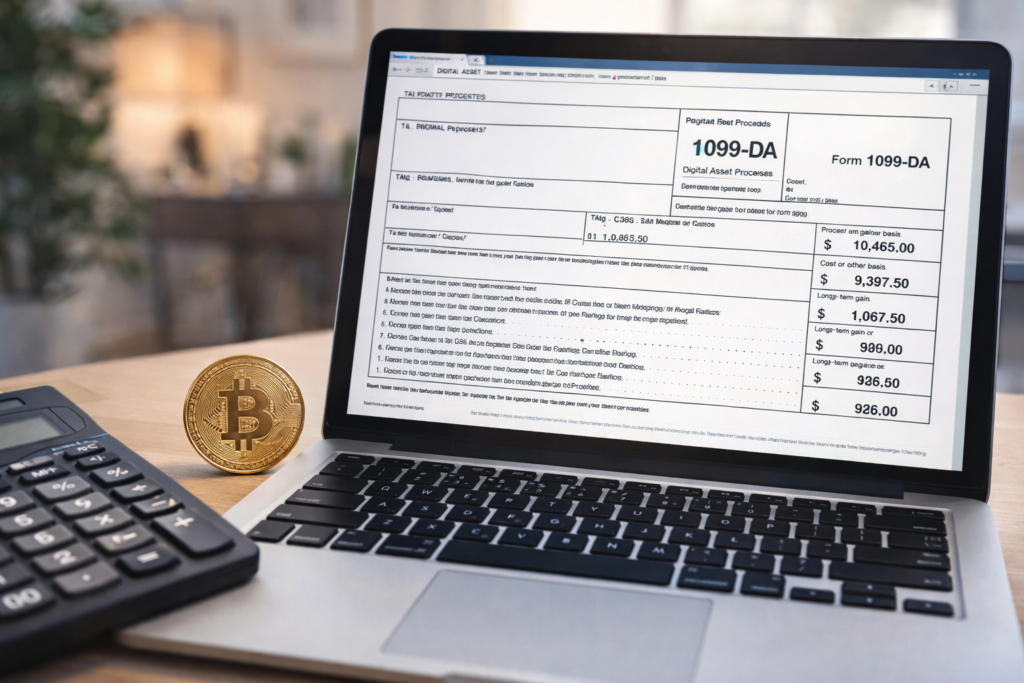
What is Form 1099-DA?
Form 1099-DA is the digital equivalent of the traditional 1099-B used for stocks. It requires “brokers”—a term that now includes centralized exchanges like Coinbase and Kraken, as well as certain hosted wallet providers—to report the gross proceeds from the sale or exchange of digital assets.
Starting in 2026, the IRS receives a direct copy of your transaction data, including the date of sale, the proceeds, and, in many cases, the ‘cost basis’—the original price you paid for the asset.
This automation means that the IRS’s ability to match tax returns with actual blockchain activity has increased exponentially. If you sell Bitcoin or an NFT in 2026, there is now a digital paper trail that links that transaction directly to your Social Security Number.
The ‘Cost Basis’ Challenge
While reporting “gross proceeds” is straightforward, reporting the cost basis remains the most technical hurdle for investors this year.
- Transferred Assets: If you bought Ethereum on one exchange in 2022 and moved it to another exchange to sell it in 2026, the second exchange may not know what you originally paid for it.
- Non-Reported Basis: In these cases, the 1099-DA might show a cost basis of $0 or mark it as “non-covered,” which could lead to you being taxed on the entire sale price unless you provide documented proof of your original purchase price.
- Standardized Tracking: To solve this, many investors in 2026 are adopting specialized tax software that syncs with their 1099-DA forms to fill in the missing historical data.

DeFi, Staking, and NFTs in 2026
The reach of Form 1099-DA extends beyond just simple Bitcoin trades. The IRS has clarified that several other activities now fall under strict reporting requirements:
- Staking Rewards: In 2026, income earned from staking is generally treated as ordinary income at the time you receive dominion and control over the tokens.
- NFT Sales: High-value NFT transactions are now reported via 1099-DA, and depending on the nature of the asset, they may be taxed as “collectibles” at a higher 28% rate.
- DeFi Swaps: While decentralized finance (DeFi) remains a regulatory frontier, the IRS expects taxpayers to report “crypto-to-crypto” swaps as taxable events, even if no US Dollars were involved in the transaction.
How to Prepare Your 2026 Filing
To avoid audits or penalties, investors must treat their 1099-DA with the same seriousness as a W-2.
- Review for Errors: Do not assume the broker’s data is 100% correct. Check for duplicated transactions or missing cost basis information.
- Use Form 8949: You will still need to use Form 8949 to reconcile the data from your 1099-DA with your actual records before the final numbers go onto your Schedule D.
- Keep Wallet Records: Maintain clear records of all “off-exchange” activity, such as transfers to hardware wallets, as these are the areas most likely to trigger an IRS inquiry.
Summary of 1099-DA Impact for 2026
| Feature | Pre-2026 (Legacy) | 2026 Reality |
| Reporting Method | Investor Self-Reporting | Broker Mandatory Reporting |
| IRS Visibility | Low / Audit-Based | High / Automatic Matching |
| Cost Basis Info | Often missing | Reported for “Covered” Assets |
| DeFi / Staking | Grey Area | Defined Taxable Events |
| Forms Used | Form 8494 | 1099-DA + Form 8494 |
FAQ – Frequently Asked Questions About Form 1099-DA
What if I don’t receive a 1099-DA?
Even if you don’t receive the form (for example, if you only use decentralized wallets), you are still legally required to report all digital asset gains and losses to the IRS.
Does the 1099-DA apply to small purchases?
The IRS has specific thresholds, but generally, any sale or exchange of a digital asset for cash or other property is a reportable event in 2026.
Will my crypto be taxed twice?
No. The 1099-DA is an information return. It tells the IRS you had a transaction, but you only pay tax on the gain (Profit = Sale Price – Cost Basis).