

The professional landscape of 2026 has officially entered the era of the “Liquid Workforce,” where the traditional concept of a fixed department is technically obsolete. In the previous decade, companies operated through rigid hierarchical silos where talent was often “hoarded” by mid-level managers seeking to protect their specific departmental outputs. Today, the institutionalization of the Internal Talent Marketplace (ITM) has dismantled these silos, replacing them with a skills-based ecosystem that prioritizes organizational agility over managerial possession. For the 2026 professional, this shift means that your career trajectory is no longer dictated by a single supervisor, but by the technical demand for your verified competencies across the entire enterprise.
This transition is driven by a fundamental change in Work Design. In 2026, a “job” is no longer a static list of duties, but a dynamic collection of projects and “gigs” that can be unbundled and reallocated. This unbundling allows organizations to move talent to where it is most needed at any given moment, effectively treating their human capital as a programmable resource. This level of technical flexibility is essential in the high-velocity markets of 2026, where the half-life of a technical skill has shrunk to less than 18 months, requiring a continuous and fluid redistribution of expertise.
Furthermore, the 2026 ITM has introduced a new level of Professional Visibility. Historically, high-performers were often hidden from the wider organization by managers who feared losing their “star players” to other teams. In the current ecosystem, AI-driven transparency makes “talent hoarding” technically impossible. Every employee’s skill profile is visible to every project leader in the company, ensuring that opportunities are democratized and that the most complex challenges are always matched with the most capable minds, regardless of where they currently sit on the org chart.
AI-Powered Matching: The Technical Core of ITMs
At the center of the 2026 internal economy is the AI Matching Engine, a sophisticated algorithm that analyzes the “Digital Footprint” of every employee. These systems don’t just look at a CV; they ingest real-time data from project management tools, code repositories, and collaborative workspaces to maintain a “Living Skills Inventory.” By cross-referencing this data with open internal roles and short-term “stretch assignments,” the ITM can technically predict which employee is the best fit for a new initiative before the initiative is even fully scoped.
In 2026, the marketplace uses a multi-dimensional scoring system to ensure the “Perfect Match.” Rather than relying on a manager’s recommendation, the algorithm calculates a Matching Probability Score based on five key parameters:
- Verified Skills: Hard evidence of competency from past project artifacts.
- Developmental Interests: The employee’s stated goals for career expansion.
- Availability/Capacity: Real-time bandwidth tracked through integrated calendars.
- Historical Impact: Measurable ROI delivered on previous internal “gigs.”
- Strategic Priority: The relative importance of the project to the 2026 corporate mission.
This technical approach ensures that internal mobility is objective and data-driven. For the employee, the goal is to consistently feed the system with “High-Signal” data—completing certifications, documenting project outcomes, and participating in cross-functional forums. By optimizing your digital profile for the ITM Algorithm, you ensure that the most lucrative and challenging opportunities find you, technically bypassing the need for traditional internal networking or “political” maneuvering within your immediate department.
Breaking the Hoarding Cycle: Managerial Accountability in 2026
The most significant cultural hurdle of 2026 has been the shift in managerial incentives. In the past, managers were rewarded for the performance of their team; in 2026, they are increasingly rewarded for being “Net Talent Exporters.” This means that a manager’s own performance score is technically boosted when a member of their team moves to a higher-value project elsewhere in the company. This structural realignment has effectively ended the era of talent hoarding, turning managers into career coaches rather than gatekeepers.
In the 2026 marketplace, a manager’s greatest KPI is no longer what their team produces in a silo, but how effectively they develop and export talent to the rest of the organization’s high-priority value streams.
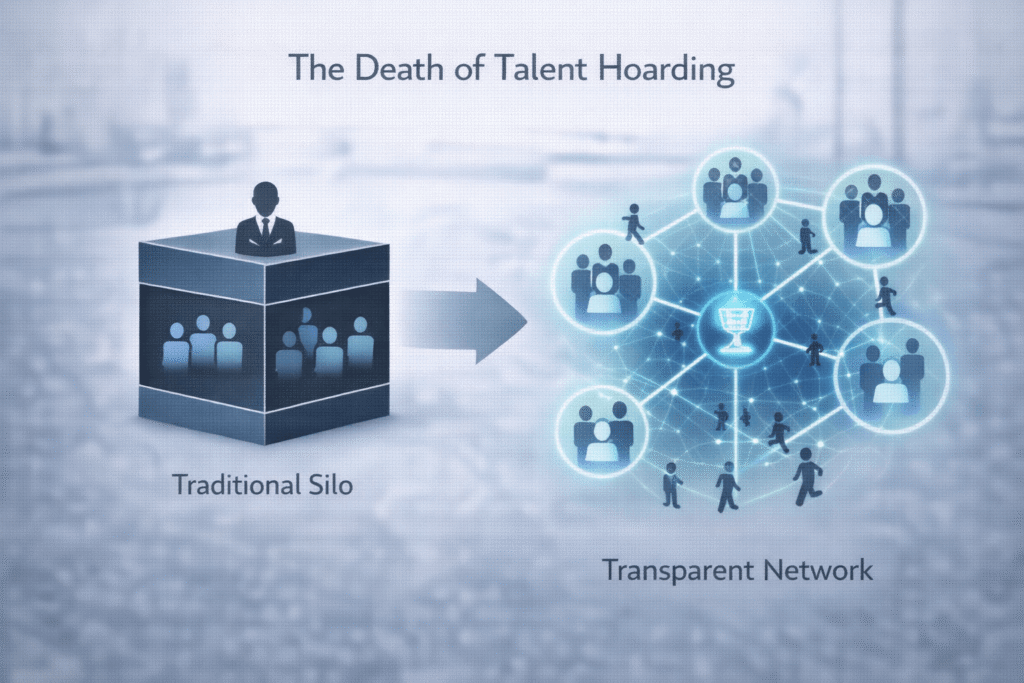
This accountability is enforced through Mobility Analytics. If a specific manager consistently blocks their employees from participating in the internal marketplace, the ITM algorithm flags this as “Strategic Inefficiency.” In 2026, leadership dashboards provide real-time alerts on “Stagnation Hubs”—departments where high-potential talent is being underutilized or held back. This technical oversight provides the C-Suite with the evidence needed to intervene, ensuring that the company’s human capital remains liquid and responsive to market demands.
The “Gig-ification” of Internal Work: Strategy for Career Mobility
The 2026 ITM has popularized the “Internal Gig” model, where employees can dedicate up to 20% of their working hours to projects outside their primary department. These “micro-assignments” are the technical equivalent of a professional lab, allowing workers to test-drive new roles and build a “T-shaped” profile without the risk of a full job change. For many in 2026, these gigs serve as the primary vehicle for upskilling, providing real-world experience that is far more valuable than traditional classroom training.
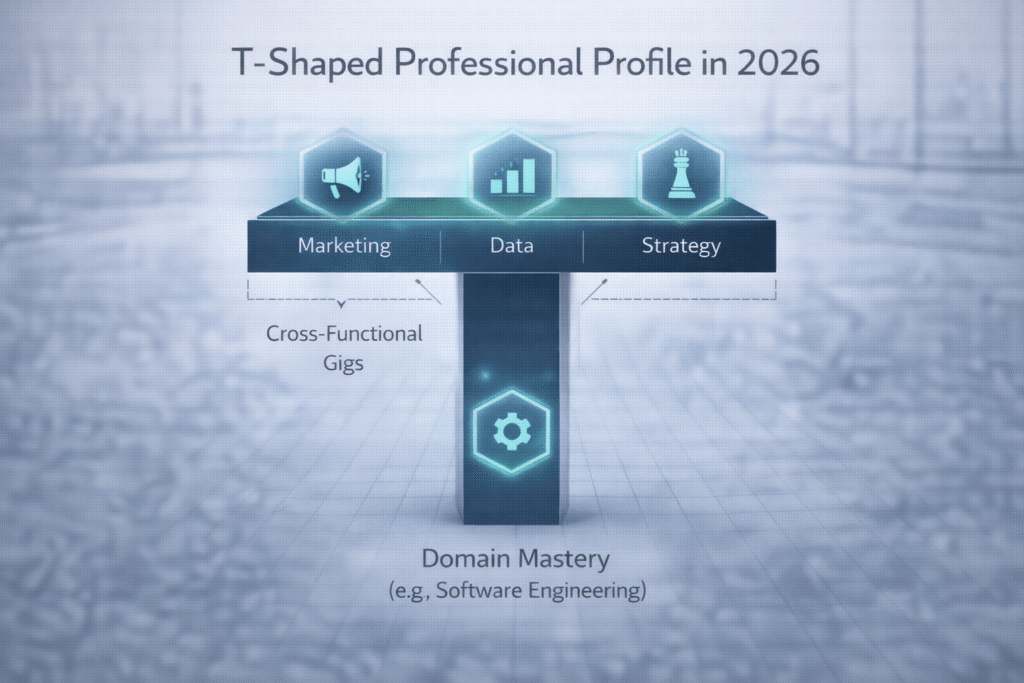
Strategically, the internal gig model creates a “Skills Portability” effect. By working on five different projects across three departments in a single year, an employee builds a broad internal network and a diverse portfolio of artifacts. This technically increases their “Internal Market Value,” making them a prime candidate for high-level cross-functional roles. In 2026, the most successful career paths are no longer “ladders” but “lattices,” where lateral moves into different technical domains are seen as the fastest way to increase total compensation and long-term security.
Furthermore, these internal gigs allow for “Frictionless Experimentation.” A software engineer can technically spend a quarter helping the “Product-Led Growth” team, while a marketing specialist might join a “Sustainability Audit” project. This cross-pollination is the engine of 2026 innovation, ensuring that diverse perspectives are applied to every problem. For the professional, it provides a “Safe Sandbox” to reinvent their career identity, technically reducing the barrier to entry for new and emerging 2026 industries.
ROI and Retention: The Mathematics of Internal Mobility
For the organization, the ITM is a massive financial engine. In 2026, the cost of an external hire is estimated to be 1.5x to 2x the salary of the role when accounting for recruitment fees, onboarding time, and “cultural risk.” By filling roles through the internal marketplace, companies technically eliminate these costs while simultaneously boosting retention. A 2026 employee who sees a clear, algorithmically-backed path for growth is 40% less likely to leave for a competitor, creating a powerful “Retention Dividend.”
The technical success of the ITM is measured through the Internal Mobility ROI (ROIim). In 2026, CFOs track this metric using a formula that compares the cost of internal redeployment (Cre) against the saved external hiring costs (Sext):

Comparison: Traditional Hiring vs. Internal Marketplace (2026)
| Metric | Traditional External Hiring | Internal Talent Marketplace (ITM) |
| Time-to-Value | 6 – 9 Months | 2 – 4 Weeks |
| Recruitment Cost | High (15-30% of Salary) | Negligible (Platform Cost) |
| Cultural Fit Risk | High | Zero (Existing Employee) |
| Employee Retention | Variable | Significantly Higher (+40%) |
| Skills Accuracy | Based on “Signals” (CV) | Based on “Artifacts” (Verified) |
FAQ: Navigating the Internal Marketplace
Can my current manager stop me from taking an internal gig in 2026?
Technically, no. In the 2026 “Open Talent” model, managers can provide feedback on the timing of a move to ensure project continuity, but they cannot “veto” your participation in the marketplace. If a manager attempts to block a high-priority match, the system automatically escalates the issue to HR for a “Strategic Reallocation Review.”
Will taking internal gigs affect my primary performance review?
In 2026, your “Primary” and “Gig” performances are technically integrated into a single Holistic Score. Your success in an internal gig is seen as a signal of high versatility and “Organizational Citizenship.” Far from hurting you, being a sought-after internal “gig worker” is the fastest way to be flagged for high-potential leadership programs in 2026.
How often should I update my ITM profile?
Your ITM profile in 2026 is “Self-Updating” through API integrations. However, you should manually review your “Interests” and “Career Aspirations” every quarter. The algorithm prioritizes matches that align with your stated goals, so keeping your “Trajectory Compass” updated ensures the system doesn’t suggest roles that no longer interest you.
Is my identity hidden when I browse internal roles in 2026?
Yes. To prevent “Managerial Friction,” the 2026 ITM standard includes Anonymous Browsing. You can view and “soft-apply” for roles without your current manager being notified. The notification only occurs once the matching algorithm identifies a high-probability fit and a formal “Exploratory Interview” is scheduled.
What happens if I fail an internal gig?
In 2026, the internal marketplace is a “High-Trust/Low-Risk” environment. A failed gig is technically viewed as a “Skills Gap Diagnostic” rather than a professional failure. The system will typically suggest targeted learning modules or a different type of project to help you recalibrate, ensuring that the marketplace remains a safe space for experimentation.
How does the marketplace handle “Cross-State” internal moves in 2026?
The ITM is technically synchronized with the company’s Compliance and Tax Engine. If you apply for a role in a different state, the system automatically provides a “Pre-Offer Disclosure” showing the salary adjustment (COLA) and the tax implications of the move. This ensures that internal mobility is frictionless and that there are no “technical surprises” after the move is finalized.
About the Author

Vinícius Andrade writes about the practical side of personal growth — employee benefits, career moves, personal finance, and everyday wellbeing. He turns dense rules and jargon into steps anyone can act on, so readers spend less time decoding fine print and more time making decisions that actually improve their lives.
