In 2026, the “work from anywhere” dream has met its match in technical reality: the rise of real-time payroll geofencing and strict global tax nexus enforcement.
As we enter 2026, the era of “digital nomadism under the radar” is officially over. Multinational corporations and tax authorities have caught up with the remote workforce, deploying sophisticated AI-driven compliance tools to monitor where value is being created. For the high-level professional, building a border-blind career now requires more than just a laptop and a VPN; it requires a deep understanding of Employer of Record (EOR) 2.0 models and the technicalities of “Permanent Establishment” risk.

Payroll Geofencing and the Death of the VPN Trick
In 2026, HR tech has evolved to prevent “jurisdiction fraud.” Major payroll platforms like Workday and ADP now integrate Continuous Location Telemetry.
- IP-to-Nexus Mapping: Modern enterprise systems use advanced “Nexus Shields” that go beyond simple IP checks. They analyze latency patterns, GPS metadata from hardware-level sensors, and cellular tower pings to verify a worker’s physical location.
- The Compliance Lockout: If a worker in 2026 logs in from a state or country where the company does not have a legal tax “nexus,” the system may automatically restrict access to sensitive company data to prevent the firm from inadvertently creating a Permanent Establishment (PE)—a legal status that could force the company to pay local corporate taxes and follow local labor laws.
EOR 2.0: The Infrastructure of Global Employment
Because most companies cannot afford to set up legal entities in 100 different countries, the Employer of Record (EOR) has become the dominant employment model in 2026.
Unlike the early days of remote work, EOR 2.0 in 2026 is fully automated. Platforms like Deel and Remote now offer:
- Automated Visa Sponsoring: They manage “Digital Nomad Visas” directly through government APIs, ensuring you are legally authorized to work in places like Portugal, Japan, or Brazil.
- Local Pension & Benefits Sync: The system automatically calculates and pays local social security, healthcare, and 13th-month salaries required by local law, ensuring the worker is “compliant-by-default.”
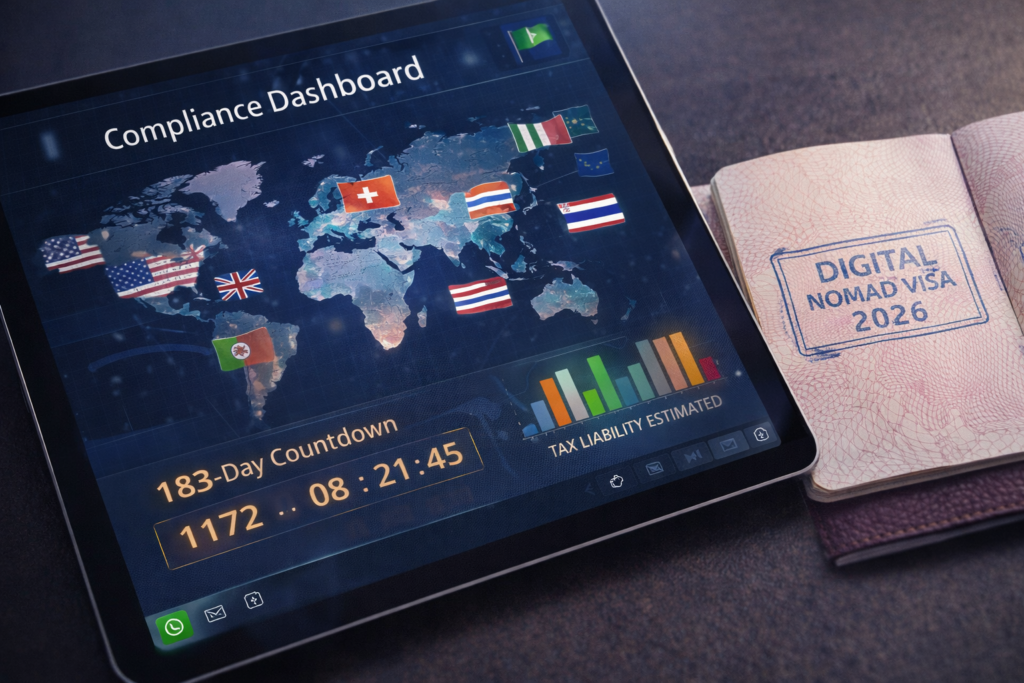
- The 183-Day Sentinel: AI monitors your travel and alerts both you and the HR department as you approach the 183-day threshold in a single country, which usually triggers tax residency and significant personal tax liabilities.
Managing Your Personal Tax Nexus
In 2026, the burden of “Compliance Readiness” has shifted partly to the employee. To negotiate a global remote role this year, you must present a Personal Compliance Dossier.
“In the 2026 talent market, a candidate who can say ‘I already have a compliant EOR structure or a local tax ID in this region’ is significantly more attractive than one who simply asks to work from a beach without a plan.”
Comparison: 2026 Global Work Models
| Feature | Direct Remote Hire | EOR 2.0 Model | B2B Contractor |
| Tax Responsibility | Company (High Risk) | EOR Platform (Low Risk) | Individual (High Risk) |
| Local Benefits | Limited/None | Full Local Compliance | None (Self-Paid) |
| Legal Status | Standard Employee | Statutory Employee | Independent Contractor |
| Best For… | Single-State/Country | Global Nomadism | Short-term Gigs |
| Compliance Tech | Basic | AI-Geofencing Integrated | Self-Reported |
The 2026 “Digital Nomad Visa” Mature Phase
Many countries have refined their 2026 visa offerings to attract high-income professionals while ensuring they pay their fair share. For instance, the 2026 Spain Nomad Visa now requires a minimum income of €3,400 per month, but offers a flat tax rate of 15% for the first four years, provided the worker uses a certified EOR. Understanding these specific technical requirements in January 2026 is the difference between a successful transition and a legal nightmare.
FAQ – Frequently Asked Questions About 2026 Global Careers
Can I use a travel router and VPN to hide my location in 2026?
It is increasingly difficult. Modern corporate laptops in 2026 have BIOS-level tracking and “always-on” hardware beacons that ignore software-based VPNs. If caught, it is often grounds for immediate termination due to the massive tax risk you pose to the company.
What is “Double Taxation” and how do I avoid it in 2026?
Double taxation occurs when two countries claim the right to tax your income. In 2026, you must verify if your “Work Country” and “Home Country” have a Tax Treaty. If they do, you usually receive a tax credit in your home country for any taxes paid abroad.
Do I need a special bank account for a global career?
Yes. In 2026, “Border-Blind” accounts like Revolut Business or Wise are essential for receiving multi-currency payments without losing 3-5% on hidden exchange fees.