
The professional landscape of 2026 has officially moved past the “Remote vs. In-Office” binary. We have entered the era of the Intentional Office, where the value of a physical workspace is no longer measured by the quantity of emails sent from a desk, but by the density of social capital generated within its walls. For the 2026 professional, the office is no longer a factory for tasks—a function now perfectly handled by AI-augmented remote setups—but a high-end hardware accelerator for “Human Software.” It is the primary site for building the non-linear Influence that dictates who gets promoted and who remains an anonymous digital ghost.
This transition is driven by the realization that while digital tools are excellent for coordination, they are notoriously poor for innovation. In 2026, the “Default Office”—where employees showed up simply because it was 9:00 AM—is technically dead. It has been replaced by a “Hub-and-Spoke” model where physical presence is a strategic choice made during high-leverage moments: brainstorming sessions, conflict resolution, and the “casual collisions” that lead to breakthrough ideas. In this environment, your presence is a signal of your commitment to the organization’s social fabric, making it a new, albeit subtle, performance metric.
Ultimately, 2026 is the year where career strategists recognize the “Invisible Ceiling” of total remote work. While individual productivity often peaks at home, career velocity often peaks in the office. This is due to the spontaneous exchange of “tacit knowledge”—the unwritten rules, internal politics, and strategic whispers that never make it into a Slack thread. The intentional professional uses the office to harvest this data, ensuring they are not just “doing the work,” but “shaping the direction” of the company.
Quantifying Your Social Capital: The SCQ Metric
In 2026, forward-thinking HR departments and career coaches have begun utilizing the Social Capital Quotient (SCQ). This metric attempts to quantify the value of your professional network beyond simple LinkedIn connections. It measures the quality of your internal and external relationships and your ability to mobilize those relationships to achieve strategic goals. In a world where AI can replicate your technical output, your SCQ is your most resilient competitive advantage. To technically manage your career in 2026, you must optimize for the four pillars of the SCQ:
- Trust Density: The level of psychological safety and reliability you have established with key stakeholders through face-to-face interaction.
- Access to Hidden Info: Your proximity to the “informal networks” where strategic decisions are discussed before they are formalized.
- Influence Velocity: How quickly your ideas are adopted or championed by others within the organizational graph.
- Reciprocity Loops: The network of “professional favors” and mutual support that you can call upon during a crisis or a pivot.
The technical calculation of your SCQ is often modeled as the sum of your high-trust connections divided by the communication latency of your network. In 2026, we express this as:
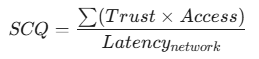
Physical presence in the office serves to technically lower the “Latency” and increase the “Trust” multiplier. By being physically present, you reduce the friction of communication, allowing for the micro-expressions and real-time feedback that build deep trust. The intentional professional doesn’t just “show up”; they plan their office days to maximize these specific pillars, ensuring that every hour spent in person is a high-ROI investment in their long-term social capital.
The Architecture of Intentional Proximity
The 2026 office is designed to technically facilitate Proximity Effects. Gone are the rows of cubicles; in their place are “social neighborhoods” and “innovation plazas” designed to force inter-departmental mixing. The goal of the 2026 office architecture is to engineer serendipity. It is a recognition that the most valuable business outcomes often occur in the thirty seconds between formal meetings, or while grabbing a coffee. These “Micro-Moments” are the building blocks of corporate culture and individual influence.
In 2026, the office is no longer a place where you go to work; it is a strategic tool of proximity designed to foster the trust and spontaneity that digital interfaces still cannot technically replicate.
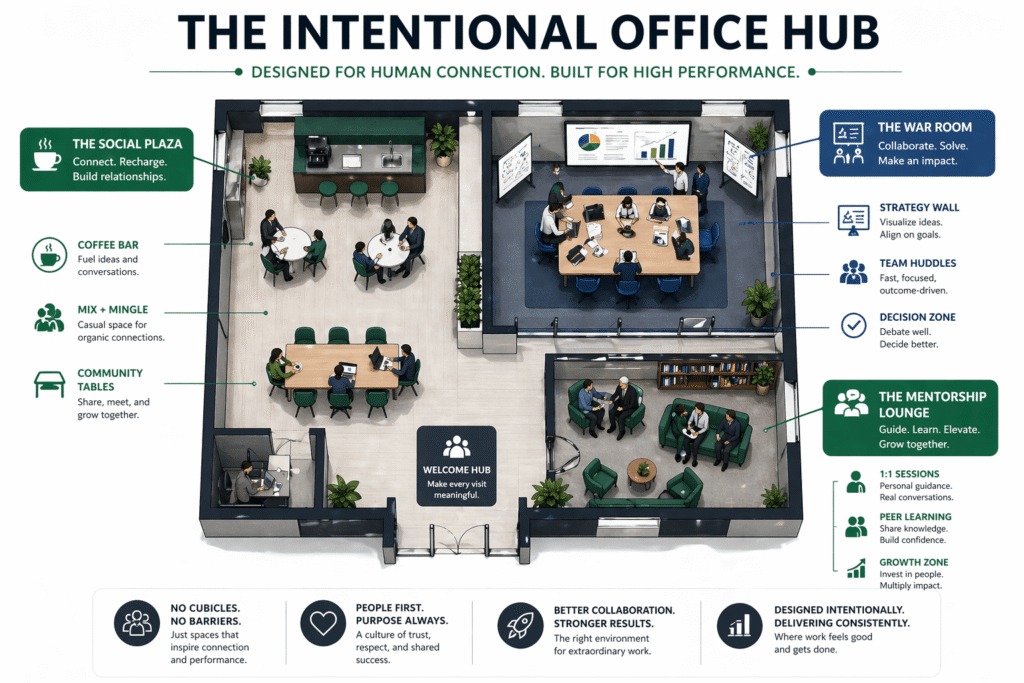
This architecture also serves as a “Mentorship Hub.” In 2026, the junior-to-senior knowledge transfer has suffered in purely remote environments. The intentional office fixes this by creating “Observation Zones” where junior staff can witness how senior leaders navigate complex social dynamics in real-time. This “social shadowing” is the fastest way to build professional maturity, and it is a technical advantage that purely remote workers are increasingly finding difficult to match.
Navigating Proximity Bias and “The Visibility Tax”
Despite the rise of flexible work, the human brain in 2026 is still technically wired for Proximity Bias. We are evolutionary predisposed to trust and favor those we see in the physical world more than those we see through a screen. This leads to the “Visibility Tax”—the reality that remote workers, despite higher productivity, are often overlooked for promotions or high-profile projects because they lack “Environmental Presence.” The 2026 professional must manage this bias with technical precision.
Managing this requires a “Hybrid Visibility Strategy.” You must ensure that when you are in the office, your presence is Hyper-Visible. This means scheduling your most collaborative, high-stakes meetings on in-person days and ensuring you spend time in common areas rather than hiding in a private pod. You are effectively “paying the tax” in short, high-intensity bursts of presence to maintain your influence while enjoying the “tax-free” comfort of your remote deep-work days.
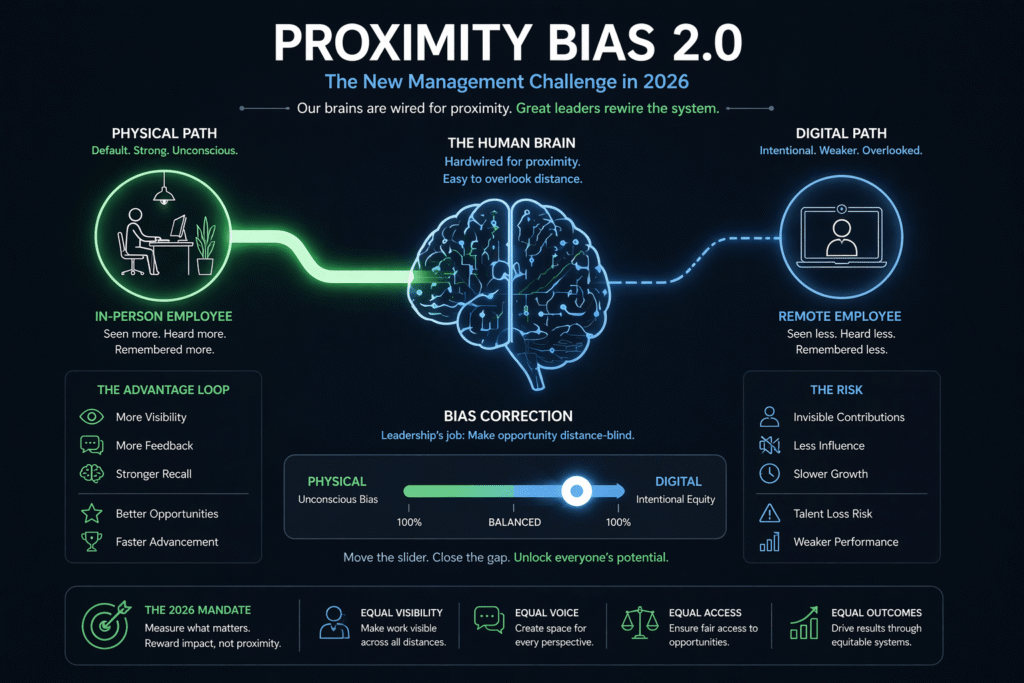
Furthermore, the 2026 professional uses “Presence Artifacts” to bridge the gap during remote days. This involves being extremely active in high-value digital channels and utilizing video-first communication to maintain a “Visual Link” with the team. However, the intentional office remains the “Ground Truth” for your reputation. By strategically appearing during critical organizational milestones, you technically refresh your “Presence Credit” in the minds of leaders, ensuring that proximity bias works for you rather than against you.
ROI of Presence: Spontaneous Innovation vs. Deep Work
The 2026 professional treats their location as a variable in an ROI equation. They recognize that “Deep Work”—tasks requiring high concentration and zero distraction—is best performed in the controlled environment of a home office. Conversely, “Social Leverage”—tasks requiring influence, persuasion, and creative synthesis—is best performed in the high-entropy environment of the physical office. Balancing these two is the secret to 2026 career longevity.
| Metric | Remote (Deep Work) | Office (Social Leverage) |
| Output Type | Individual Deliverables | Collaborative Innovation |
| Primary Value | Technical Efficiency | Social Capital & Influence |
| Communication | Asynchronous (High Latency) | Synchronous (Low Latency) |
| Trust Building | Transactional | Relational |
| Mentorship | Formal / Scheduled | Spontaneous / Shadowing |
FAQ: Mastering the Intentional Office
How many days in the office are “technically ideal” for career growth in 2026?
There is no universal number, but the 2026 standard is “2+1 Strategy”: two days for collaborative team synergy and one day for “Passive Networking” (walking the halls, having lunches). This ensures you are present enough to maintain your SCQ without sacrificing the productivity gains of remote work.
How do I measure my Social Capital Quotient (SCQ) without a tool?
Look at your “Information Access.” In 2026, if you are the last to know about a strategic pivot or a departmental change, your SCQ is technically low. If you are regularly consulted “off-the-record” before a decision is made, your trust density and influence velocity are high.
What is “Office Etiquette 2.0” in 2026?
The golden rule is: Do not go to the office to do Zoom calls. If you are in the physical hub, your goal is to be “interruption-friendly.” Wearing noise-canceling headphones at a desk in 2026 is seen as a waste of the office’s social potential. If you need deep focus, stay home.
How can I manage a hybrid team without falling into proximity bias?
As a 2026 manager, you must use “Objective Performance Artifacts.” Rely on the verified output in the digital portfolio and ITM data rather than “feeling” who is working based on who you see. However, you must also intentionally schedule “Remote-First” bonding events to ensure your digital ghosts feel as included as your office regulars.
Is the “Status Meeting” presencial dead in 2026?
Yes. In 2026, using the expensive social real estate of an office for a boring status update is technically an ROI failure. Status updates should be handled via asynchronous AI-dashboards. Office time is reserved for “Conflict, Creativity, and Culture.”
How do I avoid being the “Digital Ghost” of the company?
If you are 100% remote, you must become a “Master of Digital Artifacts.” You need to contribute so much visible, high-impact value to the company’s public-facing projects that your name becomes a synonym for “Expertise.” Even then, in 2026, most remote experts still make “Strategic Pilgrimages” to the headquarters at least once a quarter to refresh their physical social bonds.
About the Author

Vinícius Andrade writes about the practical side of personal growth — employee benefits, career moves, personal finance, and everyday wellbeing. He turns dense rules and jargon into steps anyone can act on, so readers spend less time decoding fine print and more time making decisions that actually improve their lives.
