

In 2026, the obsession with “thinness” has been replaced by a focus on “Skeletal Muscle Index.” We now recognize that muscle is not just for aesthetics; it is a sophisticated endocrine organ that secretes myokines—molecules that regulate brain health, metabolic rate, and immune function.

In the wellness landscape of 2026, we have moved past the superficial pursuit of the “beach body.” Muscle is no longer viewed through the narrow lens of aesthetics; it is technically recognized as the most effective Life Insurance Policy an individual can own. As we navigate an era of metabolic instability, skeletal muscle has emerged as the primary “Metabolic Sink” of the body, responsible for clearing up to 80% of post-meal glucose. In 2026, your muscle mass isn’t just about how you look in a mirror; it’s about how well your body manages the “fuel” of modern life.
The transition to this “Muscle-First” paradigm is driven by the stark reality of the 2020s health crisis. In 2026, clinicians treat low muscle mass with the same urgency as high blood pressure. Muscle serves as a protective buffer against insulin resistance, systemic inflammation, and the frailty that often defines the final decades of life. For the proactive 2026 professional, skeletal muscle is a biological asset—the more you deposit into this “structural bank” now, the more metabolic interest you draw in your later years.
The true power of muscle lies in its role as a massive endocrine organ. Every time you lift a weight or sprint to catch a flight, your muscles are technically “talking” to your brain, liver, and fat cells through chemical signals. In 2026, we don’t just lift to get stronger; we lift to engineer a systemic environment of resilience that protects every other organ in the body.
Muscle is the currency of longevity. In 2026, we have stopped trading our health for comfort and started investing in the only structural asset that pays dividends in metabolic stability and cognitive clarity.
Beyond Movement: The Endocrine Power of Myokines
The most profound technical advancement in 2026 muscle science is our understanding of Myokines—specialized proteins secreted by muscle fibers during contraction. These molecules act as systemic “messengers,” traveling through the bloodstream to reduce neuroinflammation and promote cellular repair. In 2026, a session of resistance training is technically a “pharmacological dose” of health-promoting chemicals that no pill can replicate.
During high-intensity muscular work, your body secretes a specific cocktail of myokines that dictate the health of distant organs:
- Irisin: Technically facilitates the “browning” of white adipose tissue, increasing your basal metabolic rate and improving thermogenesis.
- Catepsin B: Crosses the blood-brain barrier to stimulate the production of BDNF, directly enhancing memory and protecting against cognitive decline.
- Muscle-derived BDNF: Acts locally and systemically to support neural plasticity and metabolic health.
- Interleukin-6 (IL-6): When secreted by muscle (rather than fat), it acts as a potent anti-inflammatory agent, dampening the “inflammaging” that drives chronic disease.
By 2026, we have identified over 600 unique myokines, each contributing to a technical “Molecular Map” of health. This makes skeletal muscle the body’s largest internal “pharmacy,” where the price of admission is simply a consistent, technical challenge to the tissue.
Sarcopenia vs. Dynapenia: The 2026 Power Standard
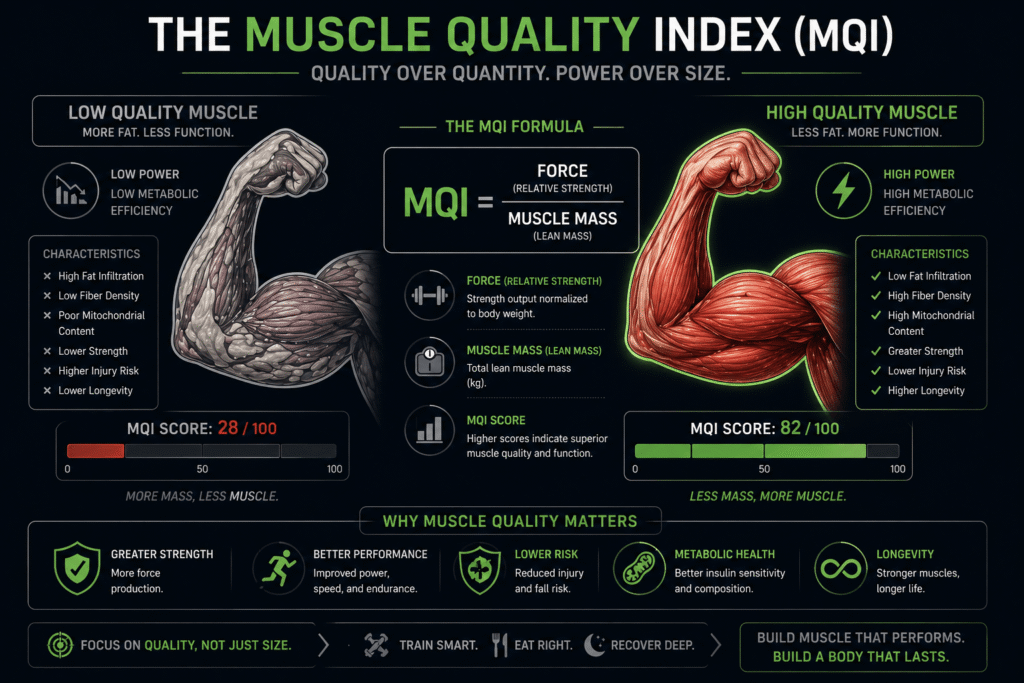
As we age, we face two distinct technical threats that are often conflated but require different intervention strategies: Sarcopenia (the loss of actual muscle volume) and Dynapenia (the loss of muscle strength and power). In 2026, clinical research has confirmed that while maintaining mass is important for metabolism, it is the loss of power—the ability to generate force with speed—that most accurately predicts functional decline. You can technically have large muscles that are “slow” or functionally dampened by fatty infiltration, a condition often hidden in standard BMI checks.
The 2026 standard for longevity focuses on Power Output because it represents the synergy between the muscular and nervous systems. It is the technical capacity to react instantly to a trip or a fall, or to generate explosive force when needed. In this paradigm, muscle is not just a static weight; it is a dynamic engine. Longevity experts now prioritize “Power over Bulk,” recognizing that the rapid-firing fast-twitch fibers are the first to atrophy if not specifically challenged through high-velocity movements.
To track this, we utilize the Muscle Quality Index (MQI). Instead of looking at size alone, the MQI evaluates the “torque” or force produced relative to the muscle’s cross-sectional area. A high index indicates dense, high-quality fibers with excellent neurological recruitment. This shift in measurement allows the 2026 professional to ignore the scale and focus on the technical integrity of their tissue, ensuring that every gram of muscle is optimized for performance and protection.
The 2026 Resistance Protocol: Hypertrophy and Power
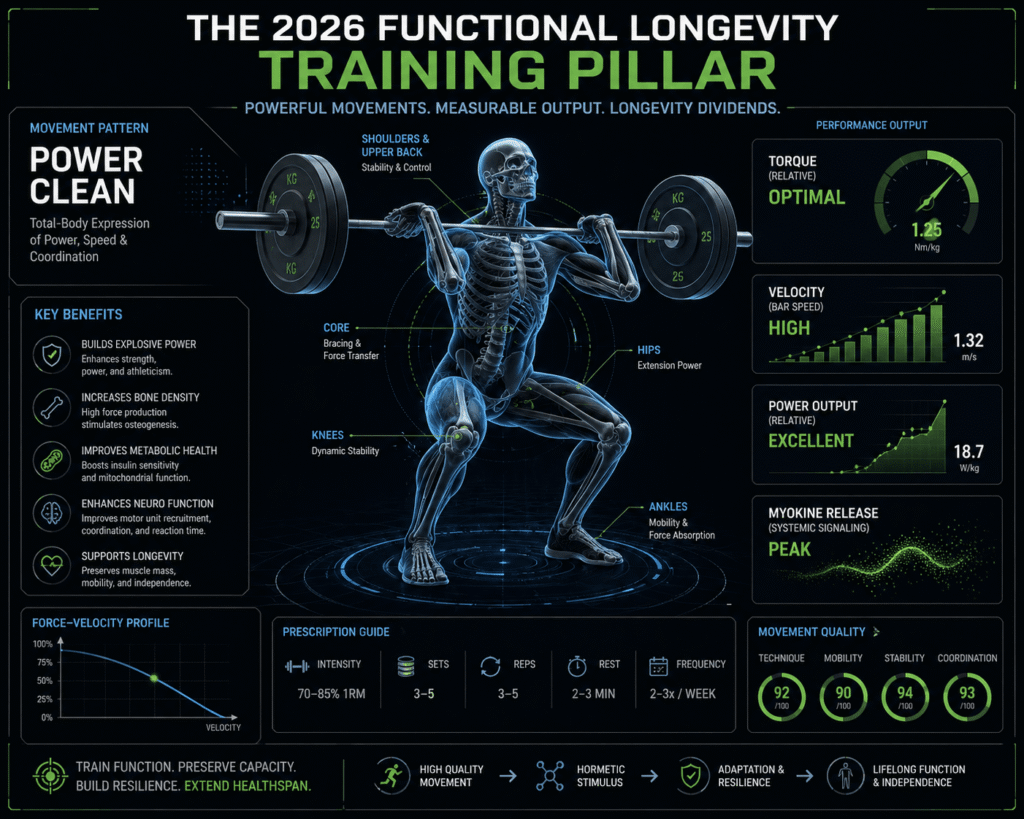
To maintain a “Master-Level” muscle profile in 2026, the traditional “3 sets of 10” has been replaced by a more technical, multi-modal protocol. The goal is to maximize both the structural density of the fiber and the neurological efficiency of the contraction. Modern 2026 training systems use “Smart Torque” sensors to ensure every repetition is performed at the optimal velocity to trigger the maximum myokine release. The 2026 Functional Longevity Protocol is built on 5 technical pillars:
- Eccentric Overload: Focusing on the “lowering” phase of the lift to maximize structural remodeling and tendon strength.
- Velocity-Based Training: Moving weights as fast as safely possible to target the high-threshold, fast-twitch fibers that are the first to be lost with age.
- Leucine Threshold Loading: Ensuring every meal contains at least 3g of the amino acid Leucine to technically “flip the switch” for muscle protein synthesis.
- Multi-Planar Torque: Training in all three planes of motion (front-to-back, side-to-side, and rotational) to prevent “structural leakage” and injury.
- Neuromuscular Connectivity: Utilizing “Bio-Sync” wearables to verify that the muscle is being fully recruited during every set.
| Feature | Aesthetic Training (Legacy) | Functional Longevity (2026) |
| Primary Metric | Body Fat % / Muscle Size | Muscle Quality Index / Power Output |
| Nutritional Focus | Calorie Counting | Leucine Threshold / Myokine Support |
| Training Speed | Slow & Controlled (Tension) | Explosive Concentric (Power) |
| Recovery Strategy | Passive Rest | Active Hormetic Recovery (Fire & Ice) |
| Longevity Goal | Looking Younger | Technical Biological Resilience |
FAQ: Investing in Your Biological Assets
Is it actually possible to gain muscle after age 70 in 2026?
Absolutely. Technical research in early 2026 has confirmed that “muscle plasticity” never truly disappears. Even in the 8th or 9th decade, the body can initiate hypertrophy if the stimulus is high enough and the protein intake (specifically Leucine) is technically optimized to overcome age-related “Anabolic Resistance.”
What is the role of Creatine in the 2026 longevity landscape?
Creatine is no longer just for bodybuilders. In 2026, it is considered a “Longevity Essential.” Beyond its role in muscle energy, it has a technical neuroprotective effect, supporting brain energy metabolism and reducing the oxidative stress that contributes to cognitive decline.
Does “Cardio” kill my muscle gains in 2026?
The “Interference Effect” was largely a technical myth. In 2026, we utilize Concurrent Training, where high-intensity interval training (HIIT) is paired with resistance work. As long as the cardiovascular work isn’t so excessive that it depletes the “Recovery Budget,” it actually improves muscle quality by increasing capillary density.
How do torque sensors help me train better?
Torque sensors measure the rotational force around a joint. In 2026, this allows you to see if your “Power Output” is dropping mid-set. If the sensor detects a 20% drop in torque, the set is technically over, as further reps would only contribute to “junk volume” without providing the necessary stimulus for growth.
Can I get enough protein on a plant-based diet in 2026?
Yes, but it requires more technicality. Because plant proteins often have lower concentrations of Leucine and Lysine, 2026 plant-based athletes often use “Amino Fortification.” By adding specific isolated amino acids to their plant-based meals, they can technically match the anabolic response of animal-based proteins.
Why is grip strength such a big deal in 2026 longevity?
Grip strength is a technical proxy for Systemic Vitality. It correlates with overall muscle mass, cognitive function, and cardiovascular health. In 2026, a weak grip is viewed as an “Early Warning System” for systemic sarcopenia, prompting immediate intervention in the individual’s resistance protocol.
About the Author

Vinícius Andrade writes about the practical side of personal growth — employee benefits, career moves, personal finance, and everyday wellbeing. He turns dense rules and jargon into steps anyone can act on, so readers spend less time decoding fine print and more time making decisions that actually improve their lives.
