

In the professional wellness landscape of 2026, we have moved beyond the reductionist view of the body as a collection of isolated muscles. The focus has shifted toward Fascial Integrity—the health and fluidity of the connective tissue network that binds our entire structure together. Fascia is no longer seen as a mere “wrapping” for muscles; it is recognized as a sophisticated, body-wide communication system and our largest sensory organ. For the modern professional, chronic pain and stiffness are rarely issues of muscular weakness, but rather of fascial densification—a biological consequence of the static, sedentary postures required by our digital infrastructure.
The technical brilliance of the fascial system lies in its ability to manage force. When healthy, fascia acts like a liquid crystal lattice, distributing tension across the entire body to protect individual joints and muscles. However, when we remain immobile for hours, the extracellular matrix (ECM) within the fascia begins to thicken, creating “adhesions” that restrict movement and compress nerves. In 2026, the primary goal of physical longevity is to maintain the “glide” between these fascial layers, ensuring that our biological architecture remains elastic rather than brittle.
Restoring fascial health is a “low-tech, high-science” endeavor. It doesn’t require futuristic machinery; it requires a return to multi-planar movement and a deep understanding of tissue hydration. By treating the fascial network as a singular, interconnected web, we can achieve a level of structural resilience that traditional strength training alone cannot provide. This is the foundation of the 2026 “Movement as Medicine” philosophy: prioritizing the integrity of the framework to ensure a lifetime of pain-free, fluid motion.
The Architecture of Connective Tissue: Hyaluronan and Tissue Hydration
The secret to fascial “glide” is a substance called Hyaluronan (hyaluronic acid). This molecule acts as a biological lubricant between the layers of deep fascia and muscle. When we move dynamically, hyaluronan remains fluid, allowing tissues to slide past each other without friction. However, during periods of prolonged stasis—such as a 10-hour workday—the hyaluronan becomes viscous and “glue-like.” This is what causes that familiar feeling of morning stiffness or the “stuck” sensation in the lower back after sitting.
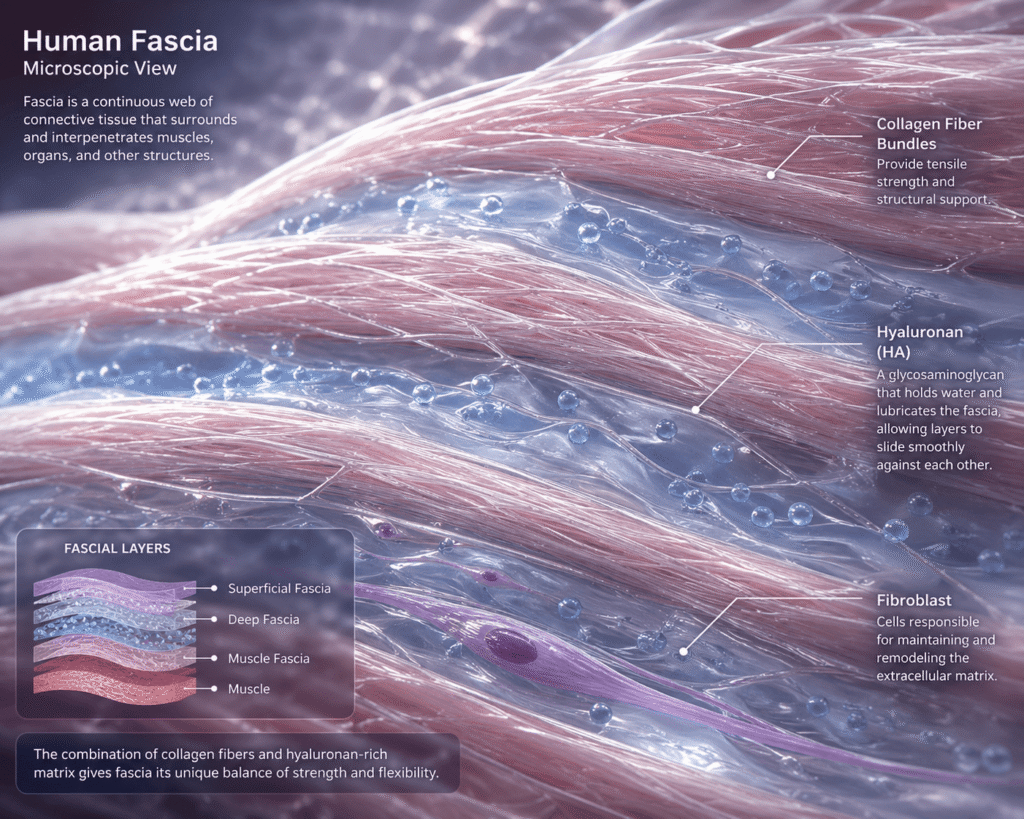
In 2026, we understand that tissue hydration is not just about how much water you drink, but how that water is distributed within the ECM. “Loading” the tissue through varied movement—stretching, bouncing, and compressing—acts like squeezing a sponge, forcing old fluid out and allowing fresh, nutrient-rich fluid to enter. This mechanical irrigation is the only way to maintain the health of the hyaluronan and prevent the formation of densified “trigger points” that eventually lead to chronic pain.
Fascia is the architecture of human form; when it loses its fluidity, the entire structure begins to collapse under the weight of its own tension.
Proprioception and the Fascial Sensory System: Why it Matters for Longevity
Fascia is our primary organ of proprioception—the body’s ability to sense its position in space. It contains six times more sensory nerve endings than muscle tissue, making it the most critical player in balance and injury prevention. In 2026, we recognize that as we age, the loss of “structural awareness” is often a result of fascial sensors becoming muffled by dehydrated, thickened tissue. Keeping the fascia “awake” and hydrated ensures that the brain receives high-fidelity data from the limbs, allowing for the micro-adjustments that prevent falls and strains.
To understand why prioritizing the connective web is so vital, we must look at the technical differences between our contractile and non-contractile tissues:
| Feature | Muscle Tissue | Fascial Tissue (Connective) | Wellness Impact |
| Function | Contraction & Power | Support & Force Transmission | Structural Integrity |
| Recovery Rate | Fast (High Blood Flow) | Slower (Diffusion-Based) | Longevity Planning |
| Sensory Input | Moderate | Maximum (High Nerve Density) | Balance & Agility |
| Movement Style | Linear / Concentric | Elastic / Multi-directional | Fluidity |
Biotensegrity: The Engineering of Whole-Body Support
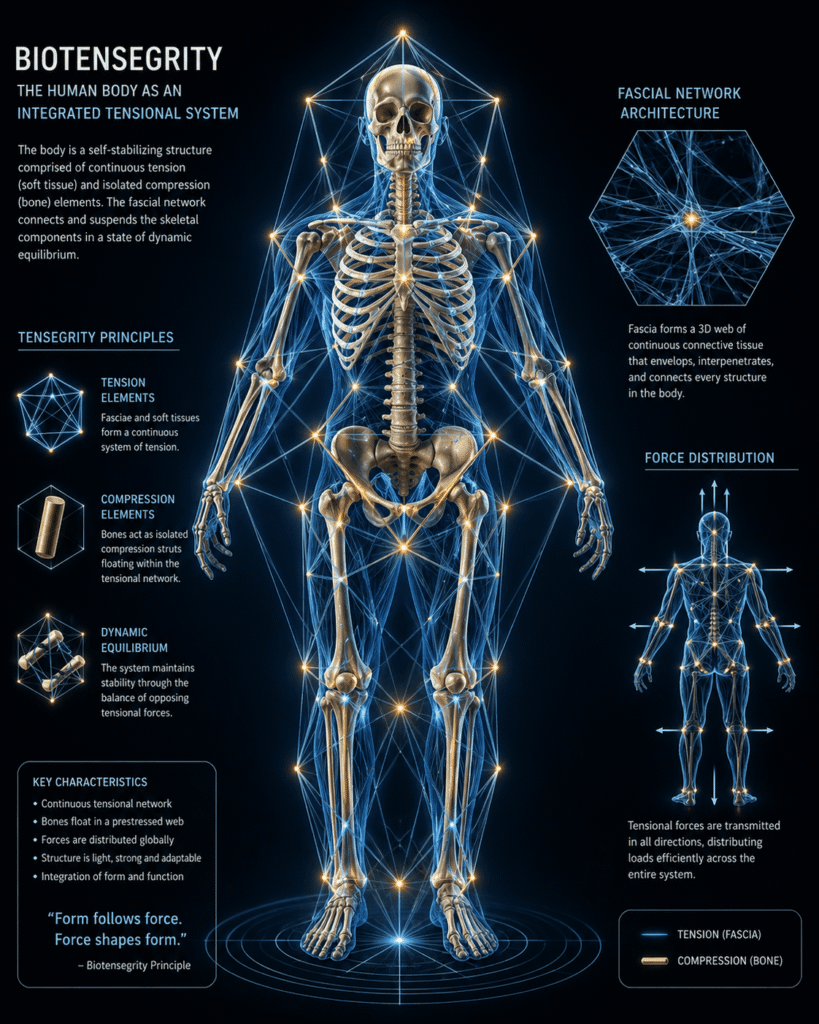
The 2026 model of human movement is based on Biotensegrity—a term borrowed from architecture (tension + integrity). In a biotensegrity system, the bones are “floating” in a sea of continuous fascial tension. This means that a restriction in your ankle can manifest as pain in your neck, because the tension is distributed across the entire web. When the fascial system is balanced, the body supports itself with minimal muscular effort. This is the “weightless” feeling of perfect posture that professionals strive for in an era of “tech-neck” and pelvic tilts.
By understanding biotensegrity, we stop chasing the “site of pain” and start looking for the “source of tension.” If the fascia in the front of your chest is tight from typing, it pulls on the entire web, forcing your back muscles to work overtime just to keep you upright. Correcting this doesn’t involve “strengthening” the back; it involves releasing the fascial “line” in the front. This holistic engineering approach is what makes 2026 wellness so much more effective at resolving long-term structural issues.
Fascial Training Protocols: From Elastic Recoil to Myofascial Release
Fascia responds best to rhythmic, elastic movements. While muscles grow through heavy, slow loads, fascia thrives on “elastic recoil”—the spring-like bounce found in activities like jumping rope, dancing, or light plyometrics. In 2026, the “Fascial Health Protocol” has become a daily staple for professionals. These routines focus on “pumping” the tissue through various angles, ensuring that every part of the web is irrigated and energized.
Myofascial release (MFR), using tools like foam rollers or balls, acts as a form of manual irrigation. By applying pressure to specific points, you create a temporary blockage that, when released, allows a “tsunami” of fresh fluid to rush back into the tissue. This not only hydrates the hyaluronan but also resets the sensory nerves, lowering the “background noise” of chronic tension and allowing the nervous system to relax into a more parasympathetic state. To maintain your structural framework, implement the Daily Fascial Health Protocol:
- The Morning “Cat-Stretch”: Slow, multi-directional reaching to wake up the global fascial lines.
- Micro-Movements: Every 30 minutes of sitting, perform a 1-minute “wiggle” to prevent hyaluronan densification.
- Elastic Recoil: 2 minutes of light bouncing or “shaking” to stimulate the elastic fibers.
- Hydration Loading: Sip water consistently and include electrolyte-rich foods to support ECM fluid retention.
- Targeted MFR: Spend 5 minutes at night rolling the feet or upper back to reset the day’s “postural imprints.”
FAQ: Connective Tissue Health and Structural Longevity
Does taking collagen supplements actually help my fascia in 2026?
Collagen peptides can provide the “raw materials” for fascial repair, but they are useless without mechanical signaling. Fascial cells (fibroblasts) only create new, healthy collagen when they are under tension. Therefore, supplementation must be paired with movement to “tell” the body where to send those nutrients. Without the movement, the collagen doesn’t know where it’s needed in the structural web.
Is fascial stiffness linked to emotional stress?
Absolutely. In 2026, we have mapped the connection between the sympathetic nervous system and fascial tension. Under chronic stress, the body releases TGF-beta1, a cytokine that causes fascial cells to contract independently of the muscles. This is why you feel “tight” when you’re stressed, even if you haven’t exercised. Managing fascial health is, in many ways, a form of neurological stress management.
Why is “mobility” better than “stretching” for fascial integrity?
Static stretching can sometimes “over-elongate” certain parts of the fascia while ignoring the deeper, densified layers. Mobility, which involves moving a joint through its full range under control, ensures that the layers are sliding against each other. In 2026, we prefer “dynamic oscillations”—small, pulsing movements at the end of a range—to safely hydrate the tissue without causing microscopic tears.
Can fascial health improve my athletic performance?
Yes, significantly. Most of our “explosive” power comes from the elastic recoil of our tendons and fascia, not just muscle contraction. Think of a kangaroo; its muscles are relatively small, but its fascial system is highly tuned for energy storage and release. By training your fascial integrity, you become more “springy” and efficient, allowing you to move with more power and less fatigue.
About the Author

Vinícius Andrade writes about the practical side of personal growth — employee benefits, career moves, personal finance, and everyday wellbeing. He turns dense rules and jargon into steps anyone can act on, so readers spend less time decoding fine print and more time making decisions that actually improve their lives.
