In 2026, “Prompt Engineering” has evolved from a standalone job into a basic literacy skill. The high-value career path has shifted toward AI Orchestration—the complex discipline of designing, coordinating, and auditing fleets of autonomous agents.
As we move through the first month of 2026, the professional landscape is no longer impressed by someone who can “talk to a chatbot.” The industry has entered what experts call the Agent Economy, where the competitive advantage lies in building multi-agent systems that can execute end-to-end business processes with minimal human intervention. The “AI Orchestrator” is the new conductor of this digital orchestra, responsible for integrating Retrieval-Augmented Generation (RAG) infrastructure, managing LLM Ops (Large Language Model Operations), and maintaining the critical “Human-on-the-Loop” oversight that ensures reliability.

Beyond the Prompt: The Shift to “Context Engineering”
In 2026, prompt engineering—the art of finding the right words—has been largely automated by the models themselves. The new technical frontier is Context Engineering.
Instead of crafting a single static instruction, the 2026 AI Orchestrator designs the Context Window Architecture. This involves:
- Dynamic Data Retrieval: Using RAG systems to feed real-time, proprietary company data into the AI, ensuring responses are grounded in current facts rather than outdated training data.
- State Management: Developing systems that allow AI agents to “remember” previous interactions across different platforms (email, Slack, CRM) to maintain a persistent workflow.
- Orchestration Frameworks: Utilizing tools like LangChain, Microsoft Power Automate, or specialized agent-hosting platforms to route tasks between different specialized models (e.g., one model for data analysis, another for creative copy).
The Rise of the Multi-Agent System (MAS)
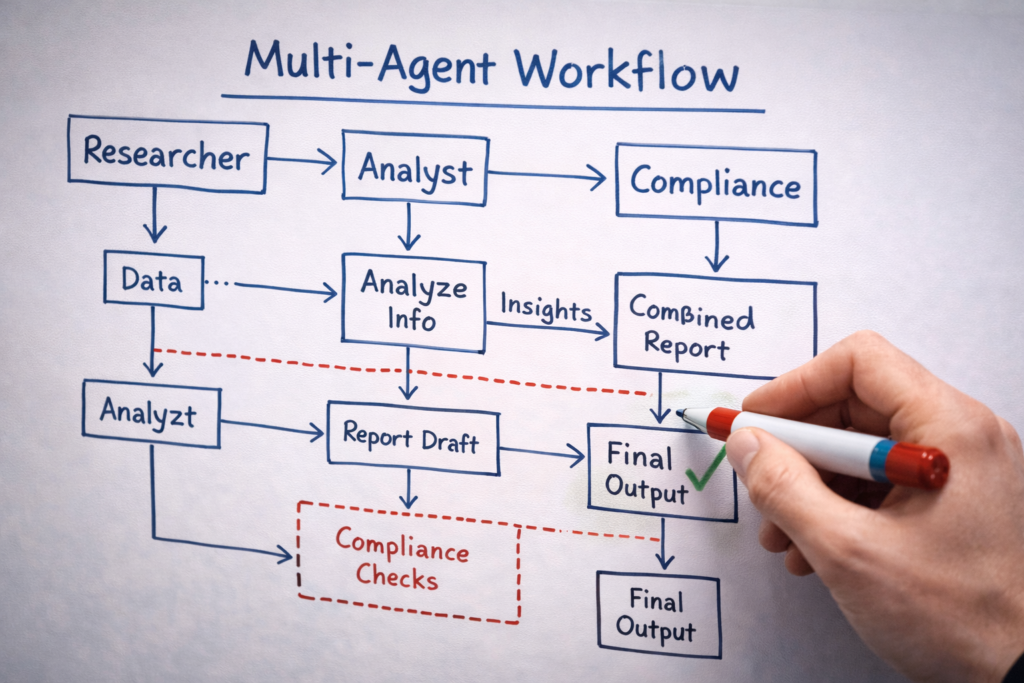
The hallmark of a senior career in 2026 is the ability to manage a Multi-Agent System (MAS). Unlike a single chatbot, a MAS consists of multiple “agents” with specific personas and tools that collaborate to solve complex problems. For example, an AI Agent Orchestration Specialist in a marketing department might manage:
- The Researcher Agent: Scrapes market trends and competitor data.
- The Analyst Agent: Processes that data into a strategic report.
- The Creative Agent: Generates ad copy and visual concepts based on the report.
- The Compliance Agent: Checks all outputs against brand guidelines and legal regulations.
The Orchestrator’s job is to define the Rules of Engagement between these agents, preventing “logic loops” and ensuring that the final output is cohesive and safe.
“Human-on-the-Loop” and Stewardship
A critical technical term in 2026 is the transition from “Human-in-the-Loop” to “Human-on-the-Loop” (HOTL). In early 2026, the professional’s role is no longer to perform the task with the AI, but to act as a Steward or “Pilot” monitoring the “Autopilot.” This requires a new set of Auditing Skills:
- Bias Detection: Identifying when an autonomous agent is hallucinating or showing demographic bias in decision-making (e.g., in hiring or loan approvals).
- Exception Handling: Stepping in only when the AI flags a high-risk or ambiguous situation that requires nuanced human judgment.
- Performance Optimization: Using LLM Ops metrics to track “token efficiency” and “task success rates” to lower the operational costs of the agent fleet.
Career Comparison: 2023 Prompting vs. 2026 Orchestration
| Feature | Prompt Engineer (2023/24) | AI Orchestrator (2026) |
| Primary Output | Text, code, or images | Autonomous workflows/systems |
| Core Technology | ChatGPT / Single LLM | RAG, Vector DBs, Multi-Agent Ops |
| Human Role | Iterative “Prompt-and-Check” | Strategic Oversight (HOTL) |
| Data Interaction | Static input | Real-time API & Context Integration |
| Evaluation Metric | “Does it look right?” | KPI fulfillment & Error rates |
FAQ – Frequently Asked Questions About 2026 AI Careers
Is Prompt Engineering dead in 2026?
Not dead, but subsumed. Knowing how to write a good prompt is now expected of everyone—much like knowing how to use a search engine was in 2010. The high salaries are now reserved for those who can architect the systems behind the prompts.
What technical skills do I need for AI Orchestration?
Familiarity with Vector Databases (like Pinecone or Weaviate), API Integration, and System Thinking are paramount. You don’t necessarily need a CS degree, but you must understand the logic of data flow and software architecture.
How do I “audit” an AI agent for bias?
In 2026, professionals use Adversarial Testing tools and Explainability Dashboards that show exactly which data points led the AI to a specific conclusion.