

A credit score affects more than whether you get a loan. It changes the interest rate on a car, the deposit on an apartment or a utility account, and sometimes the price of insurance. The good news is that scores respond to a short list of habits, and you can start most of them this week for free.
This guide walks you through a step-by-step plan: how scores are built, how to find and fix errors, which moves raise a score fastest, and how long negative marks really last. It ends with a 90-day example you can copy.
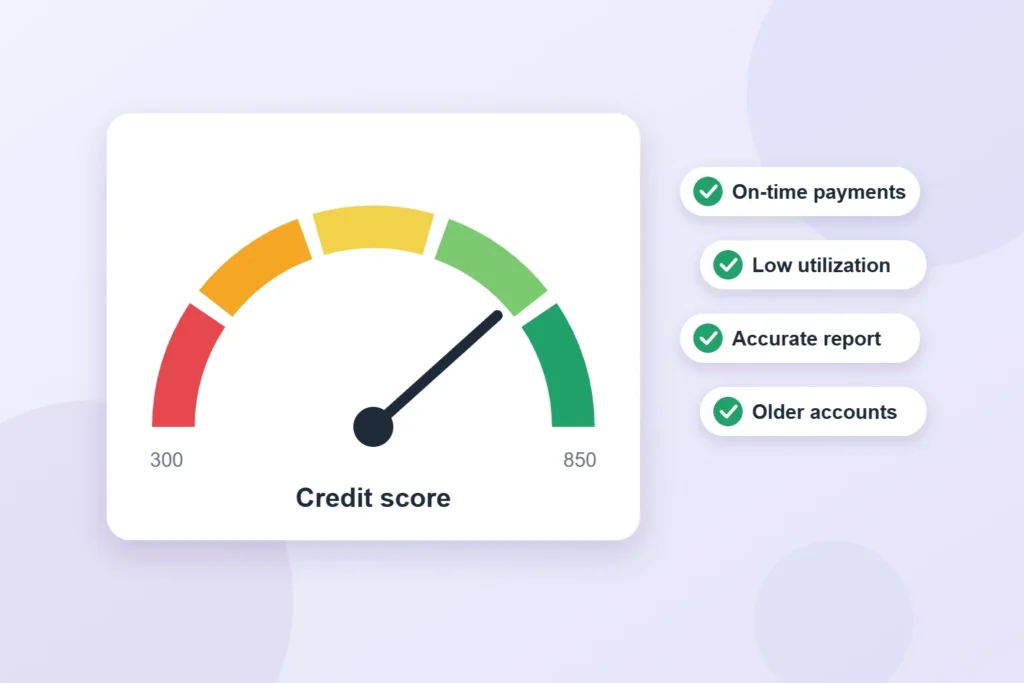
How your credit score is calculated
FICO, the company behind the scores most lenders use, groups the information on your credit report into five categories. The percentages below are FICO’s general weights for most people; your own mix can differ depending on how long your history is.
| Factor | Weight | What helps |
| Payment history | 35% | Paying every account on time, every month |
| Amounts owed | 30% | Low card balances compared with your credit limits |
| Length of credit history | 15% | Keeping older accounts open and in good standing |
| New credit | 10% | Applying for new credit only when you need it |
| Credit mix | 10% | Handling different types of credit well over time |
Two takeaways come straight from this table. Payment history and amounts owed make up about two thirds of the score, so that’s where your effort pays off most. And “credit mix” is the smallest factor, so you never need to take out a loan just to improve it.
Step 1: Get your credit reports for free
Your score is calculated from your credit reports, so start there. Equifax, Experian, and TransUnion now let you check your reports for free every week at AnnualCreditReport.com, the only site authorized by federal law for this. The free weekly access was made permanent in 2023.
Download all three, because lenders don’t always report to every bureau. As you read each one, check:
- Your name, addresses, and Social Security number are correct.
- Every account belongs to you. An account you don’t recognize can be a sign of identity theft.
- Payments marked “late” really were late.
- Balances and credit limits match your latest statements. A missing credit limit can make a card look maxed out.
- Old negative items haven’t stayed past the time limits listed later in this guide.
Step 2: Dispute errors the right way
Errors are more common than many people think, and fixing one can lift a score quickly. The Consumer Financial Protection Bureau recommends disputing in two places:
- With the credit bureau that shows the error. Explain in writing what’s wrong and why, and include copies (never originals) of documents that prove it, such as a bank statement showing an on-time payment.
- With the company that reported it (the “furnisher”), such as your card issuer or lender. Furnishers generally must investigate and respond within 30 days.
Keep copies of everything and note the dates you sent each letter. If the company insists the information is accurate and you still disagree, you can ask the bureau to add a short statement about the dispute to your file, and you can submit a complaint to the CFPB.
Be careful with “credit repair” companies. Anything they can legally do, you can do yourself for free, and none of them can remove accurate negative information.
Step 3: Make sure you never miss another payment
Because payment history is the biggest factor, one late payment can undo months of progress. A payment usually isn’t reported to the bureaus as late until it’s at least 30 days past due, so if you just missed a due date, pay it right away. You’ll likely owe a late fee, but you can often avoid the credit damage.
- Set up autopay for at least the minimum payment on every card and loan.
- Move due dates so they land a few days after payday. Most issuers let you change this online.
- If you can’t pay, call the lender before the due date and ask about a hardship plan. A reduced payment arranged in advance is far better than a missed one.
Step 4: Lower your credit utilization
Credit utilization is the share of your card limits you’re using. It’s the fastest factor to change, because it’s based on the balances reported each month, not on years of history.
How to calculate it: add up your card balances and divide by your total card limits. If you owe $2,700 on cards with $6,000 in total limits, your utilization is 45%. A common guideline is to stay under 30%, and people with the highest scores tend to stay in single digits.
- Pay before the statement closes. Most issuers report the balance on your statement date. Paying part of the balance a few days earlier lowers the number that gets reported, even if you always pay in full.
- Spread or reduce balances. Both your overall utilization and the utilization on each card count, so avoid having any single card near its limit.
- Ask for a higher limit on a card you’ve had for a while, as long as you won’t spend more because of it. Ask whether the request causes a hard inquiry.
If card balances are the real problem, our guide on how to pay off credit card debt compares the two most popular payoff methods with real numbers.
Step 5: Protect the age of your accounts
- Keep old cards open, especially ones with no annual fee. Closing your oldest card can shorten your history and raise your utilization at the same time. Use it for one small purchase every few months so the issuer doesn’t close it.
- Space out applications. Each application for new credit can cause a hard inquiry. Hard inquiries stay on your report for two years, though FICO scores only count them for 12 months. Checking your own score never hurts it.
- Rate-shop in a short window. When you shop for a mortgage, auto, or student loan, scoring models generally treat several inquiries in a short period as one.
Step 6: Build credit if your file is thin
If you have no score or only one or two accounts, you need positive history before the other steps can help:
- Secured credit card: you put down a deposit, often $200 to $500, which becomes your limit. Use it for one small bill and pay it in full every month. Confirm that it reports to all three bureaus.
- Credit-builder loan: offered by many credit unions and community banks. The loan amount is held in savings while you make payments, then released to you at the end.
- Authorized user: a family member with a long, on-time card history adds you to their account. Only do this if they keep a low balance and pay on time, because their habits will show on your report too.
How long negative items stay on your report
| Item | How long it can be reported |
| Late payments | 7 years from the date of the missed payment |
| Collection accounts | 7 years from the original delinquency |
| Chapter 7 bankruptcy | Up to 10 years |
| Hard inquiries | 2 years (FICO counts them for 12 months) |
The impact fades long before the item disappears. A late payment from four years ago weighs far less than one from last month, which is why steady on-time payments matter so much. Also note that the three bureaus voluntarily leave paid medical collections and medical collections under $500 off credit reports.
Example: a 90-day plan that works
Tasha has two credit cards with $6,000 in total limits and $2,700 in balances (45% utilization). She paid one card 30 days late last year, and her score is in the low 600s.
- Days 1 to 7: She pulls all three reports and finds a $480 medical collection that was already paid. She disputes it with the bureaus, attaching her receipt.
- Days 1 to 30: She turns on autopay for the minimum on both cards and moves both due dates to the 5th, two days after payday.
- Days 1 to 90: She pays $300 extra per month toward the cards, always a few days before the statement closes. After three months, balances are $1,800 (30%), and the reported balances drop even lower because of her early payments.
- Day 45: The paid medical collection is removed after her dispute.
She hasn’t erased the late payment, and she doesn’t need to. With lower utilization, one error removed, and three more months of on-time payments, her score can climb noticeably, and every additional on-time month keeps pushing it up.
4 credit myths to ignore
- “Carrying a balance builds credit.” It doesn’t. Paying in full every month builds the same history without the interest.
- “Checking my score lowers it.” Checking your own score or report is a soft inquiry and has no effect.
- “Closing unused cards helps.” It usually hurts, by raising utilization and, over time, shortening your history.
- “Buy now, pay later never shows up.” Some providers now report to the bureaus. See our guide on using buy now, pay later without hurting your credit.
A strong score is easier to keep when you have a cushion for surprises, so you don’t have to put an emergency on a card. Our guide to building an emergency fund shows how to start, even on a small budget.
Sources
- myFICO, What’s in your credit score?
- Consumer Financial Protection Bureau, How do I dispute an error on my credit report?
- Federal Trade Commission, You now have permanent access to free weekly credit reports
- AnnualCreditReport.com
About this guide: Telyf is an independent publication. We are not affiliated with any government agency, and this article is general information, not legal or financial advice. Rules can vary by state and change over time, so confirm the details with the official agency before making decisions.
About the Author

Vinícius Andrade writes about the practical side of personal growth — employee benefits, career moves, personal finance, and everyday wellbeing. He turns dense rules and jargon into steps anyone can act on, so readers spend less time decoding fine print and more time making decisions that actually improve their lives.
