

In the 2026 wellness paradigm, we have come to recognize that true vitality is as much about what the body removes as what it absorbs. While the cardiovascular system receives the majority of medical attention, its silent partner—the lymphatic system—is the true architect of biological waste management. Often described as the body’s “sanitation department,” the lymphatic system is a vast, one-way drainage network responsible for removing cellular debris, neutralized pathogens, and excess interstitial fluid. For the modern professional, understanding this architecture is critical; unlike blood, lymph has no central pump (like the heart) and relies entirely on external mechanical pressure to function.
The technical importance of lymphatic flow cannot be overstated. When the system becomes stagnant due to sedentary behavior or poor breathing patterns, the body begins to accumulate interstitial “sludge.” This stagnation triggers low-grade systemic inflammation, manifests as persistent puffiness, and significantly impairs the immune response. In 2026, we view lymphatic health not as an aesthetic luxury but as a core requirement for immunological resilience. A well-functioning lymphatic system ensures that white blood cells can travel efficiently to sites of infection and that metabolic byproducts are processed by the lymph nodes without causing toxic backlog.
Restoring the “flow” of this biological sanitation system is a matter of physics and mechanics. It requires a strategic combination of muscular contraction, deep pressure differentials, and gravity. By treating the lymphatic system as a complex engineering problem, we can implement simple, “grounded” daily habits that ensure our internal environment remains clean, oxygenated, and primed for high performance. This is the science of biological waste management: a proactive approach to clearing the path for optimal health.
The Interstitial Space: Understanding the Flow of Lymphatic Fluid
The lymphatic journey begins in the interstitial space—the fluid-filled area surrounding every cell in your body. About 90% of the fluid that leaves your blood capillaries is reabsorbed, but the remaining 10% (the lymph) contains proteins and waste molecules too large for the veins to handle. This fluid must enter the lymphatic capillaries, which are designed with specialized “swinging tips” that open when interstitial pressure increases. If this pressure isn’t managed through movement, the fluid remains trapped, leading to lymphedema or chronic swelling.
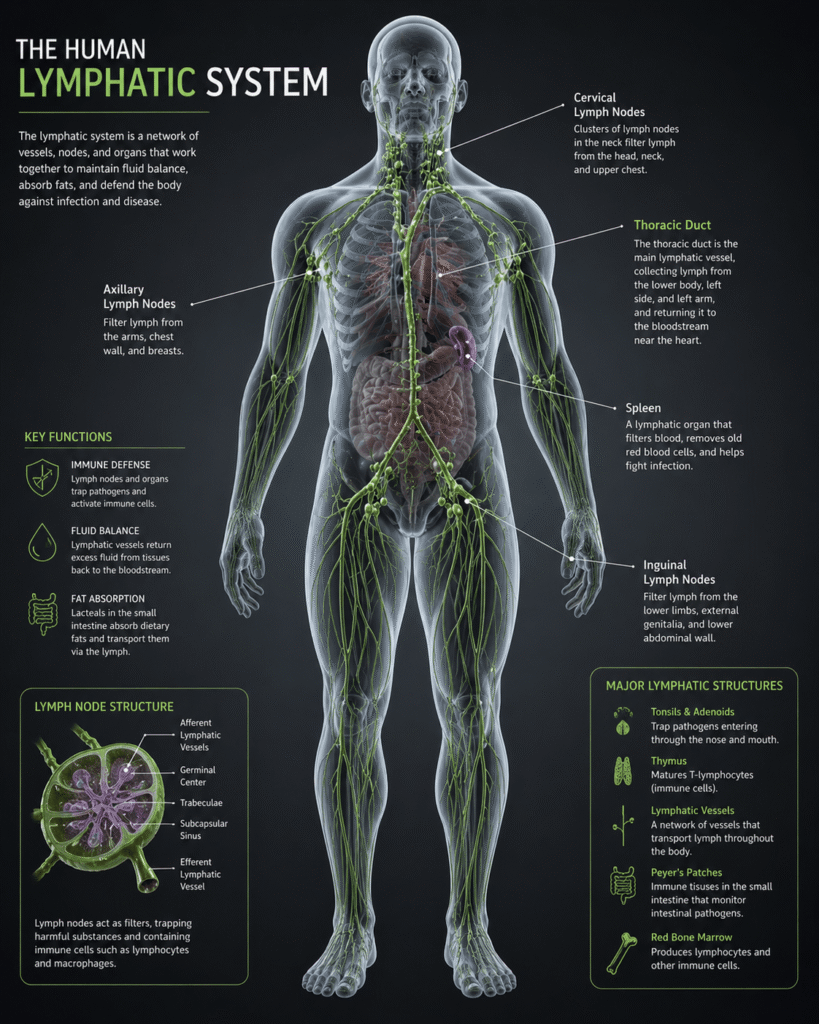
As the lymph travels toward the heart, it passes through hundreds of lymph nodes. These are biological “filters” packed with immune cells that scan the fluid for bacteria, viruses, and cellular mutations. In 2026, we understand that a “clogged” node isn’t just a local issue; it creates a hydraulic backup that affects the entire upstream network. Maintaining the health of the interstitial space requires consistent movement to keep these swinging tips active and the fluid moving toward the filtration stations, ensuring that the body’s waste doesn’t turn into a source of systemic toxicity.
The Manual Pump: Why Movement is the Engine of Detoxification
Because the lymphatic system lacks a heart-like pump, it is entirely dependent on the musculoskeletal pump. Every time a muscle contracts, it squeezes the adjacent lymphatic vessels, which are equipped with one-way valves that ensure the fluid only moves in one direction (toward the neck). This is why “sitting is the new smoking” in 2026—without the pump, the waste stays put. To understand the disparity between these two vital systems, we look at their mechanical blueprints:
| Feature | Cardiovascular System | Lymphatic System | Wellness Impact |
| Pump Mechanism | Central Pump (Heart) | Manual Pump (Muscle/Breath) | Requires Active Movement |
| Flow Circuit | Closed Loop (Circular) | One-Way (Linear Drainage) | Direct Waste Removal |
| Flow Speed | Fast (High Pressure) | Very Slow (Low Pressure) | Susceptible to Stagnation |
| Main Function | Nutrient/Oxygen Delivery | Waste/Pathogen Removal | Core of Immune Health |
Deep Breathing and the Cisterna Chyli: The Central Hub of Drainage
The most powerful “hidden pump” for the lymphatic system is the diaphragm. Deep at the center of the abdomen, just below the ribs, lies the Cisterna Chyli—the largest lymphatic reservoir in the body. When you take a deep, diaphragmatic breath, the downward movement of the diaphragm creates a pressure differential that literally “sucks” lymph from the lower extremities up into the thoracic duct. This is the central hub of all drainage, and in 2026, breathing is coached as a primary tool for visceral detoxification.
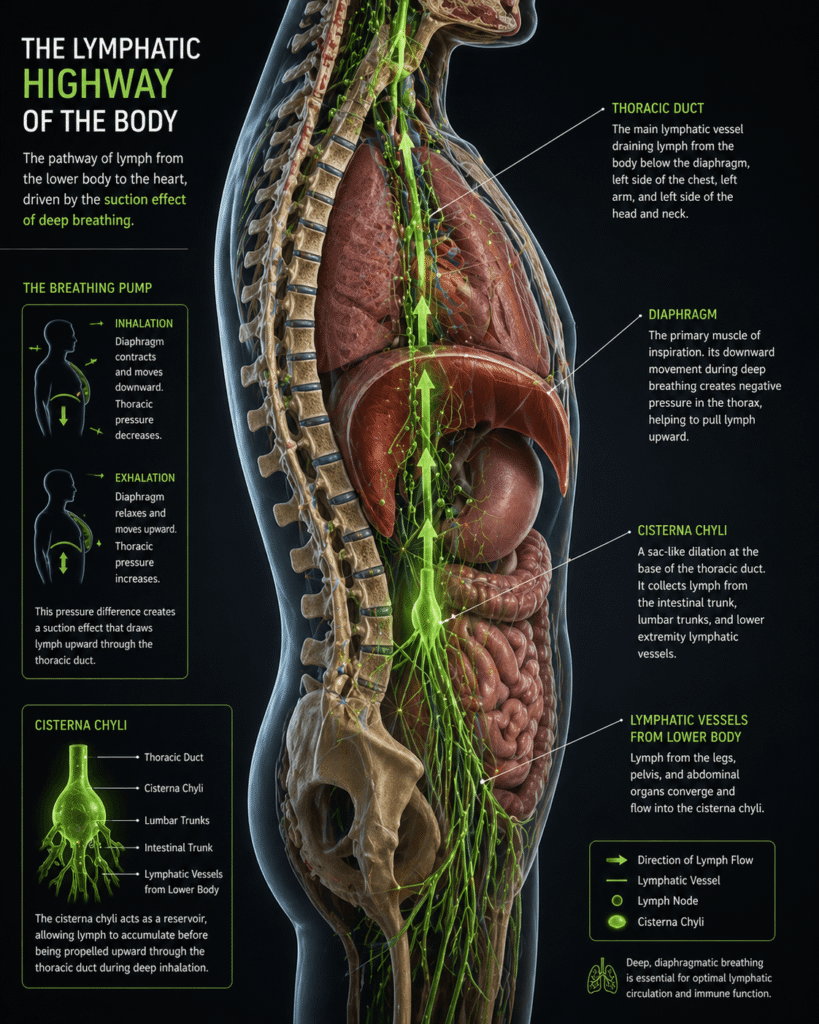
Chronic shallow breathing, common among stressed professionals, leaves the Cisterna Chyli stagnant. This often results in abdominal bloating and lower-body heaviness. By practicing “belly breathing” for just five minutes a day, you are manually stimulating the central pump of your sanitation system, facilitating the return of waste fluid to the bloodstream for final excretion via the kidneys. This is the most efficient, low-tech way to ensure that the body’s central lymphatic highway remains clear of congestion.
Self-Care Protocols: Dry Brushing, Inversion, and Contrast Therapy
While movement and breath are the foundation, 2026 wellness protocols utilize specific tools to accelerate drainage. Dry Brushing is a mechanical technique that stimulates the superficial lymphatic capillaries just beneath the skin. By brushing toward the heart in light, rhythmic strokes, you manually assist the fluid in finding its way to the deeper vessels. This not only improves skin texture but provides a significant boost to systemic circulation and immune signaling.
Additionally, Inversion (elevating the legs above the heart) leverages gravity to assist the slow-moving lymph in the lower limbs, while Contrast Therapy (alternating hot and cold) creates a “vascular flush” that pumps both blood and lymph through the tissues. These methods are grounded in the simple physics of pressure and temperature. By incorporating these habits into a daily routine, you move from passive waste accumulation to active biological management. To keep your “sanitation department” running at peak efficiency, follow the Daily Lymphatic Health Protocol:
- Hydration First: Lymph is 95% water; dehydration makes it thick and difficult to move.
- The “Morning Jump”: 2 minutes of gentle bouncing or “rebounding” to activate the one-way valves.
- Diaphragmatic Sprints: 5 minutes of deep belly breathing to stimulate the Cisterna Chyli.
- Strategic Brushing: Use a natural fiber brush on dry skin, moving from extremities toward the center.
- Postural Breaks: If sitting for an hour, perform 10 calf raises to activate the lower-limb muscular pump.
FAQ: Biological Detoxification and Immune Support
Does the lymphatic system actually remove “toxins” from the body?
In 2026, we define “toxins” as metabolic waste, broken proteins, and neutralized pathogens. The lymphatic system doesn’t “neutralize” them (that’s the job of the liver and kidneys), but it is the only transport system that carries them to the processing plants. Without lymphatic flow, your liver and kidneys have nothing to clean.
Why does my face look puffy in the morning, and can lymphatic drainage help?
Morning puffiness is a classic sign of nocturnal lymphatic stasis. Because you aren’t moving while you sleep, the manual pump is off. Since the head and neck have a high density of lymph nodes, gentle facial drainage (using hands or a tool) can manually move that fluid toward the “terminus” near the collarbone, reducing inflammation and improving clarity in minutes.
Can “Compression Wear” improve my lymphatic health?
Yes. Graduated compression socks or sleeves provide external pressure that mimics the action of muscle contraction. For those who stand or sit for long periods, compression wear helps maintain the pressure gradient needed to prevent the lymph from pooling in the extremities. It is a highly effective “passive” tool for 2026 professionals.
Is there a link between the lymphatic system and the brain?
Absolutely. We now know about the Glymphatic System—the brain’s unique waste management system that operates primarily during deep sleep. While the body’s lymph doesn’t enter the brain, the health of the body’s drainage system ensures that the “outflow” from the brain can be properly processed. A clogged body makes for a “congested” brain.
About the Author

Vinícius Andrade writes about the practical side of personal growth — employee benefits, career moves, personal finance, and everyday wellbeing. He turns dense rules and jargon into steps anyone can act on, so readers spend less time decoding fine print and more time making decisions that actually improve their lives.
