

In the professional landscape of 2026, the primary occupational hazard has shifted from ergonomic back pain to a profound biological challenge: Retinal Mitochondrial Exhaustion. As the workforce spends increasing hours immersed in high-fidelity digital displays, augmented reality (AR) interfaces, and 4K video conferencing, the eyes are subjected to a photon density that far exceeds evolutionary precedents. This constant demand for visual processing has moved “Digital Eye Strain” beyond mere surface-level dryness into the realm of metabolic failure within the photoreceptor cells, where the mitochondria can no longer keep pace with the oxidative stress of the digital environment.
The retina is one of the most metabolically active tissues in the human body, possessing a higher density of mitochondria than even the heart or the brain. In 2026, clinical research has identified that chronic exposure to short-wave blue light (400-450nm) triggers a cascade of Reactive Oxygen Species (ROS) that damages retinal mitochondrial DNA. This “Digital Eye Strain 2.0” results in a measurable decline in contrast sensitivity and a slowing of the dark adaptation response, signaling that the visual system is operating in a state of chronic energy deficit. For the high-performing professional, maintaining ocular longevity is now a matter of cellular energy management.
Restoring visual performance in 2026 requires a shift from passive protection—such as simple blue-light blocking glasses—to active mitochondrial recovery. This involves utilizing specific wavelengths of light, targeted nutritional interventions, and precise circadian hygiene to repair the damage caused by the digital workday. By treating the eye as a metabolic engine rather than just a passive lens, professionals can mitigate the long-term risk of age-related macular degeneration (AMD) while enhancing their daily cognitive endurance and visual acuity.
The Photoreceptor Energy Crisis: Understanding ATP Depletion in the Retina
The “Energy Crisis” within the eye occurs because the process of phototransduction—converting light into electrical signals for the brain—is incredibly ATP-intensive. Every photon that hits the retina triggers a chemical cycle that must be reset using cellular energy. When we stare at bright screens for 8 to 12 hours a day, we are essentially redlining our retinal engines. This leads to a depletion of Adenosine Triphosphate (ATP), the universal currency of cellular energy. By mid-afternoon, the resulting energy gap manifests as “brain fog,” eye heaviness, and a loss of focus.
This depletion is compounded by the fact that mitochondria themselves are light-sensitive. While blue light accelerates their aging, longer wavelengths are required for their repair. In 2026, the wellness community has adopted the concept of “Photobiomodulation” to address this imbalance. Without specific recovery periods, the retina remains in a state of glycolytic stress, unable to switch back to efficient aerobic metabolism. This metabolic inflexibility in the eye is a direct precursor to the chronic visual fatigue that characterizes the modern digital workflow.
The eye is not just a window; it is a high-performance metabolic furnace that requires specific spectral inputs to prevent its own internal burnout.
Red Light Therapy and the 670nm Mitochondrial Reset
The most significant technical breakthrough for ocular wellness in 2026 is the use of Long-Wave Red Light (670nm) for retinal rejuvenation. Research has demonstrated that brief exposure to 670nm light can stimulate the cytochrome c oxidase in the mitochondria, effectively “recharging” the ATP production in the retina. This process, often called the 670nm Reset, can improve color contrast and visual sensitivity by up to 20% in individuals experiencing digital fatigue.
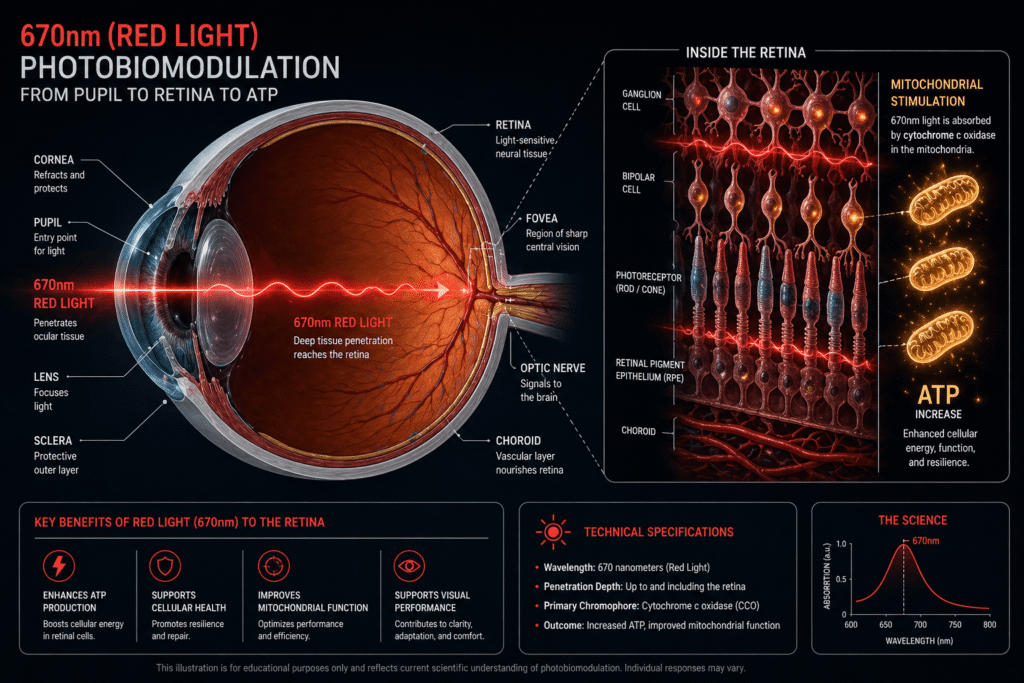
Unlike the harmful energy of blue light, red and near-infrared light provide the thermal and electromagnetic cues required for cellular repair. In 2026, professionals are integrating “Red Light Breaks” into their schedules—typically a three-minute exposure in the morning—to prime the mitochondria for the day’s digital load. This proactive approach ensures that the retinal cells have the energy reserves necessary to handle the high-energy photons emitted by modern LED and OLED screens. The following table illustrates the spectral impact on retinal health:
| Light Spectrum | Wavelength | Biological Impact | Professional Utility |
| High-Energy Blue | 400-450nm | Mitochondrial ROS Production | High Focus / Circadian Signaling |
| Deep Red | 630-670nm | ATP Stimulation / Repair | Recovery & Rejuvenation |
| Near-Infrared | 800-1200nm | Deep Tissue Healing | Anti-inflammatory / Protection |
| Green | 500-550nm | Low Metabolic Stress | Visual Comfort / Reading |
Nutritional Shielding: Carotenoid Density and the Macular Pigment
Beyond light therapy, the 2026 professional utilizes Nutritional Shielding to build an internal filter against digital damage. This centers on the accumulation of three specific carotenoids: Lutein, Zeaxanthin, and Astaxanthin. These pigments concentrate in the macula (the center of the retina), where they act as “internal sunglasses,” absorbing blue light before it can reach the sensitive photoreceptors. High Macular Pigment Optical Density (MPOD) is now a standard biomarker for visual resilience in executive health physicals.
While Lutein and Zeaxanthin provide the primary filter, Astaxanthin has emerged as the “ultimate antioxidant” for the eye due to its unique ability to cross the blood-retinal barrier and neutralize ROS within the mitochondrial membrane itself. In 2026, the “Standard Visual Supplement” has moved away from basic Vitamin A toward these highly bioavailable carotenoids. For the professional, increasing MPOD through diet and supplementation directly correlates with reduced glare sensitivity and faster recovery times after long sessions of “screen-intensive” work.
Circadian Hygiene for the Visual System: Strategies Beyond Blue Light Filters
The visual system is the primary driver of our Circadian Rhythm. In 2026, we understand that “Circadian Hygiene” is not just about sleeping; it is about the nightly regeneration of Rhodopsin, the light-sensitive protein in our eyes. Chronic digital light exposure at night prevents the full restoration of these proteins, leading to “Visual Hangover” the next morning. To combat this, professionals use Spectral Transitioning—slowly shifting their environment from blue-rich light to amber and eventually total darkness as the evening progresses.
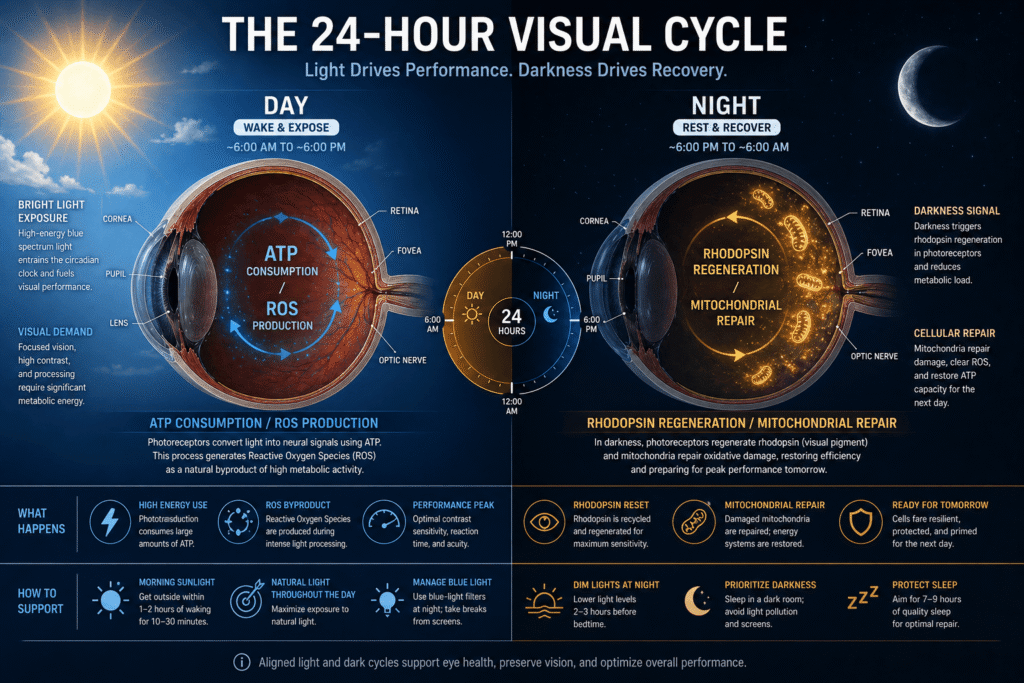
This hygiene protocol also includes the management of the Ciliary Muscle. Staring at a screen at a fixed distance for hours causes this muscle to lock, leading to “Accommodative Spasm.” In 2026, the “20-20-20 Rule” (every 20 minutes, look 20 feet away for 20 seconds) has been upgraded to include Focus Sweeps, where the professional spends 2 minutes focusing on various distances to ensure muscular elasticity. This mechanical recovery is just as vital as the chemical recovery happening at the mitochondrial level. To maintain peak visual performance, follow the Daily Visual Recovery Protocol:
- Morning Red Light (670nm): 3 minutes of low-intensity red light exposure to prime retinal ATP.
- The 20-20-20+ Rule: Supplement every 20 minutes of screen time with a “Focus Sweep” at varying distances.
- Carotenoid Loading: Ensure daily intake of 10mg Lutein and 4mg Astaxanthin for internal blue light filtering.
- Ambient Contrast Matching: Ensure your workspace lighting is at least 50% of the brightness of your screen to reduce pupil strain.
- Total Darkness “Blackout”: Ensure 100% darkness during sleep to allow for maximum Rhodopsin and mitochondrial repair.
FAQ: Ocular Longevity and Digital Performance
Is it true that “Blue Light Glasses” are becoming obsolete in 2026?
Passive blue light glasses are not obsolete, but they are now viewed as an entry-level solution. In 2026, the focus has shifted to “Spectral Management.” Instead of just blocking blue light, which can negatively impact mood and alertness during the day, professionals use Smart Filters that only block the most harmful 415-455nm range while allowing “healthy” blue-turquoise light to pass through. The emphasis is now on active mitochondrial repair rather than just passive shielding.
How can I tell if my Contrast Sensitivity is declining due to digital strain?
Early signs of declining Contrast Sensitivity include needing more light to read comfortably, difficulty seeing objects clearly at twilight, and experiencing “ghosting” or halo effects around text on a screen. In 2026, many professionals use Digital Acuity Apps once a month to perform a “Contrast Audit.” If your score drops, it is a leading indicator that your retinal mitochondria are in a state of chronic stress and require a “Spectral Reset.”
Does “Dark Mode” on my computer actually help reduce retinal mitochondrial stress?
“Dark Mode” is a dual-edged sword. While it reduces the total photon load on the retina, which can preserve ATP, it also causes the pupil to dilate more. A dilated pupil allows more light to hit the peripheral retina, which may increase strain if the surrounding room is bright. The 2026 technical consensus is to use Dark Mode only in low-ambient light settings and to prioritize “High-Contrast Light Mode” in bright offices to keep the pupil constricted and focused.
Can “Eye Yoga” or specific exercises actually improve my vision in 2026?
While “Eye Yoga” won’t change your refractive error (like myopia), specific Accommodative Exercises are scientifically proven to reduce ciliary muscle fatigue. In 2026, we differentiate between “visual exercises” (muscular) and “mitochondrial recovery” (biochemical). You need both: exercises to keep the physical lens-moving muscles elastic, and spectral therapy to keep the retinal cells energized.
About the Author

Vinícius Andrade writes about the practical side of personal growth — employee benefits, career moves, personal finance, and everyday wellbeing. He turns dense rules and jargon into steps anyone can act on, so readers spend less time decoding fine print and more time making decisions that actually improve their lives.
