

The shift toward skills-based hiring has reached its technical maturity in 2026, fundamentally altering how professional value is calculated and exchanged. The traditional university degree, once the primary signal of competence, has been relegated to a “baseline credential”—a floor that proves general persistence but fails to capture the specific, high-velocity skills required in a modern tech-driven economy. In its place, the Skill Graph has emerged as the definitive architectural framework for career progression. This multi-dimensional map links discrete abilities to real-world outcomes, allowing for a quantifiable competency ledger that provides employers with high-fidelity proof of a candidate’s immediate utility.
This evolution is powered by the decomposition of monolithic job titles into atomic competencies. In 2026, being a “Marketing Director” is less relevant than possessing a verified skill graph that includes “LLM Fine-Tuning for Ad Copy,” “Zero-Party Data Architecture,” and “Cross-Platform Attribution Modeling.” For the professional, this necessitates a move away from passive career management toward active skill engineering. By treating one’s career as a dynamic portfolio of verified assets, individuals can pivot between industries with surgical precision, leveraging their most valuable “nodes” to enter new markets without the need for total retraining.
The technical infrastructure of 2026 talent markets relies on the interoperability of these skill graphs. Professional data is no longer siloed within a single platform like LinkedIn; instead, it exists as a decentralized ledger of evidence-based achievements. This transparency forces a higher level of accountability, as “skill inflation” (the tendency to exaggerate abilities) is easily detected by AI-driven verification engines. Consequently, the most successful career paths in 2026 are those built on a foundation of radical technical truth, where every claimed ability is backed by a digital trail of code, strategic documents, or peer-reviewed project outcomes.
The Decomposition of Roles into Discrete Micro-Competencies
The primary driver of the skills-first revolution is the granularity of work. As organizations move toward “agile project teaming,” they no longer hire for a role; they hire for a specific set of micro-competencies required to solve a particular problem. This decomposition allows firms to assemble “hyper-specialized” squads with unprecedented speed. For the worker, this means that their marketability is defined by the breadth and depth of their skill nodes. In 2026, the most resilient professionals are those who maintain a “T-shaped” skill graph: a broad base of foundational knowledge across many domains, with deep, specialized expertise in a few high-demand technical areas.
Managing this complexity requires the use of Skill Mapping Software, which visualizes the connections between disparate abilities. For example, a professional might discover that their expertise in “Data Visualization” is the perfect bridge to “Predictive Analytics,” creating a new pathway for career growth. This semantic mapping of skills allows individuals to identify “high-leverage learning opportunities”—skills that, once acquired, unlock a disproportionate number of new job opportunities. This data-driven approach to upskilling replaces the “spray and pray” method of traditional continuing education.
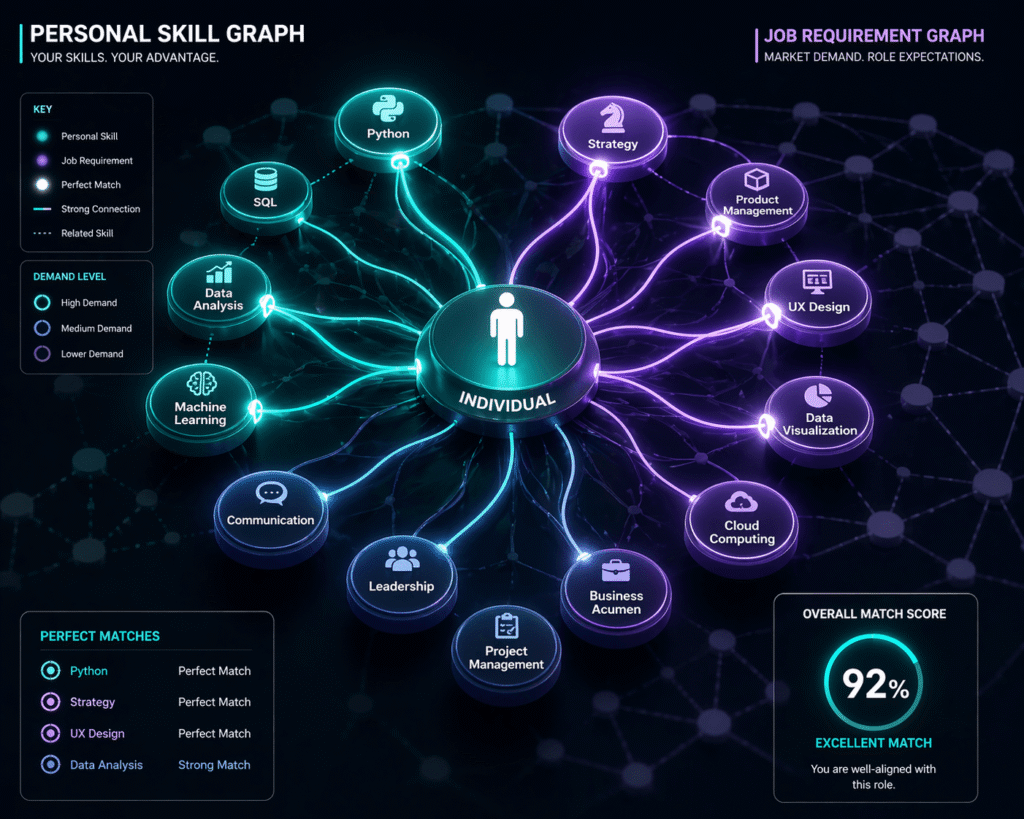
The fundamental unit of value in the 2026 labor market is the Verified Skill Node, a discrete unit of competence that has been tested, applied, and validated through real-world telemetry rather than academic theory.
Furthermore, the rise of Fractional Work has accelerated this decomposition. When a company hires a fractional executive for 10 hours a week, they aren’t looking for a “leader”; they are looking for a specific skill set, such as “Series B Capital Structuring” or “International Supply Chain Optimization.” This trend places a premium on clarity and specificity. If your professional profile still relies on vague adjectives like “hardworking” or “innovative,” you are effectively invisible to the algorithmic sourcing tools that dominate the 2026 recruitment landscape.
Validation Engines: Beyond Peer Endorsements to Evidence-Based Proof
In the early 2020s, skill validation was largely social, relying on “endorsements” from colleagues. In 2026, this has been replaced by automated validation engines. These AI systems analyze a professional’s actual work output—reviewing GitHub repositories, Figma files, or architectural blueprints—to verify that the individual actually possesses the skills they claim. This telemetry-based validation eliminates the “noise” of social endorsements and provides a “Proof of Competency” score that is far more reliable for hiring managers.
To understand the magnitude of this shift, consider the following technical comparison of how skills are proven in the 2026 environment:
| Validation Layer | 2020 Methodology (Legacy) | 2026 Methodology (Modern) | Technical Credibility |
| Technical Skill | Mentioned in Resume | Automated Code/Output Audit | High (Verified) |
| Soft Skills | Interview Performance | NLP Analysis of Team Comms | Moderate (Behavioral) |
| Experience | Years in Job Title | Verified Milestone Completion | High (Outcome-Based) |
| Education | University Diploma | Cumulative Evidence Portfolio | Variable (Skills-First) |
The integration of Blockchain and Self-Sovereign Identity (SSI) allows these validations to be permanent and portable. Once an AI engine validates your proficiency in “Cloud Security Architecture,” that validation is “signed” and added to your Digital Competency Ledger. You own this data, and you can present it to any prospective employer as an immutable proof of your expertise. This shift from “employer-owned” to “worker-owned” data is a cornerstone of professional sovereignty in 2026.
Finally, these validation engines are increasingly used for internal mobility. Companies now use “Skill Inventory Audits” to identify hidden talents within their own workforce. If the system detects that a junior accountant has been teaching themselves “Python for Data Science” through side projects, it can automatically flag them for a transition into the analytics department. This proactive talent discovery reduces recruitment costs for the firm and provides employees with a clear, data-driven path to advancement.
The Interoperability of Professional Credentials and Digital Badging
The proliferation of online courses and bootcamps created a “fragmentation crisis” in the early 2020s, where it was difficult to compare the value of different certificates. In 2026, the industry has standardized around Interoperable Digital Badges. These are not just images; they are metadata-rich containers that include the specific syllabus, the assessment criteria, and the student’s actual performance data. When you add a badge to your skill graph, the system automatically understands where that skill fits into the broader Competency Taxonomy.
This interoperability allows for the creation of “Skill Stacks.” A professional can combine a badge in “Ethical AI” from one provider with a “Neural Network Architecture” badge from another to create a unique, high-value credential that is greater than the sum of its parts. This modular education model allows workers to respond to market changes in weeks rather than years. In 2026, the “half-life” of a technical skill is shorter than ever, making the ability to rapidly stack new credentials a vital survival trait.
Moreover, the Credentialing Ecosystem now includes “Micro-Internships” and “Simulated Work Environments.” These platforms provide a space for professionals to prove their skills on real-world tasks provided by companies. Successfully completing a “Micro-Challenge” for a firm like Google or Amazon results in a verified badge that carries significant weight in the talent marketplace. This allows candidates from non-traditional backgrounds to bypass the “elite university” filter and prove their worth through direct, measurable performance.
Architecting a High-Signal Portfolio for Algorithmic Sourcing
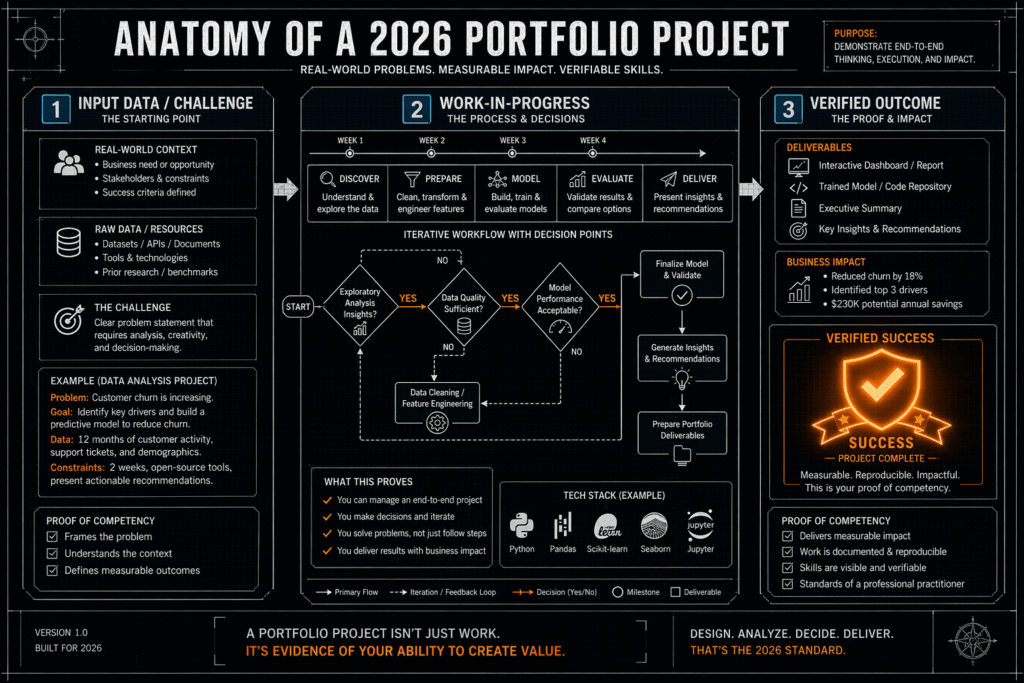
In 2026, the Portfolio is the central artifact of a professional’s career. However, a modern portfolio is not just a gallery of past work; it is a high-signal data source designed to be read by both humans and AI. To be effective, a portfolio must provide “Machine-Readable Proof,” utilizing structured data and clear “outcome metrics” for every project. If an AI recruiter cannot easily extract the “What, How, and Result” from your portfolio, your chances of being shortlisted drop significantly.
A high-signal project in 2026 is defined by its Technical Density. This means providing more than just a final product; you must show the “Work-in-Progress” (WIP) data—the iterations, the failures, and the decision-making logic that led to the final result. This “behind-the-scenes” look is what provides the E-E-A-T (Experience, Expertise, Authoritativeness, and Trustworthiness) that modern employers crave. It proves that you didn’t just “get lucky” or use an AI to generate the final result without understanding the underlying principles.
To ensure your portfolio is optimized for the 2026 landscape, utilize the following Proof of Competency Checklist:
- Quantified Outcomes: Every project must include a “Success Metric” (e.g., “Reduced latency by 15%” or “Increased conversion by $2.4M”).
- Technical Stack Transparency: Explicitly list every tool, language, and framework used in the execution.
- Peer/Expert Validation: Include links to public code reviews, pull requests, or third-party audits of your work.
- Iterative History: Show the versioning of the project to demonstrate your problem-solving process over time.
- AI-Summary Ready: Provide a concise, structured summary of each project that an LLM can easily parse for a recruitment report.
The shift to a Portfolio-First mindset requires a continuous commitment to “Building in Public.” In 2026, the most successful professionals treat their portfolio as a living document, updating it with small “skill sprints” and project updates every few weeks. This consistent signal generation ensures that their skill graph remains fresh and that they are always visible to the “always-on” algorithmic sourcing tools that dominate the executive and technical search industries.
FAQ: Skills-Based Hiring and Professional Verification
How do “Skill-Based Assessments” in 2026 avoid the bias issues common in early AI hiring tools?
Modern assessments use Blind Skill Testing, where the candidate’s demographic data is completely decoupled from their technical performance data. Furthermore, the algorithms are now required to undergo “Bias Audits” to ensure they are not inadvertently penalizing certain neurodivergent work patterns or non-standard educational paths. By focusing purely on the telemetry of the work sample, the 2026 system provides a much fairer and more objective evaluation of talent than the subjective “culture fit” interviews of the past.
Can I “back-fill” my Skill Graph with experience from decades ago that wasn’t digitally tracked?
Yes, but it requires Retroactive Verification. This involves finding “Third-Party Attestors”—former colleagues or managers—who can digitally sign a “Competency Affidavit” on the blockchain. While not as “high-signal” as real-time telemetry data, these verified testimonials can provide a “Foundation Layer” for your skill graph. However, to remain competitive in 2026, it is highly recommended to “refresh” those old skills with a modern Micro-Project that produces fresh, machine-readable evidence.
What is the legal status of “Portfolio Data” if a project was done under a strict Non-Disclosure Agreement (NDA)?
This is a critical “edge case” in 2026. Professionals utilize “Obfuscated Case Studies,” where the sensitive proprietary data is removed or altered, but the technical challenges and the worker’s specific contributions remain clear. Several legal frameworks now support “Safe Harbor for Portfolio Work,” provided the individual does not reveal trade secrets. Additionally, the use of Zero-Knowledge Proofs allows a professional to prove they achieved a certain result (e.g., “Managed a $100M budget”) without revealing the specific company or financial details.
If the “Degree is the Floor,” is there still a reason to pursue higher education in 2026?
Higher education has pivoted toward Deep Theoretical Research and “meta-skills” like “Critical Thinking” and “Complex Systems Design.” While a degree may no longer be the primary way to get a job in software engineering or marketing, it remains the gold standard for roles that require long-term, multi-disciplinary thinking (e.g., Bio-Ethics or Quantum Policy). The 2026 consensus is that degrees provide the context, while skill graphs provide the execution.
About the Author

Vinícius Andrade writes about the practical side of personal growth — employee benefits, career moves, personal finance, and everyday wellbeing. He turns dense rules and jargon into steps anyone can act on, so readers spend less time decoding fine print and more time making decisions that actually improve their lives.
