

The traditional model of executive leadership—characterized by a singular, 60-hour-a-week commitment to one organization—has undergone a radical decomposition in 2026. In its place, the Fractal Leadership model has emerged, allowing high-tier talent to deploy their expertise across multiple companies simultaneously. This shift is not merely a move toward “high-end consulting”; it is a structural evolution where the executive operates as a multi-tenant resource, providing strategic “bursts” of leadership that scale with the organization’s specific lifecycle needs. For the professional, this era represents the pinnacle of executive sovereignty, decoupling high-value decision-making from the traditional constraints of a single-payroll hierarchy.
The technical viability of the multi-tenant executive in 2026 relies on a sophisticated “fractal” approach to organizational governance. Instead of managing people and processes through constant physical presence, these leaders utilize asynchronous governance frameworks and AI-augmented decision support. This allows an executive to maintain a “high-fidelity” presence in three or four companies at once, focusing exclusively on high-leverage activities such as capital allocation, strategic pivoting, and top-tier talent acquisition. By stripping away the administrative “noise” of traditional management, fractal leaders can deliver a disproportionate impact, essentially “downloading” their expertise into the company’s operational marrow.
Success in this parallelized career path requires a rigorous commitment to operational modularity. A fractal leader must be able to “plug into” a company’s existing data stream, provide the necessary strategic direction, and “unplug” without causing a vacuum in the daily workflow. This requires the organization to have reached a certain level of digital maturity, where key performance indicators (KPIs) and decision-making logs are transparent and machine-readable. In 2026, the market value of a fractional executive is determined by their “interoperability”—how quickly and effectively they can harmonize their leadership style with diverse corporate cultures and technical stacks.
Context Switching vs. Context Stacking: Cognitive Infrastructure for Fractional Roles
The primary barrier to multi-tenant leadership has historically been the “tax” of context switching, where the mental energy required to jump between different companies leads to cognitive fatigue and degraded decision quality. In 2026, however, elite fractional executives have mastered Context Stacking. This technique involves organizing multiple roles into “thematic clusters” where the strategic challenges are similar, even if the industries are different. By stacking roles that share a similar “strategic archetype”—such as “Scale-up Crisis Management” or “AI Transformation”—the executive can maintain a consistent mental framework, reducing the drag of constant re-orientation.

The primary barrier to multi-tenant leadership has historically been the “tax” of context switching, where the mental energy required to jump between different companies leads to cognitive fatigue and degraded decision quality. In 2026, however, elite fractional executives have mastered Context Stacking. This technique involves organizing multiple roles into “thematic clusters” where the strategic challenges are similar, even if the industries are different. By stacking roles that share a similar “strategic archetype”—such as “Scale-up Crisis Management” or “AI Transformation”—the executive can maintain a consistent mental framework, reducing the drag of constant re-orientation.
Supporting this cognitive stack is a new generation of Executive OS (Operating Systems). these are private, AI-powered dashboards that aggregate data from all the executive’s different “tenants” into a single, unified interface. These systems use Generative AI to summarize the most critical events from each company’s Slack, Jira, and financial portals, providing a “high-level situational awareness” that would be impossible to maintain manually. This technical infrastructure allows the executive to stay “always-on” in a strategic sense, while remaining “selectively-present” in an operational sense.
The transition from context switching to context stacking is the fundamental shift that enables a leader to scale their impact across multiple P&Ls without sacrificing the intellectual depth required for executive excellence.
Furthermore, the “fractal” nature of this leadership means that the executive’s influence is distributed through delegated protocols rather than direct supervision. In 2026, the most effective fractional leaders are masters of “architectural leadership,” where they design the systems and incentives that guide the team’s behavior in their absence. This requires a high degree of trust and a robust internal talent marketplace that can execute on the executive’s high-level directives without needing constant course correction.
The Fractional Tech Stack: AI Orchestration for Cross-Company Governance
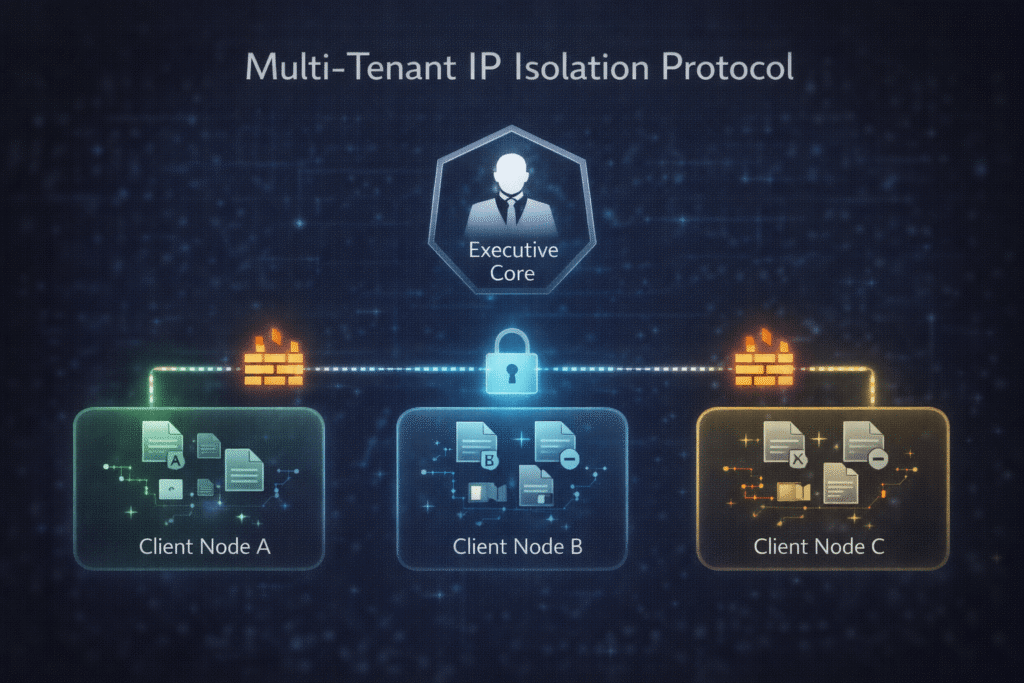
Operating as a multi-tenant leader requires a specialized technical stack that ensures data security and cross-company governance. In 2026, this stack is built on a foundation of Zero-Trust Architecture, ensuring that the data from “Company A” never contaminates the environment of “Company B.” Fractional executives utilize hardware-level isolation (such as secure enclaves or separate virtual machines) to manage their various roles, preventing even the possibility of accidental intellectual property leakage. This technical rigor is a prerequisite for high-level fractional roles, where the conflict-of-interest risks are naturally higher.
Governance in the fractional era is also increasingly algorithmic. Executives use “Smart Contracts” to define their engagement terms, where payments and equity vesting are automatically triggered by the achievement of specific, verifiable milestones within the company’s data ecosystem. This reduces the administrative friction of managing multiple contracts and ensures that the executive’s incentives are perfectly aligned with the company’s value creation. The following table illustrates the key governance shifts from traditional to fractional frameworks:
| Governance Metric | Full-Time Executive (Legacy) | Fractional Executive (2026) | Technical Implementation |
| Operational Focus | Broad / Administrative | Targeted / Strategic | Priority-Only Dashboarding |
| Data Access | Unlimited / Flat | Granular / Purpose-Driven | Role-Based Access Control (RBAC) |
| Performance Tracking | Annual Reviews | Real-Time Milestone Triggers | On-Chain KPIs |
| Knowledge Transfer | Tacit / In-Person | Explicit / AI-Codified | Automated Decision Logging |
The “orchestration” layer of the fractional stack involves using Agentic AI to act as a surrogate in lower-stakes meetings and communication loops. These “Executive Agents” are trained on the leader’s specific decision-making history and strategic philosophy, allowing them to provide “initial takes” on routine queries. This allows the human leader to reserve their prefrontal cortex for the highest-value “Black Swan” events and complex negotiations that require nuanced human empathy and ethical judgment.
Equity Modeling and Risk Mitigation in Multi-Vesting Scenarios
One of the most complex technical challenges for the 2026 fractal leader is managing a multi-vesting equity portfolio. Instead of having one large stake in a single company, a fractional executive might have smaller, accelerated vesting schedules across five or six startups. This creates a “diversified executive risk” profile that is much more resilient than the traditional “all-eggs-in-one-basket” approach. However, it requires sophisticated tax and legal modeling to ensure that the total compensation package is optimized for the leader’s long-term wealth goals.
In 2026, the use of Equity Derivative Contracts and “performance-based accelerators” has become common in the fractional space. If a fractional CEO hits a specific growth target in 12 months that was originally projected for 24, their equity “cliffs” are automatically triggered. This ensures that the leader is rewarded for the velocity of their impact rather than their tenure. For the executive, this necessitates a deep understanding of “Capital Table Engineering” to ensure their small, high-impact stakes aren’t diluted by subsequent funding rounds.
Risk mitigation also involves the use of specialized Executive Liability Insurance (D&O) that is specifically tailored for fractional work. Traditional policies often struggle to account for a leader with multiple “active” roles. In 2026, the leading insurers offer “portable” D&O policies that follow the individual executive across all their various engagements, provided those engagements meet certain compliance and auditing standards. This ensures that the leader is protected from the unique legal risks of managing multiple high-stakes corporate environments simultaneously.
Legal Boundaries of IP Contamination and Non-Compete Intersections
The legal framework of 2026 has adapted to support the fractional economy, particularly with the widespread ban on non-compete clauses in most major tech hubs. However, the risk of Intellectual Property (IP) Contamination—where a strategic insight developed for Company A is inadvertently applied to Company B—remains a major legal hurdle. To mitigate this, fractal leaders use “Clean Room” methodologies for their strategic work, maintaining strict digital and mental partitions between their different tenants.
Contracts in this era have evolved from simple employment agreements into complex Multi-Tenant Service Level Agreements (SLAs). These SLAs explicitly define the “Scope of Innovation” for each role, clearly demarcating what constitutes the company’s proprietary IP versus the executive’s own “General Knowledge and Experience.” In a 2026 legal dispute, the primary evidence is the Digital Audit Trail, which shows exactly which files and communications the executive accessed and when.
To ensure total legal and technical compliance, a robust fractional engagement should always include the following Contractual Guardrails:
- Reverse Non-Solicitation: Protecting the executive’s right to work with other non-competing firms simultaneously.
- IP Carve-outs: Explicitly listing pre-existing methodologies and “Executive Tools” that the leader brings with them.
- Accelerated Vesting Triggers: Defining “Change of Control” or “Target Achievement” events that shorten the equity timeline.
- Information Barrier Protocols: Codifying the specific software and hardware isolation techniques the executive will use.
- Mutual Indemnification: Ensuring the executive is protected from liabilities arising from the actions of the company’s full-time staff.
Finally, the “termination” phase of a fractional role is designed to be as modular as the onboarding. In 2026, the “Transition Memorandum” is often a machine-learning model or a structured data repository that contains the executive’s decision-making logic and strategic roadmap. This ensures that the company retains the “Strategic DNA” of the fractal leader even after the official engagement has concluded, making the fractional hire a long-term investment in organizational intelligence rather than a short-term patch.
FAQ: Fractional Leadership and Executive Sovereignty
How do “Multi-Tenant” executives handle the conflict of interest when two of their client companies begin to move into each other’s market space?
This is a “dynamic conflict” scenario that is governed by the Duty of Loyalty and specific “Conflict Triggers” in the SLA. In 2026, if two clients become competitors, the fractal leader is typically required to disclose the conflict immediately and, in many cases, recuse themselves from strategic decisions in the overlapping area. If the conflict is insurmountable, the leader may be required to resign from one role, often triggering a “Fair Exit” clause that protects their accrued equity. The technical defense here is the Audit Log, which proves that the executive did not share trade secrets between the two entities.
What is the impact of “Fractional AI” on the compensation rates for human fractional leaders in 2026?
While AI can handle administrative orchestration, the “Compensation Premium” for human fractal leaders has actually increased. This is because, in an AI-saturated world, the human “Black Box” of judgment—the ability to make high-stakes calls with incomplete data and ethical complexity—is the scarcest resource. Companies are willing to pay a higher “hourly-equivalent” rate for 10 hours of a human “Master Strategist” than they are for 40 hours of a standard manager, essentially paying for the certainty and accountability that only a human executive can provide.
How does a fractional leader manage “Cultural Contamination” between a high-growth startup and a legacy enterprise client?
The key is “Framework Isolation.” A fractal leader does not try to apply the same culture to every company. Instead, they act as a “Cultural Translator,” using different leadership archetypes for different tenants. Technically, this is managed through the leader’s “Client Briefing Files,” which include “Cultural Guardrails” (e.g., “Company A values radical transparency; Company B values hierarchical consensus”). By reviewing these “Cultural Profiles” before every meeting, the leader ensures they are operating within the specific social fabric of the tenant they are currently serving.
Can a fractional executive be held personally liable for a data breach at one of their client companies?
Liability typically follows the Level of Control. If a fractional CTO designed the faulty security architecture, they could face professional liability. However, most 2026 fractional contracts include “Limitation of Liability” clauses that cap the executive’s personal exposure, provided they weren’t grossly negligent. Furthermore, the use of a “Fractional D&O” policy provides a crucial secondary layer of protection, ensuring that the executive isn’t bankrupted by a systemic failure at a company where they only worked a few hours a week.
About the Author

Vinícius Andrade writes about the practical side of personal growth — employee benefits, career moves, personal finance, and everyday wellbeing. He turns dense rules and jargon into steps anyone can act on, so readers spend less time decoding fine print and more time making decisions that actually improve their lives.
