

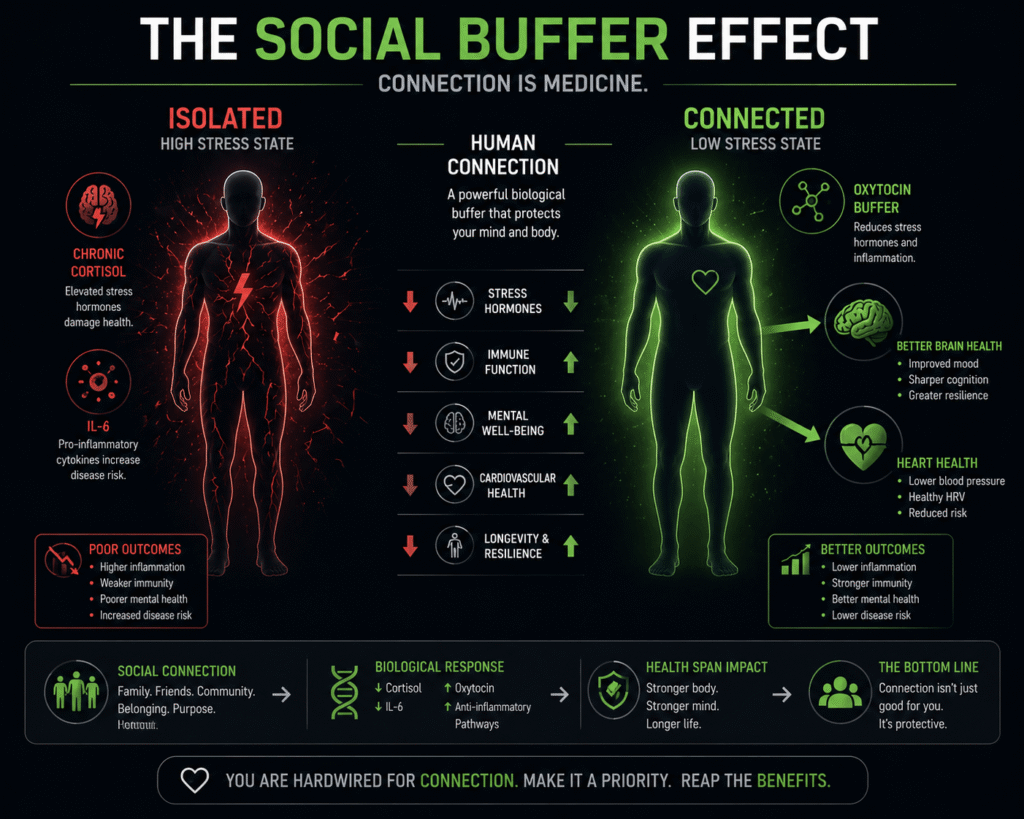
In 2026, we have finally quantified the “Loneliness Tax.” Clinical data now proves that chronic social isolation is as biologically damaging as smoking 15 cigarettes a day, leading to the rise of “Social Prescribing” as a standard medical intervention for inflammatory and cardiovascular health.

In the wellness landscape of 2026, the concept of “longevity” has expanded beyond the individual to encompass the Collective. For decades, health was treated as a solitary pursuit—measured by personal biometrics, private diets, and individual gym sessions. However, the data of 2026 has officially reclassified social isolation not just as a psychological burden, but as a quantifiable biological toxin. We now understand that a lack of meaningful connection triggers a technical “alarm state” in our evolutionarily ancient nervous systems, accelerating cellular aging as aggressively as a high-sugar diet or chronic physical inactivity.
This biological imperative stems from our history as social primates. In 2026, we recognize that our bodies treat social isolation as a survival threat. When we feel disconnected, the brain activates the Conserved Transcriptional Response to Adversity (CTRA)—a specific genetic program that upregulates pro-inflammatory genes while downregulating those responsible for antiviral defense. For the 2026 professional, “Social Health” is no longer a soft metric; it is a critical vital sign that dictates the efficiency of the immune system and the rate of biological decay.
As we navigate the hyper-digital environment of 2026, the goal has shifted toward Collective Resilience. We are learning that longevity is “contagious”—when we exist within high-quality social nodes, our nervous systems enter a state of co-regulation that buffers us against the allostatic load of modern life. In this new paradigm, being “fit” technically includes the depth and stability of your community, as your biology is inextricably linked to the health of those around you.
In 2026, we have moved past the myth of the “Self-Made Man.” We now recognize that social connection is the software that regulates our biological hardware. Without a community to synchronize with, our systems eventually desynchronize into chronic disease.
The Oxytocin Buffer: Cardio and Neuroprotection
The primary chemical driver of collective longevity in 2026 is Oxytocin, often referred to as the “cuddle hormone” but technically recognized as a potent cardioprotective and neuroprotective agent. When we engage in high-quality social interactions—characterized by eye contact, shared rhythm, or physical touch—the hypothalamus releases oxytocin, which acts as a systemic anti-inflammatory. In 2026, we use social connection to technically “dampen” the damage caused by cortisol and other stress-related hormones.
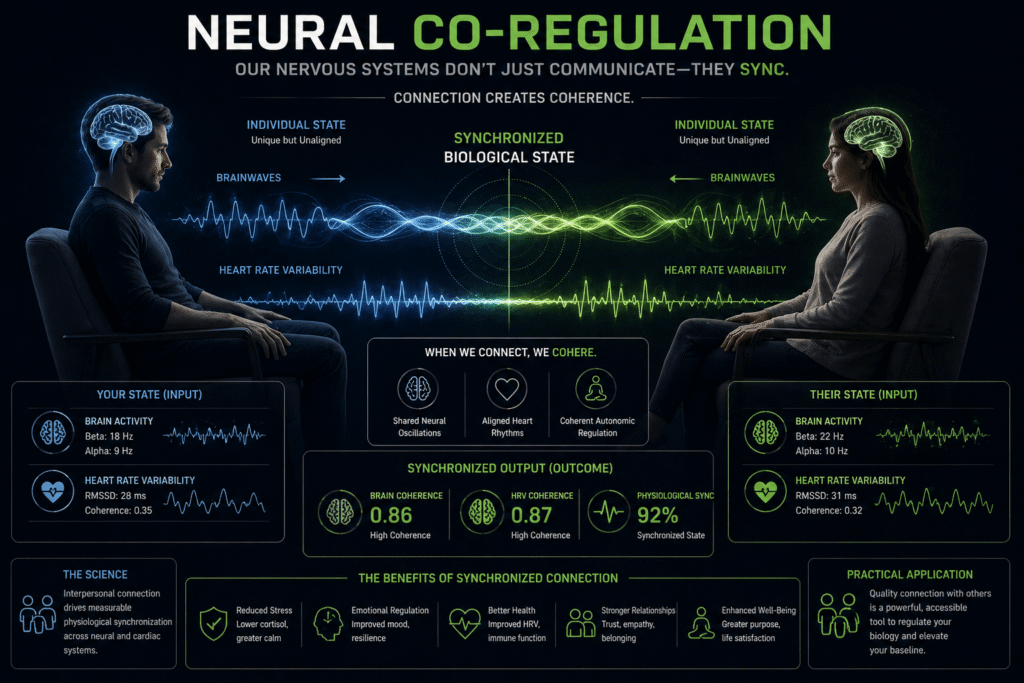
This hormonal release initiates a process of Neural Co-regulation, where the heart rates and brainwaves of individuals in a group begin to synchronize. This synchronization technically lowers the systemic energy cost of maintaining homeostasis. Instead of each individual fighting stress alone, the group shares the load, allowing everyone’s nervous system to recover faster. The biological benefits of this social co-regulation in 2026 include:
- Stabilization of Heart Rate Variability (HRV): Direct interaction with trusted peers improves the body’s ability to switch between stress and rest states.
- Reduction of Interleukin-6 (IL-6): Socially integrated individuals show lower levels of this key pro-inflammatory marker.
- Increase in Tonic Dopamine: Consistent social support provides a steady “floor” of dopamine, reducing the drive for addictive, high-spike behaviors.
- Vagus Nerve Modulation: Social safety signals technically activate the ventral vagal complex, promoting a “Rest and Digest” state.
Social Fitness: Engineering Your Community in 2026
By 2026, the term “networking” has been technically retired in favor of Social Fitness. This is the engineering of a community designed for biological resilience rather than just professional gain. We now treat social fitness with the same rigor as physical training, recognizing that our “Social Infrastructure” requires deliberate maintenance. In 2026, high-performing individuals audit their social circles to ensure they have the necessary “Bio-Sync Nodes” to sustain long-term performance. The 2026 standard for Social Fitness is built on three technical pillars:
- Interaction Frequency: Consistent “low-stakes” interactions (the “Weak Ties”) that maintain the feeling of systemic belonging.
- Vulnerability Depth: High-stakes “core nodes” where deep emotional transparency allows for true neural co-regulation and oxytocin surges.
- Motor Synchrony: Engaging in group activities that require rhythmic alignment—such as group exercise or shared music—which technically forces the nervous systems to synchronize at scale.
This engineered community acts as a Biological Buffer, ensuring that when one individual experiences a stress event, the “Collective” provides the necessary stability to prevent a total systemic collapse. In 2026, your community is your most effective defense against the accelerated aging driven by the “Loneliness Epidemic” of the previous decade.
The 2026 Standard: Social Health in the Workplace and Home
The integration of social health into the 2026 workplace has fundamentally changed how we view “productivity.” Companies now measure Collective Burnout by tracking the social cohesion of their teams. A high-performing team in 2026 is not just one that hits its KPIs, but one where the members are technically co-regulated. This has led to the design of offices and remote protocols that prioritize “Synchronous Presence” over isolated task management.
In the home, 2026 spatial design emphasizes “Interaction Pockets” that facilitate face-to-face contact. We have realized that the architecture of our living and working spaces must technically support the biology of belonging if we hope to maintain healthspan in a hyper-connected but often socially hollow digital world.
| Feature | Social Isolation (Biological Cost) | Collective Longevity (Biological Gain) |
| Gene Expression | Upregulated CTRA (Inflammatory) | Antiviral / Defensive Upregulation |
| Cortisol Levels | Chronic Elevation (Systemic Wear) | Pulsed / Regulated Output |
| Immune Profile | High IL-6 / High Oxidative Stress | Low Systemic Inflammation |
| Brain Health | Accelerated Gray Matter Loss | Enhanced Neural Plasticity |
| Longevity Impact | Equivalent to smoking 15 cigarettes/day | Primary Multiplier of Healthspan |
FAQ: Mastering Your Social Infrastructure
Do digital connections count as “social health” in 2026?
Only partially. While digital tools facilitate information exchange, they often lack the technical cues—eye contact, pheromonal exchange, and sub-second vocal timing—needed to trigger Neural Co-regulation. In 2026, we view digital social life as “social supplements” rather than the “whole food” of face-to-face interaction.
How does social isolation impact my biological age?
Socially isolated individuals in 2026 often show a Biological Age (measured via epigenetic clocks) that is 3 to 5 years older than their chronological age. The chronic “alarm state” caused by loneliness technically accelerates the shortening of telomeres and the methylation of aging genes.
How can introverts optimize their social health in 2026?
Social fitness for introverts is not about quantity but quality. In 2026, introverts are advised to focus on “Deep Nodes”—two or three relationships that offer high-fidelity co-regulation—rather than a broad network. This technically fulfills the biological requirement for belonging without the cognitive exhaustion of over-stimulation.
What is the role of pets in oxytocin production?
Pets are a significant “Bio-Hack” for social health. In 2026, we recognize that inter-species connection can technically trigger oxytocin release and lower cortisol. While they cannot replace human co-regulation, they act as powerful Parasympathetic Stabilizers, especially for those living in high-density urban environments.
Is there a link between social connection and disease recovery?
Yes. Technical data from 2025 and 2026 shows that patients with high “Social Support Scores” recover from surgery and major illnesses up to 25% faster. The social buffer technically reduces the metabolic cost of repair, allowing the body to redirect energy toward healing rather than stress management.
How do I “audit” my social circle for longevity?
A 2026 social audit focuses on Reciprocal Co-regulation. Ask yourself: Does this person leave my nervous system feeling “settled” or “agitated”? If the majority of your interactions are “agitative,” you are technically accumulating a social debt that will manifest as physical wear and tear over time.
About the Author

Vinícius Andrade writes about the practical side of personal growth — employee benefits, career moves, personal finance, and everyday wellbeing. He turns dense rules and jargon into steps anyone can act on, so readers spend less time decoding fine print and more time making decisions that actually improve their lives.
