

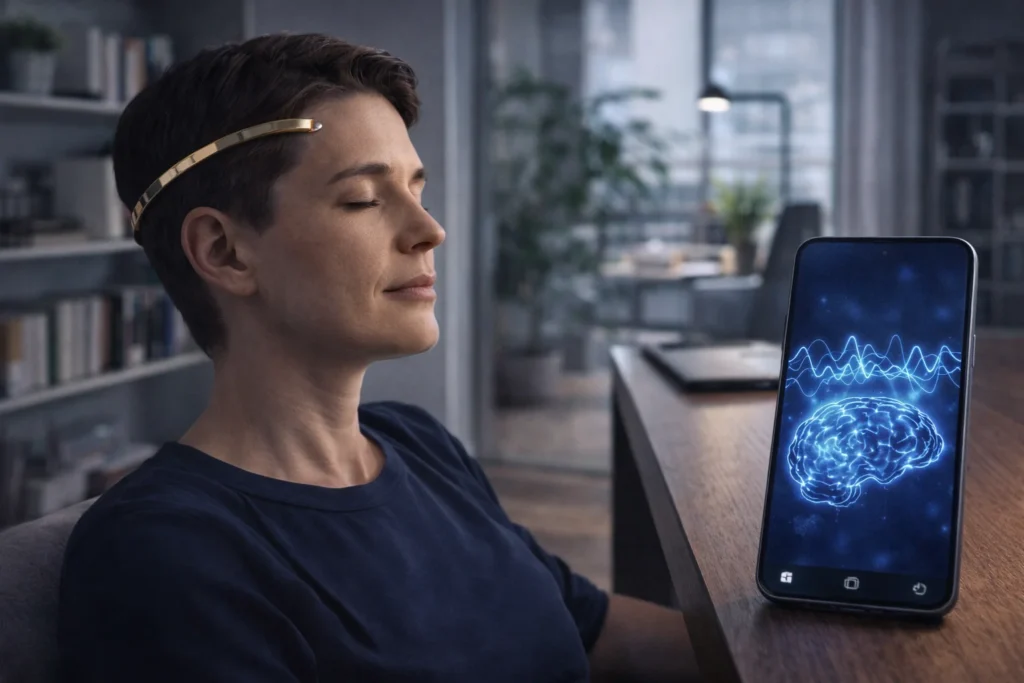
The wellness landscape of 2026 has officially transitioned from the era of “passive monitoring” to “active neural tuning.” For years, consumers were content with wearables that simply told them how poorly they slept or how stressed they were. In 2026, the market has pivoted toward interventive neuro-technology, where high-fidelity EEG (Electroencephalography) and Vagus Nerve Stimulation (VNS) devices allow individuals to modify their physiological and cognitive states in real-time. We are no longer just tracking the signal; we are engineering the response.
This shift is headlined by the maturation of dry-sensor EEG technology. In 2026, the cumbersome “wet” electrodes of the past have been replaced by graphene-based dry sensors integrated into stylish headbands and earbud forms. These devices utilize on-device AI to identify specific neural signatures—such as the Theta-Alpha bridge—required for deep “Flow State” immersion. For the 2026 professional, entering a high-output cognitive state is no longer a matter of luck or ritual, but a technical protocol facilitated by real-time neural feedback.
The normalization of these tools has created a new standard for cognitive maintenance. By 2026, “Brain Training” has evolved from simple logic games to Closed-Loop Neuro-Modulation. These systems monitor your brainwaves and, upon detecting signs of cognitive fatigue or “attentional drift,” provide subtle haptic or auditory cues to nudge the brain back into a target frequency. This level of technical intimacy with our own biology is redefining what it means to be a “high-performer” in the modern economy.
In 2026, the brain is no longer a “black box” of mysterious output; it is a tunable engine where focus, recovery, and flow are technical variables we can adjust in real-time.
Vagus Nerve Stimulation (VNS): The Technical Bypass for Stress
While EEG manages the central nervous system, Transcutaneous Vagus Nerve Stimulation (tVNS) has emerged as the 2026 standard for controlling the peripheral nervous system. By delivering micro-pulses of electricity to the auricular (ear) or cervical (neck) branches of the vagus nerve, these devices act as a “technical bypass” for the stress response. In 2026, a 10-minute VNS session is the biological equivalent of a deep meditation, forcing the body to transition from “Fight or Flight” to “Rest and Digest” by instantly elevating parasympathetic tone.
The technical efficacy of VNS in 2026 is measured by the Parasympathetic Effectiveness Index (Pe), which tracks the change in heart rate variability (HRV) relative to the stimulation intensity. The formula used to quantify this recovery velocity is:

By monitoring this index, 2026 users can determine the precise “Minimum Effective Dose” required to clear systemic cortisol. This has made VNS an essential tool for Allostatic Load Management, allowing individuals to “reset” their nervous system after high-cortisol events like public speaking or intense physical training. Unlike pharmacological solutions, VNS provides a non-invasive, electrical intervention with near-zero metabolic lag.
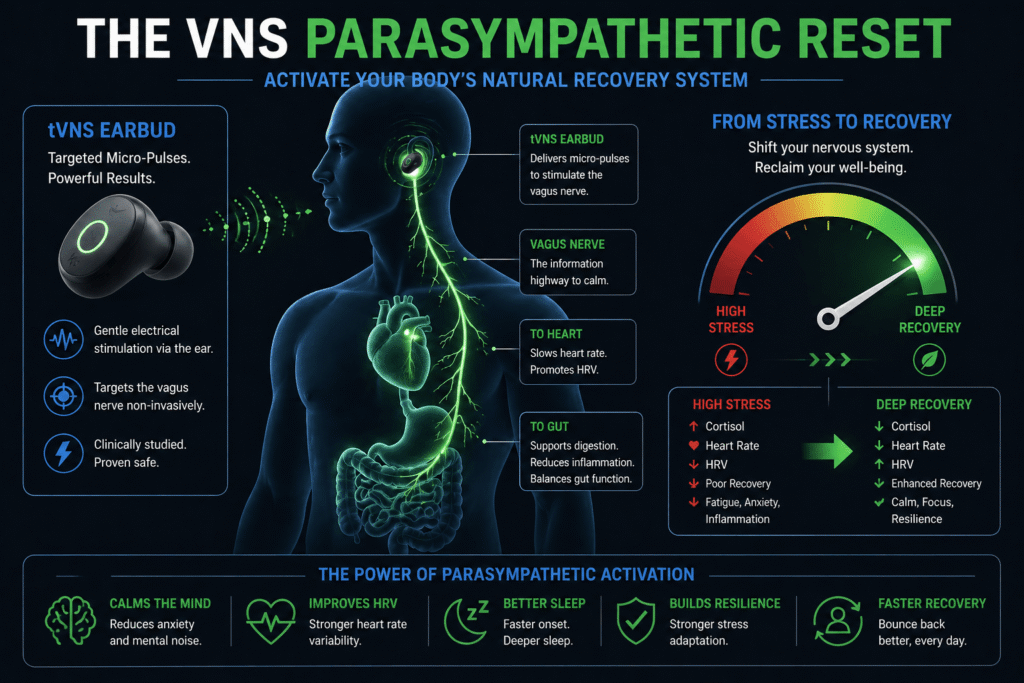
Beyond stress reduction, 2026 research has solidified the role of the vagus nerve in modulating neurogenic inflammation. By activating the “Cholinergic Anti-Inflammatory Pathway,” consumer VNS devices are now used to manage the systemic inflammation that drives brain fog and physical fatigue. This has moved VNS out of the “biohacker” niche and into the mainstream wellness kit for anyone dealing with the high-stress demands of the 2026 work environment.
Neural Privacy and the Ethics of the “Digital Brain”
As our brains become increasingly connected to consumer devices, the technical challenge of Neural Privacy has moved to the forefront. In 2026, your “Neural Signature”—the unique way your brain responds to stimuli—is as identifying as a fingerprint. This has led to the rise of Neuro-Rights legislation, mandating that brainwave data must be processed and encrypted “on-device.” In 2026, a secure neuro-wearable must technically ensure that raw EEG data is never uploaded to the cloud, protecting the user from “Cognitive Profiling” by third-party advertisers.
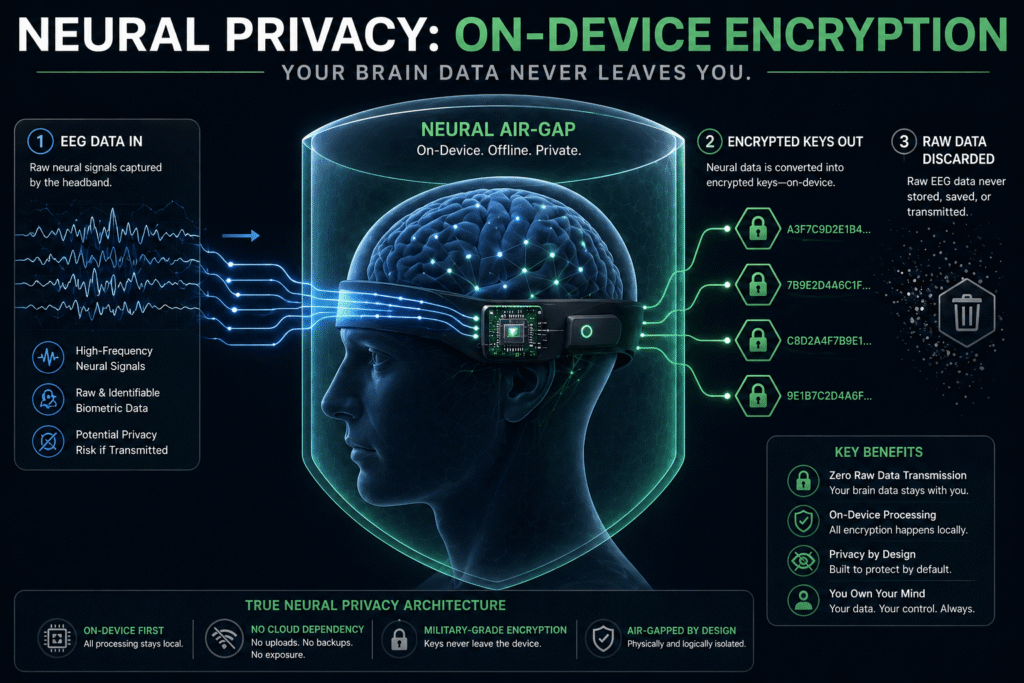
This ethical shift has transformed the architecture of 2026 wellness apps. Most premium platforms now utilize Edge Computing, where the AI model that interprets your neural states lives locally on your headband or earbuds. This “Neural Air-Gapping” ensures that while you get the benefits of neuro-performance tuning, your private emotional and cognitive states remain technically inaccessible to the prying eyes of the broader data economy. In 2026, protecting your “Digital Brain” is considered as vital as protecting your physical health.
FAQ: Mastering the Neuro-Wearable Landscape
What is the difference between clinical EEG and 2026 consumer EEG?
Historically, clinical EEG required conductive gels and hours of setup. In 2026, consumer EEG uses Dry Graphene Sensors that reach 98% of clinical signal-to-noise ratios. While clinical systems are still used for diagnosing pathology, 2026 consumer devices are technically optimized for “Performance Bandwidth”—identifying focus, fatigue, and stress rather than medical disorders.
Can Vagus Nerve Stimulation (VNS) become addictive?
There is no evidence of chemical addiction; however, users can develop a “Recovery Dependency.” In 2026, experts recommend using VNS as a “training wheel” to teach the nervous system how to down-regulate, rather than using it as a permanent crutch. The goal is to eventually achieve high Parasympathetic Effectiveness through natural breathwork, using the device only for “High-Amplitude” stress events.
How do these technologies affect deep sleep?
2026 neuro-wearables use Auditory Pacing (Pink Noise bursts) timed specifically to the “Up-State” of your slow-wave oscillations. This technically increases the amplitude of deep sleep, leading to significantly higher growth hormone release and better glymphatic clearance (brain detox). Many 2026 users report feeling “fully recovered” in only 6 hours of sleep when utilizing active neural pacing.
Is it safe for children to use neuro-wearables in 2026?
The industry standard in 2026 suggests caution for those under 18 due to the high rate of Synaptic Pruning in developing brains. While EEG (monitoring) is perfectly safe, active stimulation (like tDCS or VNS) is typically restricted to adults unless prescribed by a specialist for neuro-divergent support or specific learning protocols.
Do these devices integrate with other bio-sensors?
Yes. In 2026, “Multi-Modal Bio-Sync” is the standard. Your EEG headband communicates with your continuous glucose monitor (CGM) and your smart ring. If your brainwaves show high fatigue and your CGM shows a glucose crash, the system will suggest a specific metabolic intervention (e.g., a 15g glucose-fructose snack) to restore your cognitive “Power Band.”
What is the future of Transcranial Direct Current Stimulation (tDCS) in 2026?
tDCS has moved toward High-Definition (HD-tDCS), using smaller, more targeted arrays to stimulate specific regions like the Dorsolateral Prefrontal Cortex (DLPFC) for enhanced working memory. In 2026, this is used primarily by “Knowledge Athletes” for accelerated skill acquisition, though it remains a more “intense” technical intervention than standard VNS or EEG feedback.
About the Author

Vinícius Andrade writes about the practical side of personal growth — employee benefits, career moves, personal finance, and everyday wellbeing. He turns dense rules and jargon into steps anyone can act on, so readers spend less time decoding fine print and more time making decisions that actually improve their lives.
