

The professional and medical landscape of 2026 has witnessed a fundamental shift in the definition of health. For decades, the calendar was the primary arbiter of aging, a static number on a birth certificate that dictated social expectations and medical risk. However, we have officially moved into the era of the Biological Age Standard. In 2026, your chronological age is increasingly viewed as a “legacy metric”—a rough estimate that fails to account for the massive variability in how individuals age at the cellular level.
This transition is driven by the realization that aging is not an inevitable, linear decay, but a technically manageable process. In 2026, elite health performance is no longer measured by the absence of disease, but by the Biological-to-Chronological (B2C) Gap. A 50-year-old with a biological age of 38 is now recognized as structurally younger and more resilient than a 40-year-old with a biological age of 45. This “Age Arbitrage” has become the primary goal of modern wellness, shifting the focus from lifespan (how long you live) to healthspan (how long you remain functional).
The 2026 standard has integrated biological age testing into routine clinical check-ups. What was once the domain of specialized longevity clinics is now the “Fifth Vital Sign” for proactive professionals. By quantifying the state of your organs and systemic health through molecular biomarkers, 2026 medicine can predict disease onset with a level of precision that makes the traditional “annual physical” look like guesswork. We are no longer guessing how we feel; we are measuring how we age.
The Science of the Epigenetic Clock: Methylation Decoded
At the core of this revolution is the Epigenetic Clock, a sophisticated diagnostic tool that analyzes DNA Methylation patterns. In 2026, methylation is understood as the “software” of the genome—a layer of chemical tags that turn genes on or off without changing the underlying DNA sequence. As we age, this software becomes “corrupted” by lifestyle factors and environmental stressors, leading to the cellular dysfunction we recognize as aging. Epigenetic clocks, such as the third-generation DunedinPACE, technically decode these tags to determine your current “Pace of Aging”.
The technical sophistication of these tests in 2026 has reached a tipping point. Modern assays analyze over 900,000 CpG sites (specific regions of DNA where methylation occurs) to provide a high-fidelity map of your biological state. Unlike the first-generation clocks of the early 2010s, which merely estimated chronological age, the 2026 “Speedometer” models can detect short-term changes in aging speed. This allows individuals to see the immediate cellular impact of a new supplement protocol or a shift in their sleep architecture.
Furthermore, the rise of AI-driven multi-omic integration has allowed these clocks to become organ-specific. In 2026, a single blood or saliva sample can provide an “Age Profile” for your heart, liver, and immune system independently. This allows for “Precision Longevity,” where interventions are targeted specifically at the systems showing the highest rate of biological decay. The epigenetic clock is no longer a crystal ball; it is a real-time diagnostic dashboard for the human machine.
The Four Pillars of Bio-Age Optimization
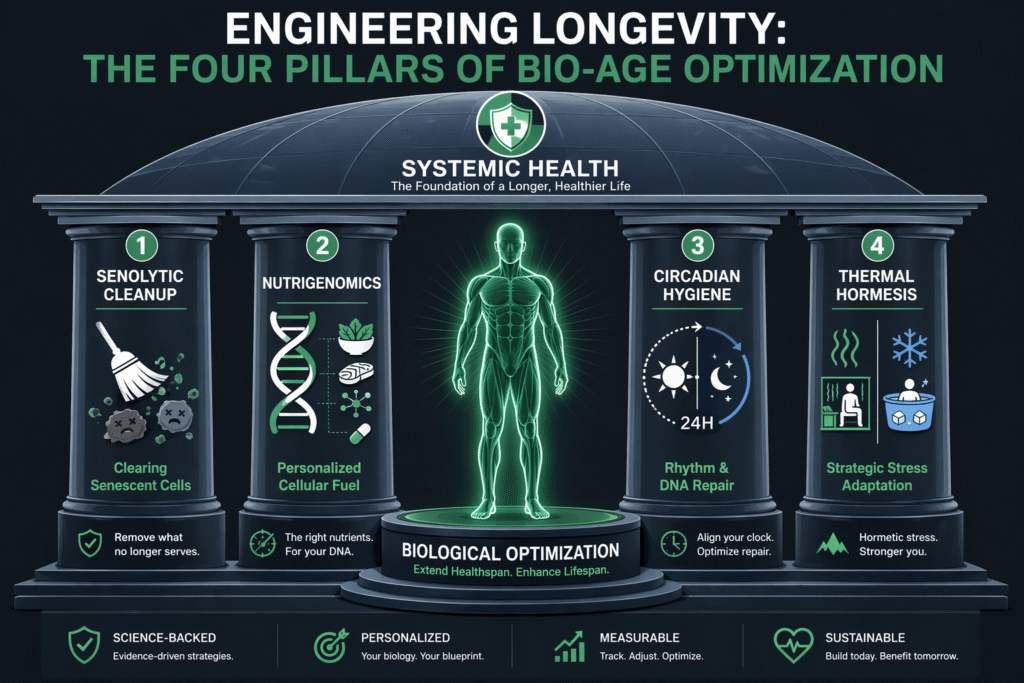
To technicality manage and potentially reverse biological aging in 2026, longevity strategists focus on four scientifically validated pillars. These interventions are designed to clear “cellular debris” and reprogram the epigenetic software to a more youthful state.
- Senolytic Cleanup: Using compounds like Fisetin, Dasatinib, and Quercetin to selectively remove senescent “zombie cells” that drive systemic inflammation.
- Nutrigenomics: Precision nutrition tailored to your genetic expressions, utilizing molecules like NAD+ precursors and Spermidine to enhance cellular repair.
- Circadian Hygiene: Technically optimizing the 24-hour light/dark cycle to align gene expression with natural biological rhythms, critical for DNA repair.
- Thermal Hormesis: Strategic exposure to extreme heat (sauna) and cold (plunge) to trigger protective Heat Shock Proteins and metabolic flexibility.
The Bio-Audit Economy: Insurance and the Corporate Performance Link
The 2026 “Bio-Audit Economy” has moved biological age metrics into the boardroom and the insurance contract. Life and health insurance providers are increasingly offering “Longevity Credits”—significant premium reductions for policyholders who maintain a biological age lower than their chronological age. This has turned biological age into a verifiable asset with direct financial liquidity. In 2026, being “young for your age” is a technical advantage that lowers your cost of living and increases your insurability.
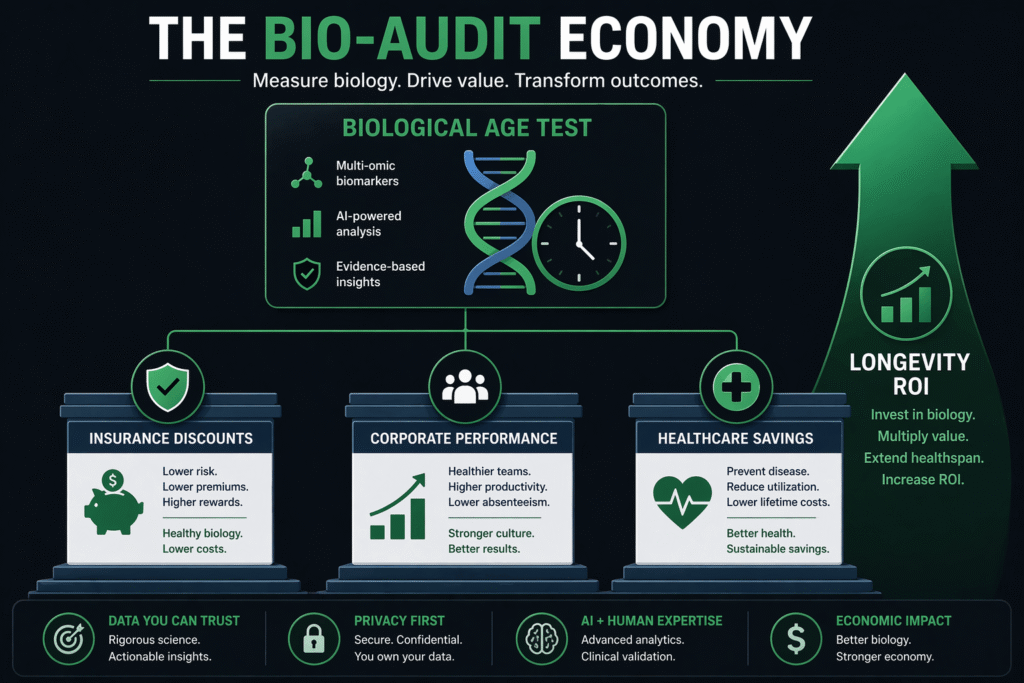
In the corporate world, biological age has become a key metric for executive performance and resilience. High-stakes industries now utilize “Bio-Resilience Audits” to ensure their leadership teams are not suffering from the accelerated aging typically driven by chronic executive stress. This has led to the integration of “Longevity Stipends” into executive compensation packages, funding the advanced diagnostics and interventions required to maintain a biological peak. The link between a “young” epigenetic profile and sustained cognitive output is now a standard KPI in high-performance organizations.
This institutionalization of longevity metrics has also fueled a surge in the Consumer Longevity Market, which is projected to reach billions by the late 2020s. For the 2026 professional, managing your epigenetic clock is seen as a form of career maintenance. Just as one might update a technical skill set, the 2026 elite worker “updates” their biological state to remain competitive in a workforce where careers now span six decades or more.
Quantifying the Reversal: Measuring Your Rate of Aging
The technical success of any longevity intervention is measured by the Rate of Aging (R). In 2026, the goal is not just a lower biological age, but a rate of aging consistently below 1.0. A value of R = 0.8 means that for every calendar year that passes, your body is only experiencing 0.8 years of biological decay. This metric allows for the quantification of “Age Reversal” strategies in real-time. The formula used to calculate your aging efficiency is:
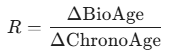
By tracking this ratio annually, 2026 practitioners can adjust protocols with surgical precision. If the R value spikes, it serves as an early-warning system for sub-clinical inflammation or metabolic dysfunction long before they manifest as symptoms.
| Feature | Chronological Aging (Legacy) | Biological Optimization (2026) |
| Primary Metric | Years lived (Calendar) | Epigenetic Methylation (Clock) |
| Prediction Power | Low (Statistical Average) | High (Molecular Precision) |
| Management | Reactive (Treating Disease) | Proactive (Managing Rate) |
| Standard Check-up | Blood Pressure / Cholesterol | DunedinPACE / multi-omic audit |
| Insurance Impact | Age-based premiums | Bio-Age based discounts |
FAQ: Navigating the Longevity Frontier
What is the average cost of an epigenetic age test in 2026?
The cost has decreased significantly due to the scale of next-generation sequencing. In 2026, a high-quality consumer test measuring hundreds of thousands of CpG sites typically ranges between $200 and $500. Some subscription-based longevity platforms include annual testing as part of their membership package to facilitate longitudinal tracking.
How often should I test my biological age?
For most 2026 professionals, annual testing is the standard. However, if you are undergoing an intensive “reversal protocol” involving new senolytics or epigenetic reprogramming therapies, quarterly testing may be used to verify the technical efficacy of the intervention. Testing more frequently than every 90 days is generally considered unnecessary as epigenetic changes take time to stabilize.
Can I actually reverse my biological age in my 50s or 60s?
Yes. Peer-reviewed human trials in 2025 and early 2026 have demonstrated that targeted lifestyle and pharmacological interventions can technically “roll back” the epigenetic clock. While you cannot change your birth year, you can significantly alter the methylation state of your DNA, potentially resulting in a biological age that is 5 to 10 years younger than your chronological self.
How does chronic stress impact my methylation patterns?
Chronic stress is one of the most aggressive drivers of epigenetic acceleration. It triggers chemical tags that silence “longevity genes” while activating inflammatory pathways. In 2026, “Stress-Induced Aging” is treated as a technical failure in nervous system regulation, requiring interventions like vagus nerve stimulation or advanced neurofeedback to restore epigenetic stability.
What is the role of AI in monitoring my biological age?
AI acts as the “Orchestrator” of your bio-data. In 2026, AI platforms ingest data from your epigenetic clock, wearable sensors, and blood panels to create a “Digital Twin.” This twin is used to run simulations on how different interventions will affect your rate of aging, allowing you to “test” a new supplement or diet in a virtual environment before applying it to your actual biology.
Is “Longevity Burnout” a real risk in 2026?
As people become obsessed with their metrics, “Longevity Burnout” has emerged as a psychological challenge. The technical pursuit of a lower bio-age can itself become a source of stress. The 2026 professional is advised to focus on the “Minimum Effective Dose” of longevity—interventions that provide the highest ROI without turning their daily life into a full-time laboratory project.
About the Author

Vinícius Andrade writes about the practical side of personal growth — employee benefits, career moves, personal finance, and everyday wellbeing. He turns dense rules and jargon into steps anyone can act on, so readers spend less time decoding fine print and more time making decisions that actually improve their lives.
