

The professional landscape of 2026 has reached a state of total geographic decoupling. The “Border-Blind” career is no longer a niche lifestyle choice for digital nomads; it has become the standard operational model for the global elite of specialized talent. In 2026, your professional value is technically portable, allowing you to reside in jurisdictions that offer the best quality of life while providing high-leverage services to corporations located on the other side of the planet. However, this freedom has introduced a new layer of technical complexity: the management of your Global Professional Footprint.
By 2026, the transition from “work-from-home” to “work-from-anywhere” has forced a massive renegotiation of international labor and tax laws. Professionals now act as their own Micro-Multinationals, navigating a web of digital residency programs and high-speed visa infrastructures that didn’t exist five years ago. This shift requires a deep understanding of “Sovereign Identity”—the ability to maintain a consistent legal and financial presence even while your physical body moves across borders. Failure to manage this technical stack can lead to catastrophic tax penalties and the loss of essential social protections.
The 2026 professional is no longer tethered to the economic cycles of a single nation. Instead, they practice Strategic Geographic Arbitrage, earning in strong currencies like the USD or Euro while spending in emerging markets with lower costs of living. This isn’t just about “saving money”; it’s about technically maximizing the Return on Life (ROL). By decoupling where you earn from where you spend, you create a financial moat that protects your career from local volatility, ensuring that your wealth and security are as borderless as your skills.
Technical Compliance: Solving the “Nexus” Problem
The most significant technical hurdle in 2026 is the “Tax Nexus”—the legal link between your physical presence and a country’s right to tax your income. In the early 2020s, many remote workers operated in a “don’t ask, don’t tell” environment. By 2026, however, national tax authorities have deployed sophisticated AI systems that cross-reference flight data, credit card transactions, and even your IP address logs to identify when a professional has stayed in a country long enough to trigger a tax liability. Mastering the “183-day threshold” is now a mandatory technical skill for the border-blind professional.
Furthermore, companies now face the risk of Permanent Establishment (PE) if their high-level employees spend too much time in a foreign jurisdiction. If a 2026 executive makes strategic decisions for a US-based firm while sitting in a villa in Portugal, the Portuguese government may technically claim that the firm now has a “taxable presence” in Lisbon. This has led to the implementation of “Compliance Dashboards” where your employer tracks your physical location in real-time to ensure that neither you nor the firm inadvertently creates a new tax nexus that violates international treaties.
To navigate this, the 2026 professional utilizes Digital Residency programs, such as the matured E-Residency of Estonia or the newer Latin American Digital Hubs. these programs provide a “Technical Home Base” for your business activities, allowing you to consolidate your tax obligations in a single, predictable jurisdiction regardless of where you are physically located. This structural setup is the key to maintaining a “clean” audit trail, ensuring that you can prove your tax status to any authority that challenges your border-blind status.
The EOR Revolution: The Infrastructure of Global Hiring
The massive growth of global hiring in 2026 is made possible by the evolution of Employers of Record (EOR). In the past, hiring someone in a foreign country required setting up a local legal entity—a process that took months and cost thousands. Today, EOR platforms act as the technical intermediary, legally employing the professional in their home country while “leasing” their services back to the global parent company. This ensures that the worker receives a local paycheck, local benefits, and remains fully compliant with local labor laws without the administrative burden.
In 2026, the EOR is no longer just a payroll tool; it is a “Compliance Shield” that protects both the professional and the corporation from the legal volatility of cross-border employment.
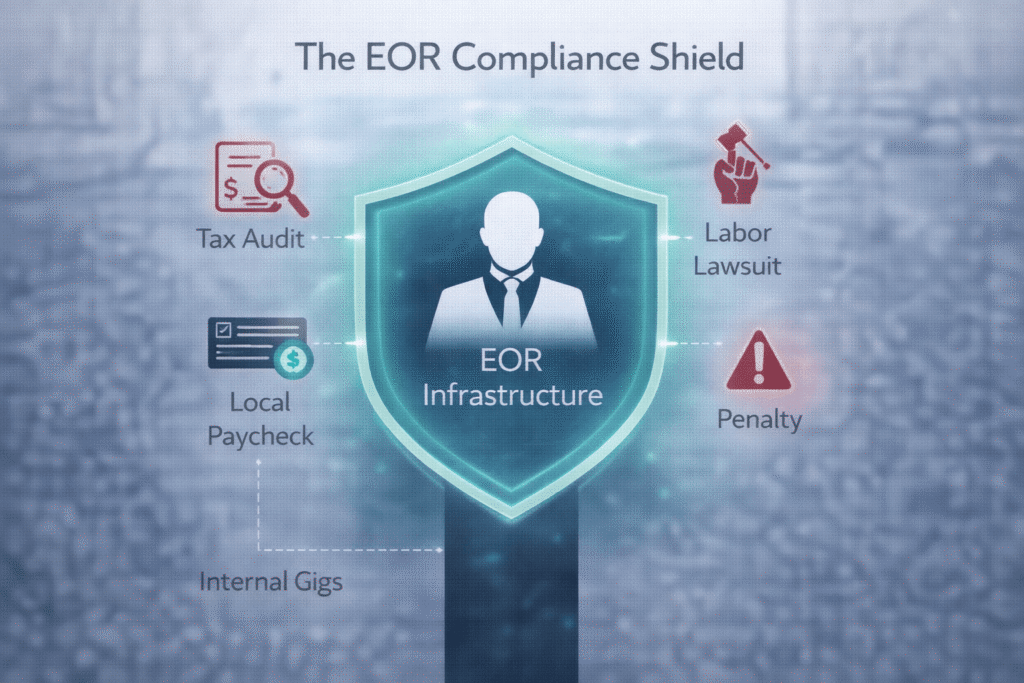
Modern EORs in 2026 also solve the “Social Protection Gap.” They provide portable health insurance, contribute to local pension funds, and manage the complex “Benefit Portability” that occurs when a worker moves between jurisdictions. For the professional, this means that even if you are working for a Silicon Valley AI startup from a mountain in Bali, you are technically accruing years of service toward your retirement and maintaining a robust social safety net. This institutionalization of global work has removed the “risk premium” formerly associated with location-independent careers.
Designing Your Global Strategy: The 5 Pillars of Compliance
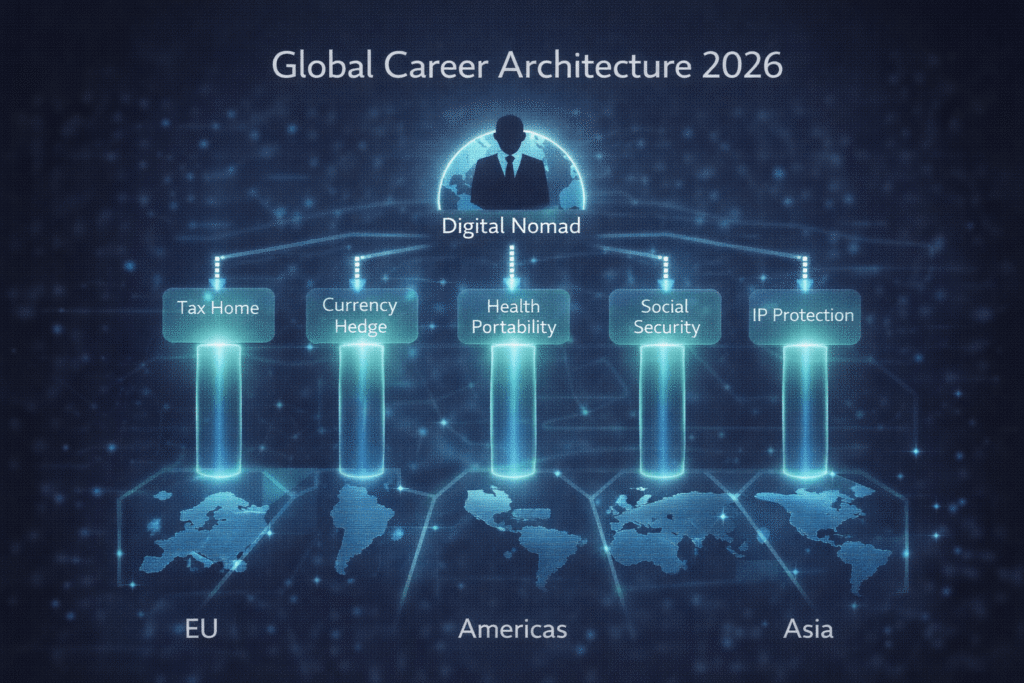
A successful border-blind career in 2026 is built on a Five-Pillar Architecture. Professionals who ignore any of these pillars face the risk of “Administrative Stranding”—where they are technically unable to access their funds, healthcare, or legal rights due to a compliance mismatch. To avoid this, you must treat your global setup as a technical project, auditing each pillar annually:
- Tax Residency: A clearly defined “Anchor Country” where you file your primary return.
- Social Security Portability: Ensuring your contributions are tracked across “Totalization Agreements.”
- Intellectual Property (IP) Protection: Ensuring your work-product belongs to the right entity across borders.
- Currency Hedge: Maintaining accounts in multiple currencies to offset local inflation risks.
- Healthcare Continuity: A global private policy that covers you in every jurisdiction you inhabit.
Implementing these pillars requires a “Digital Vault” strategy. In 2026, border-blind professionals maintain a centralized, encrypted repository of their tax certificates, work permits, and residency proofs. This “Vault” is linked to their EOR and tax platforms via API, allowing for instant verification during a bank audit or a border crossing. This proactive documentation is what separates the “Professional Nomad” from the “Administrative Refugee” in the increasingly regulated 2026 world.
Furthermore, your global strategy must include an “Exit Logic.” Every jurisdiction has its own rules for when you “cease” to be a resident. Technically, “breaking nexus” is often harder than establishing it. In 2026, professionals must provide proof of their new tax home to their previous authorities to stop the clock on their tax liabilities. Without this formal “Departure Certificate,” you may find yourself technically owing taxes in two countries for the same income—a situation that can take years of legal work to rectify.
Finally, you must manage your Data Sovereignty. Working across borders means your personal and professional data is subject to multiple jurisdictions (GDPR in Europe, LGPD in Brazil, etc.). In 2026, you must ensure that your global contracts specify which data protection law takes precedence. The border-blind professional uses encrypted tunnels and decentralized storage to ensure that their “Digital Life” remains secure and compliant, regardless of the local surveillance or data laws of their current host country.
The ROI of Arbitrage: Calculating Your Net Global Income
The true measure of a border-blind career in 2026 is your Net Global Income (Ing). This is not just your gross salary, but your income adjusted for tax arbitrage, cost of living (Col), and the “Compliance Tax” (fees for EORs and advisors). In 2026, professionals use the following formula to determine if a relocation is technically profitable:

Where G is your gross earnings, teff is your effective global tax rate, and Ccomp represents your total compliance costs. By strategically moving to a “Low-Tax, High-Quality” hub, a professional can technically increase their purchasing power by 300% without a single raise in their base salary. This is the ultimate “Career Hack” of 2026, allowing for rapid wealth accumulation that is impossible in high-cost, high-tax traditional hubs like San Francisco or London.
| Metric | Independent Contractor | EOR Employee | Local Entity (Self) |
| Tax Risk | High (Self-Managed) | Zero (Handled by EOR) | Moderate |
| Benefits Access | None (Private Only) | Full (Local Standards) | Full (Self-Paid) |
| Admin Burden | Low | Zero | Very High |
| Legal Protections | Contractual Only | Statutory (Labor Law) | Statutory (Local) |
| Best For | Short-term Gigs | Long-term Corporate | Scaling a Local Business |
FAQ: Mastering the Border-Blind Life
What is the “183-Day Rule” in 2026, and is it still the gold standard?
Technically, the 183-day rule (stating you become a tax resident after 6 months) remains the baseline. However, in 2026, many countries have added “Center of Vital Interests” tests. If your family, home, and main bank account are in Country A, you can still be taxed there even if you spend only 90 days in the country. You must technically prove that you have shifted your “Life Center” to your new home to avoid this trap.
Can I use a “Digital Nomad Visa” to work for any company in 2026?
Yes, but with a technical caveat: the visa usually only permits “Remote Work” for companies outside the host country. If you start taking local clients in 2026 while on a nomad visa, you are technically violating the visa terms and may be subject to immediate deportation and a permanent ban. Always ensure your “Service Contracts” are linked to your offshore or home-base entity.
How do I manage my retirement contributions when working across borders?
In 2026, you should utilize International Pension Portals. While “Totalization Agreements” exist between many countries to count your years of service, they are notoriously slow. The standard 2026 strategy is to maintain a “Global Private Pension” (like a cross-border SIPP or 401k equivalent) that you fund directly, ensuring that your retirement is not dependent on the administrative cooperation of multiple governments.
How do I handle “Double Taxation” if two countries claim my income in 2026?
You must technically invoke the Double Taxation Agreement (DTA) between the two nations. This requires a “Tax Residency Certificate” from your primary home. In 2026, this is done via a digital filing where you prove that tax was already paid in Jurisdiction A, allowing you to claim a “Tax Credit” in Jurisdiction B, effectively ensuring you only pay the higher of the two rates, but never both.
What is the “EOR Fee” standard in 2026, and who pays it?
EOR fees in 2026 typically range from $200 to $600 per month. While the employer technically pays the bill, it is often “factored in” to your total compensation package. When negotiating a 2026 global role, always ask if the salary is “Gross of EOR fees” to ensure that the administrative cost isn’t being silently deducted from your take-home pay.
Is my IP (Intellectual Property) safe if I work from a country with weak laws?
This is a critical 2026 technicality. Your employment contract should include a “Choice of Law” clause, stating that all IP disputes will be settled in a jurisdiction with strong protections (like Delaware or London). Regardless of where you are physically sitting, the contract technically “exists” in the chosen legal home, ensuring your inventions and code remain protected by the best possible legal frameworks.
About the Author

Vinícius Andrade writes about the practical side of personal growth — employee benefits, career moves, personal finance, and everyday wellbeing. He turns dense rules and jargon into steps anyone can act on, so readers spend less time decoding fine print and more time making decisions that actually improve their lives.
