

As of January 1, 2026, the era of “vague salary ranges” has ended. New amendments to transparency laws in key states now mandate realistic “upon hire” figures and include total compensation—equity, bonuses, and benefits—in the legal definition of wages.

The professional landscape of 2026 has reached a tipping point in the evolution of labor economics, driven by the finalized implementation of Pay Transparency 2.0. What began as a fragmented collection of state-level experiments in California and New York has matured into a sophisticated national standard for compensation clarity. In 2026, the “information asymmetry” that historically favored employers has been technically dismantled, replaced by a mandate for total rewards disclosure that fundamentally alters the power dynamics of the interview process.
This shift is not merely about listing a salary range in a job posting; it is about the standardization of compensation data. For the 2026 job seeker, transparency has become the primary filter for employer brand equity. Companies that attempt to bypass these mandates through vague language or “broad-banding” now face significant technical penalties and, more importantly, a catastrophic loss of access to top-tier talent. Recruiter algorithms in 2026 are now programmed to prioritize listings with verified data, effectively making “blind hiring” a relic of the early 2020s.
Furthermore, 2026 has introduced a higher level of interoperability between payroll systems and public disclosures. Automated compliance tools now cross-reference job postings with internal payroll audits to ensure that the “advertised” range aligns with the “actual” pay of current employees. This technical oversight has forced organizations to move away from reactive salary adjustments toward a model of continuous equity monitoring. For the career professional, this means that every salary disclosure is backed by a layer of institutional data, providing a level of reliability that was previously unattainable.
Beyond the Basic Range
The “2.0” version of pay transparency in 2026 requires a level of detail that goes far beyond the base annual salary. Regulators and platforms now demand a technical breakdown of the Total Rewards Package to prevent companies from hiding low wages behind vague promises of “generous benefits.” This transparency ensures that a candidate can perform a true “apples-to-apples” comparison between a high-base/low-equity offer and a low-base/high-variable-bonus package, which is essential in a volatile 2026 market.
To meet the 2026 standard for a “Compliant Disclosure,” employers must technically list five specific components in every job posting:
- Fixed Base Compensation: The guaranteed annual or hourly rate.
- Variable Incentive Pay: Clear benchmarks for performance bonuses and commissions.
- Equity and Long-Term Incentives (LTI): The estimated value of stock options or RSUs based on current valuation.
- Monetized Benefit Value: The employer-paid portion of healthcare, 401(k) matching, and wellness stipends.
- Geographic/Remote Adjustments: How the range shifts based on the candidate’s physical location (COLA).
This level of disclosure has effectively ended the era of “negotiation by intuition.” Candidates in 2026 are no longer guessing what a role is worth; they are analyzing a Technical Specification Sheet for their labor. By forcing companies to monetize the value of their benefits, the 2026 mandates allow professionals to calculate their true “net worth per hour,” factoring in everything from commute subsidies to high-deductible health plan contributions.
Strategically, this transparency benefits the highly specialized worker most. When the components of an offer are unbundled, the specialist can see exactly where the company is placing its value. If a 2026 disclosure shows a significantly higher bonus structure for a “Senior AI Architect” role compared to the market average, it signals a high-pressure, output-driven environment. Understanding these technical signals allows the professional to align their career choices with their preferred work-life integration model.
The “Equal Pay” Audit: How Companies Are Rebalancing in 2026
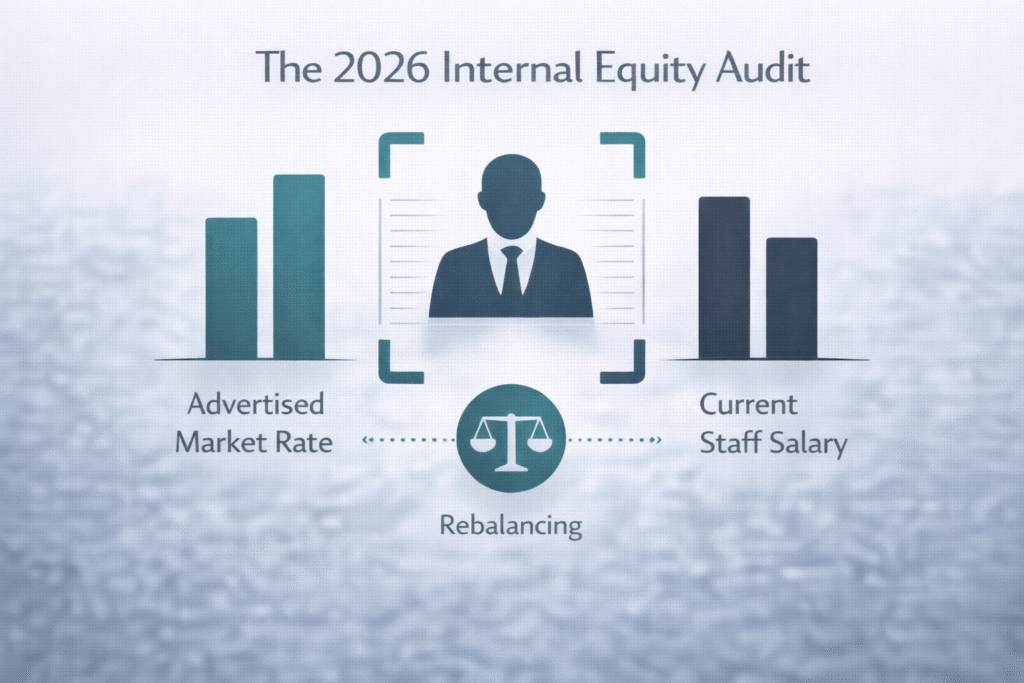
The institutionalization of transparency has triggered a massive wave of Internal Equity Rebalancing. In 2026, companies can no longer afford the “compression gap” where new hires are brought in at current market rates while long-term veterans remain tethered to outdated salary ladders. Because every new job posting is public, current employees are effectively performing their own personal audits every time their company posts a vacancy.
To mitigate the risk of litigation and mass attrition, 2026 HR departments utilize AI-driven Equity Audits. These systems technically simulate the “exposure” of current salaries against new transparency mandates, identifying “under-paid outliers” before they become a liability. This proactive adjustment period is a technical necessity for firms wanting to maintain their “Fair Pay” certification, a key competitive metric in the 2026 talent war.
In 2026, salary secrecy is no longer a tool for budget management; it is a technical liability that signals operational instability and a lack of institutional integrity to both the regulator and the market.
Strategic Negotiation: Using Transparency as Leverage
Negotiation in 2026 is a data-driven exercise rather than a psychological one. With access to verified ranges, the candidate’s goal is to position themselves within the Upper Quartile of the disclosure. Instead of asking “What is the budget?”, the 2026 professional enters the room with a benchmark analysis. They use the company’s own public data against them, proving that their verified skills (as documented in their digital portfolio) justify a position at the absolute ceiling of the advertised range.
The technical key to 2026 negotiation is the “Benchmarking Cross-Reference.” Professionals now use third-party tools that aggregate “Pay Transparency 2.0” data from a company’s competitors. If Company A is offering a $150k range for a Product Manager, but Company B (a direct competitor) has disclosed a $180k range for the same technical requirements, the candidate has immediate, indisputable leverage to demand a market adjustment before the first offer is even signed.
Finally, 2026 negotiation includes a heavy focus on the “Variable Floor.” Because transparency mandates now include bonus structures, candidates can negotiate for “guaranteed minimums” or “acceleration clauses” based on the disclosed benchmarks. This technical granularity ensures that even if the base salary is fixed, the total earning potential remains elastic, rewarding the high-performer for the specific value they inject into the organization’s 2026 growth targets.
The “Data-Driven Ask”: Calculating Your Market Position
To technically calculate your “Negotiation Target” (T), you must factor in the disclosed base (B), the variable multiplier (V), and the Geographic Cost of Living Adjustment (G). In 2026, the formula used by career strategists is:

The “Specialization Premium” is a technical percentage added for niche certifications or proven AI-literacy. By using this mathematical approach, the professional removes emotion from the discussion. They are not asking for more money because they “feel” they deserve it; they are asking for a correction based on the Technical Value of their Labor as defined by the transparency data available in the 2026 ecosystem.
Compliance Volatility: State-Specific Disclosures
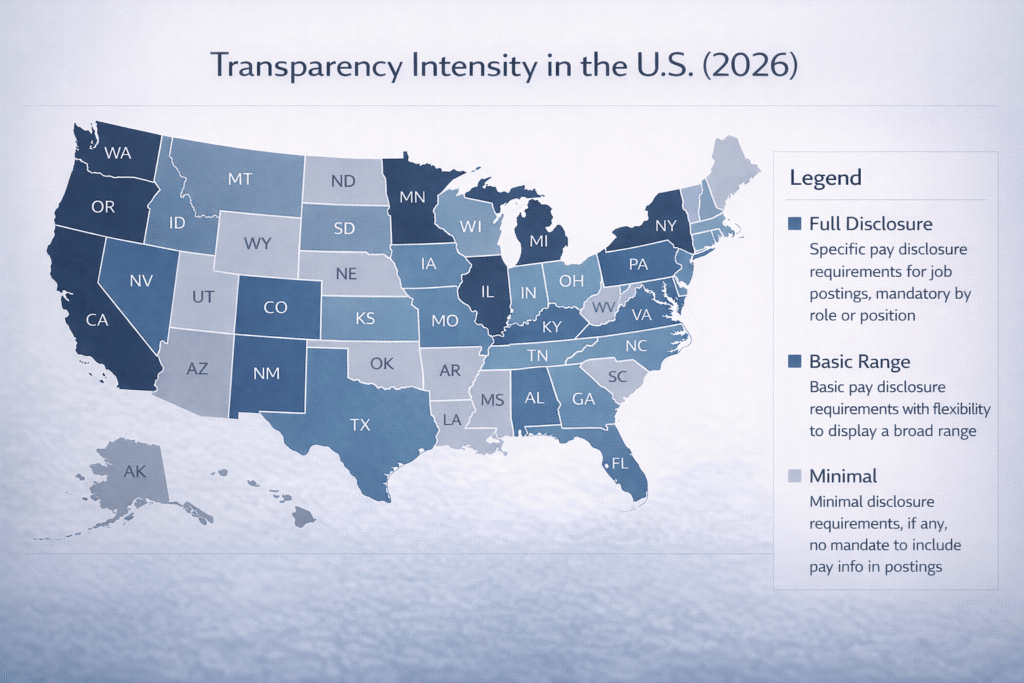
Despite the federal push, 2026 remains a landscape of Regulatory Volatility. Different states have adopted varying degrees of the “2.0” standard. For the remote professional, this creates a technical challenge: which state’s law applies when a company is in California, the employee is in Texas, and the job was posted in New York? The 2026 standard is generally “The State of the Hire,” meaning companies must adhere to the strictest disclosure rules if they intend to recruit from those talent pools.
This has led to a “race to the top” in disclosure standards. Companies that operate in “Basic Range” states are still adopting “Full Disclosure” models to ensure they don’t alienate the highly mobile 2026 workforce. This technical alignment ensures that no matter where the company is headquartered, the candidate receives a consistent data set to evaluate their future career moves.
| Feature | Full Disclosure (CA/NY/WA) | Basic Range (IL/CO/MD) | Minimal Disclosure (Other States) |
| Salary Range | Mandatory (Verified) | Mandatory (Basic) | Optional / Internal Only |
| Total Rewards | Full Monetized Breakdown | Variable/Bonus Only | Usually Omitted |
| Internal Equity | Public Audit Requirements | Voluntary Compliance | Not Required |
| Remote Portability | Follows the Candidate | Follows the Employer | Local Rules Apply |
| Retaliation Protections | Explicit & Highly Enforced | Standard Labor Protections | Minimal |
FAQ: Navigating Salary Disclosure Gaps
What should I do if a 2026 job posting shows a suspiciously wide range (e.g., $100k – $400k)?
In 2026, wide ranges are often a “compliance avoidance” tactic. Technically, you should treat the midpoint as the realistic offer. However, you can use this ambiguity to your advantage. During the initial screening, ask: “What specific technical artifacts or years of experience differentiate a $100k candidate from a $400k candidate?” This forces the recruiter to reveal their internal grading rubric, which you can then use to justify your higher-end placement.
Can an employer in 2026 still ask for my “Salary History”?
Technically, no in most states. The “Pay Transparency 2.0” movement has been accompanied by a nearly universal ban on salary history inquiries. The focus in 2026 is on the market value of the role, not your previous earnings. If a recruiter asks, the standard 2026 response is: “I’m focused on the disclosed range for this position and how my verified skills align with the top-tier benchmarks you’ve provided.”
How does pay transparency affect my “Variable Bonus” calculation in 2026?
Because variable pay must be disclosed, you have a technical right to see the historical payout data for the role. If a company advertises a “15% target bonus,” you should ask what percentage of the team actually achieved that target in 2025. This ensures that the transparency isn’t just a marketing gimmick, but a reflection of actual earning potential in the 2026 fiscal environment.
Is it legal for my boss to punish me for discussing my salary with coworkers in 2026?
No. Under the updated 2026 federal labor guidelines, pay secrecy policies are technically unenforceable. You have a protected right to discuss compensation as part of “concerted activity” for mutual aid and protection. If you face retaliation, you have a clear technical path to file a complaint with the National Labor Relations Board (NLRB), backed by the company’s own public disclosure data.
How is IA used to audit salary offers in 2026?
Many 2026 candidates now use Offer Audit AI. You upload the disclosed range and your own offer letter, and the AI scrapes thousands of Pay Transparency 2.0 listings to tell you where your offer sits on the “Market Curve.” If the AI identifies that your offer is in the bottom 10% for your specialization, it provides a drafted, data-backed negotiation script to send back to HR.
Does transparency apply to “Equity Refreshers” and long-term retention grants?
In the most advanced 2026 jurisdictions (Full Disclosure states), yes. Companies must technically outline the eligibility and frequency of equity refreshers. This is vital because a lower base salary can be technically offset by a high-frequency refresher schedule. Understanding the “vesting velocity” disclosed in the posting is a key part of calculating your total three-year ROI for any new role.
About the Author

Vinícius Andrade writes about the practical side of personal growth — employee benefits, career moves, personal finance, and everyday wellbeing. He turns dense rules and jargon into steps anyone can act on, so readers spend less time decoding fine print and more time making decisions that actually improve their lives.
