

The professional landscape of 2026 is defined by a radical shift in how high-level expertise is deployed. For decades, the “C-Suite” was a rigid, full-time commitment, often insulating top talent within a single corporate silo. Today, however, we are witnessing the institutionalization of the Fractional Executive model. This isn’t just a response to a volatile economy; it is a calculated choice by elite leaders to treat their careers as a diversified portfolio. In 2026, companies—from venture-backed startups to mid-market firms—no longer seek to “own” a leader’s entire time, but rather to lease their specific wisdom to bridge the gap known as the “Founder’s Wall.”
This “Founder’s Wall” occurs when an organization grows beyond the specialized skill set of its original leadership but lacks the $400k+ annual liquidity required for a permanent, world-class C-Level hire. Fractional leadership solves this technical bottleneck by providing surgical intervention. A Fractional CFO or CMO in 2026 doesn’t just consult; they are embedded, holding real authority and accountability for 10 to 15 hours a week. This allows the organization to access top-tier strategic thinking at a fraction of the traditional cost, while the executive gains the security of multiple revenue streams.
The macroeconomic drivers of 2026 have made this model the “new gold standard” for senior talent. With the acceleration of AI-driven business cycles, companies need to pivot faster than a full-time hiring process allows. Simultaneously, the most sought-after leaders have realized that loyalty to a single corporation is a high-risk strategy. By distributing their 40-hour work week across three or four distinct companies, they effectively hedge against industry-specific downturns and corporate restructurings, creating a resilient “career moat” that is technically superior to the traditional employment contract.
Defining the Fractional Model vs. Traditional Consulting
To navigate the 2026 market, one must technically distinguish between a “consultant” and a “fractional executive.” A consultant is typically brought in for a discrete project—they diagnose a problem, provide a roadmap, and then exit. The fractional leader, conversely, is an operating partner. They own the department, manage the team, and are measured by the long-term execution of the strategy. In 2026, the market has matured to prefer this “hands-on” approach over the high-level observational reports produced by legacy consulting firms.
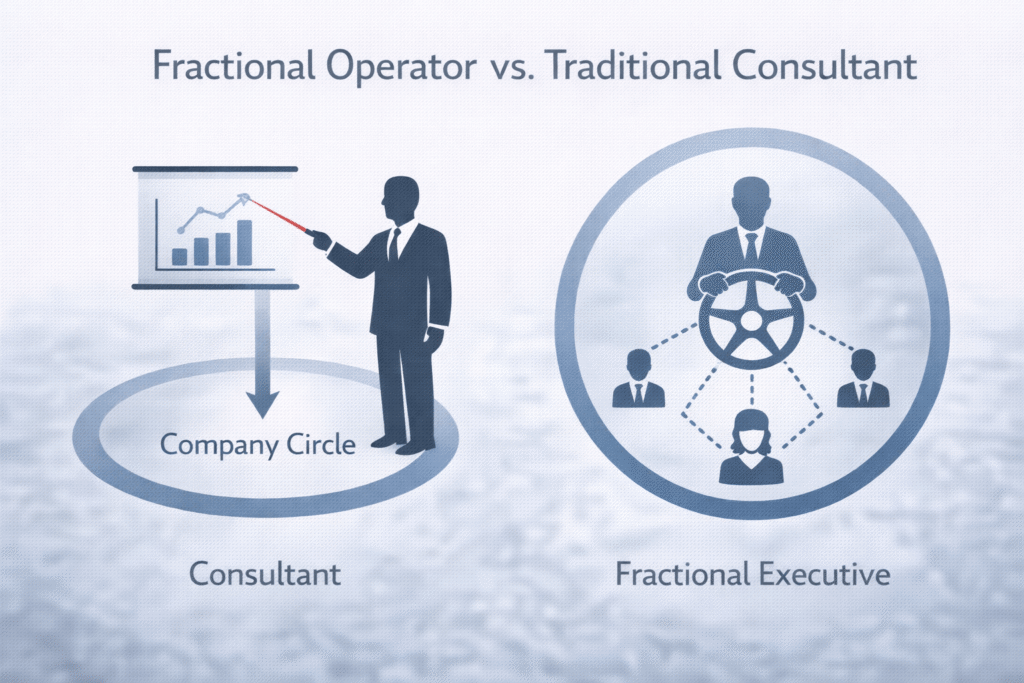
The technical integration of a fractional leader is also vastly different. While a consultant remains an “outsider” with limited access to internal systems, the 2026 fractional executive is onboarded with full operational sovereignty. They utilize the company’s internal Slack, manage their budgets via decentralized finance (DeFi) tools, and lead their teams through the same performance management software as any full-time peer. This level of embedding ensures that the executive’s “fractional” status is invisible to the day-to-day operations, providing a seamless leadership experience.
In 2026, the fractional executive is not a temporary fix; they are a strategic asset, providing high-stakes operational surgery and long-term accountability on a part-time basis.
Furthermore, the duration of the engagement has changed. In 2026, fractional roles are rarely “gigs” that last three months. They are often multi-year retentions that evolve with the company’s growth stages. A Fractional COO might join to build the operational foundations for a Seed-stage startup and stay through Series B, technically shifting their focus from “infrastructure” to “scaling” as the company matures. This continuity is what separates the fractional model from the transactional nature of the freelance economy, placing it firmly in the realm of high-level career engineering.
Finally, the 2026 model has solved the “dilution of focus” problem. Critics once argued that a leader couldn’t be effective at multiple firms simultaneously. However, the rise of AI-augmented leadership has technically proven them wrong. By utilizing personalized “Digital Twins” and executive dashboards that summarize multi-channel inputs, fractional leaders in 2026 can context-switch with nearly zero latency. They are not giving 25% of their effort to four companies; they are using technology to give 100% of their high-leverage strategic thinking to each, during their designated hours.
The Tech Stack of the 2026 Fractional Leader
Success as a fractional leader in 2026 requires more than just wisdom; it requires a specialized Tech Stack. The most successful executives now bring their own “Operating System” to every client. This includes proprietary AI-driven dashboards that integrate with the client’s ERP and CRM systems to provide a real-time “health score” of the department. This technical advantage allows the fractional leader to spot anomalies and opportunities in minutes that would take a traditional full-time executive days to uncover through manual reports.
A significant trend in 2026 is the rise of “Fractional Pods.” These are agile teams of specialists that a fractional leader “carries” with them from client to client. For example, a Fractional CMO might bring a trusted AI-media buyer and a content strategist as part of their “package.” This technically reduces the “time-to-value” for the client, as the leader doesn’t need to spend the first 90 days hiring a new team. Instead, they plug in a pre-optimized unit that is already calibrated to the leader’s specific methodology and operational rhythm.
Beyond dashboards, 2026 leaders rely on “Fractional-First” legal and financial frameworks. This involves smart contracts that automatically manage retainer payments based on pre-defined milestones and specialized NDAs that technically prevent cross-client data leakage while allowing the executive to apply “generalized insights.” This technical infrastructure is what makes the model scalable, moving the executive away from the “hours-for-dollars” trap and toward a model of value-based compensation that reflects the exponential impact of their expertise.
Risk Mitigation and Career Portfolio Diversification
In 2026, “full-time employment” for an executive is increasingly seen as a concentrated risk. If your entire income, healthcare, and professional identity are tied to a single board of directors, you are technically vulnerable to a single point of failure. The fractional model flips this dynamic by applying the principles of Modern Portfolio Theory to a career. By diversifying across multiple “clients” rather than a single “employer,” the high-level professional creates a safety net that is structurally impossible in a traditional 9-to-5.
This diversification isn’t just about income; it’s about Intellectual Cross-Pollination. A Fractional CTO working across Fintech, Healthcare, and E-commerce in 2026 is technically more valuable than a CTO locked in one sector. They can apply a breakthrough in secure ledger technology from one industry to solve a data-privacy bottleneck in another. This “cross-sector intelligence” is the highest-value currency in 2026, making the fractional executive a more adaptable and forward-thinking asset than their full-time counterparts.
The “3-2-1” Diversification Model: Engineering Your Income Stream
The 3-2-1 Model has emerged as the technical benchmark for a stable fractional career in 2026. This strategy involves managing three core clients on a monthly retainer, two advisory roles that require minimal time but provide equity upside, and one passion project or board seat. This configuration ensures that no single client represents more than 40% of the executive’s income, technically immunizing them against the sudden “firing” or budget cuts that are common in volatile markets.
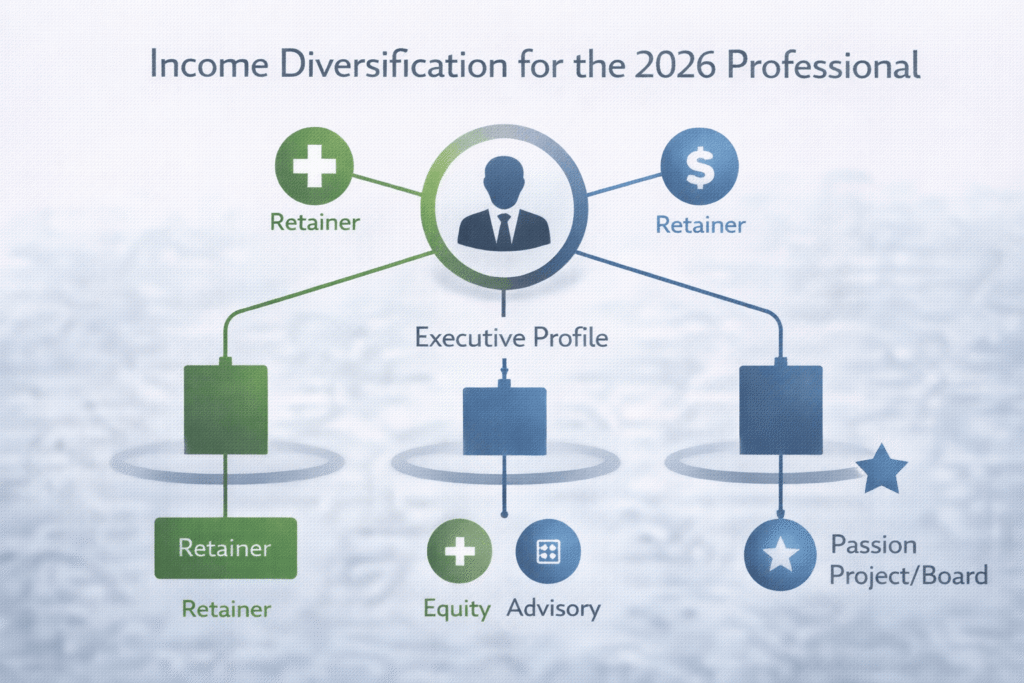
Maintaining this balance requires a strict “Operational Calendar” where days are siloed for specific clients to prevent “context-drag.” In 2026, fractional leaders utilize AI-schedulers that not only manage time but also “mental energy,” ensuring that high-stakes strategic sessions for Client A don’t overlap with the operational reviews for Client B. This technical discipline is what allows a 3-2-1 leader to maintain a higher billable rate than a traditional consultant while working significantly fewer hours.
Financial Engineering: The ROI of Fractional Intervention
For the organization, the ROI of a 2026 fractional hire is technically superior to a permanent hire in the $250k–$500k range. When you factor in the “True Cost of Employment”—including equity grants, benefits, payroll taxes, and the $100k+ recruiter fee—a full-time C-Level hire is a massive capital expenditure. A fractional leader, however, is an operational expense (OpEx) that can be scaled up or down with the company’s revenue. This financial flexibility is why boards of directors in 2026 are increasingly mandating a “fractional-first” approach for all new strategic leadership roles.
From the executive’s perspective, the financial engineering is equally compelling. In 2026, the “Retainer + Equity” model is the standard. Fractional leaders typically charge a premium monthly rate that reflects their high-impact, low-overhead status, while also negotiating “micro-equity” stakes in multiple firms. Over a decade, this technically results in a much higher probability of a significant “exit” event, as the leader has “five tickets to the lottery” instead of just one.
| Metric | Permanent C-Level | Fractional Executive |
| Annual Cash Cost | $300k – $550k+ | $120k – $180k (per client) |
| Total Comp (w/ Benefits) | 1.4x Base Salary | 1.05x Retainer Fee |
| Time to Value | 90 – 180 Days | 15 – 30 Days |
| Scalability | Fixed Contract | Highly Elastic (Month-to-Month) |
| Strategic Breadth | Single-Sector Focus | Multi-Sector Intelligence |
FAQ: Mastering the Fractional Transition
How do I handle Non-Disclosure Agreements (NDAs) when working for multiple firms in the same sector?
In 2026, the technical standard is the “Ethical Wall” clause. You must have separate, air-gapped hardware and cloud environments for each client to prevent accidental data leakage. Legally, your contracts should state that you are being hired for your “generalized strategic expertise” and that you will not disclose proprietary algorithms or trade secrets. If two clients become direct competitors, the 2026 protocol is to resign from one immediately to maintain your “Professional Integrity Score.”
Do Fractional Executives receive equity (stock options) in 2026?
Absolutely. This is the “wealth-building” engine of the model. In 2026, most fractional contracts include a Performance-Based Equity (PBE) kicker. Since you aren’t there 40 hours a week, you don’t get the same grant as a founder, but you might receive 0.25% to 1.0% of the company over a two-year vesting period. In 2026, having a “portfolio of equity” is considered the most technically sound way to build long-term generational wealth.
How do I market myself as “Fractional” without sounding like I’m just “between jobs”?
In 2026, your LinkedIn presence must reflect “Intentionality.” You shouldn’t list yourself as “Open to Work.” Instead, your profile should position you as a “Strategic Operator for [Specific Niche].” Use your digital portfolio to showcase “Transformation Artifacts”—case studies of how you helped Client X grow by 40% in six months. The key is to sell outcomes, not hours.
What is a “Strategic Retainer,” and how is it different from an hourly rate?
In 2026, the “hourly rate” is dead for high-level talent. A Strategic Retainer is a flat monthly fee for a pre-defined level of “availability and impact.” For example, a $10,000/month retainer might include one weekly board call, two team sessions, and unlimited “Asynchronous Access” via AI-messaging. This technically allows you to decouple your income from the clock, rewarding you for the speed of your wisdom rather than the duration of your presence.
Can I be a Fractional Executive while still holding a part-time W-2 role?
Technically, yes, but it’s a “Hybrid Strategy.” In 2026, some leaders maintain one Anchor W-2 (often for health benefits or a stable base) while taking on two fractional roles. However, you must ensure your W-2 contract doesn’t have a “Non-Compete” or “Full-Time Commitment” clause that technically prohibits outside consulting. Most 2026 employment contracts in the tech sector have been modernized to allow for “side-fractional” work as long as no conflict of interest exists.
What is the role of a “Fractional Platform” vs. Direct Scouting?
While platforms like Vetted or Continuum are popular in 2026 for those starting out, the highest-paid fractional leaders rely on “Personal Referral Loops.” Once you successfully scale two or three companies, the “In-Network” referral effect takes over. In 2026, the best fractional roles are never posted on job boards; they are created in the DMs of LinkedIn or via introductions from Venture Capital partners who trust your “Transformation Playbook.”
About the Author

Vinícius Andrade writes about the practical side of personal growth — employee benefits, career moves, personal finance, and everyday wellbeing. He turns dense rules and jargon into steps anyone can act on, so readers spend less time decoding fine print and more time making decisions that actually improve their lives.
