In 2026, the American job market has reached a tipping point: 70% of employers have officially adopted skills-based hiring, shifting the focus from university prestige to verifiable technical competencies and digital proof of work.
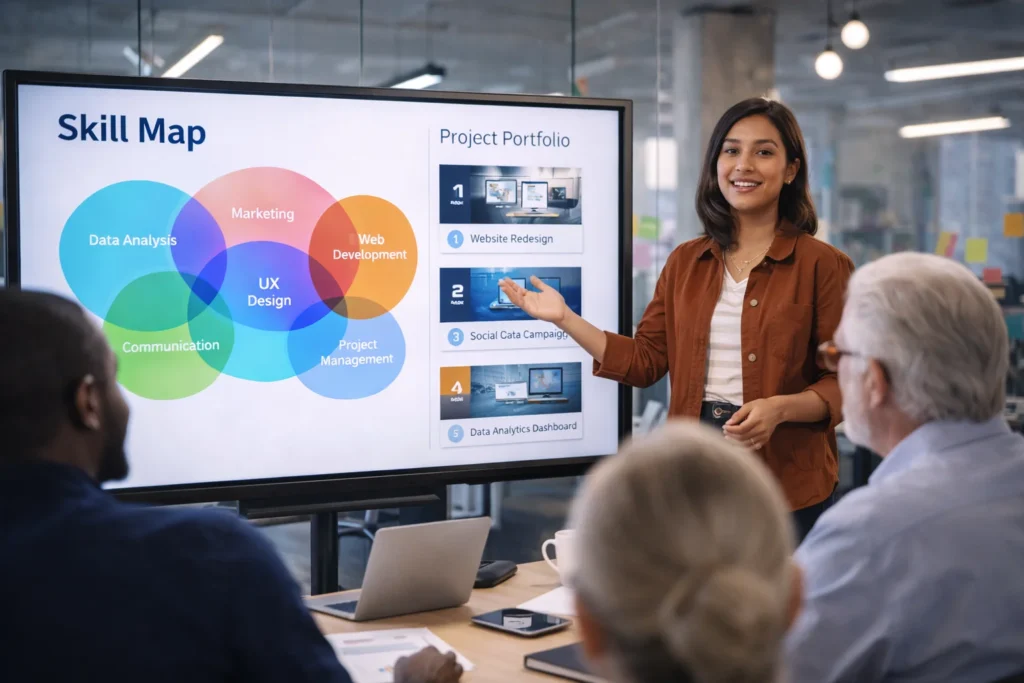
The professional landscape of 2026 has officially undergone a seismic shift, moving away from the “prestige-based” hiring models that dominated the last century. For decades, a university degree was the primary filter used by recruiters to gauge a candidate’s potential; today, that credential has been technically downgraded to a baseline “entry signal.” In the current market, hiring managers and AI-driven Applicant Tracking Systems (ATS) are prioritizing “verified output” over academic pedigree. This “Skills-First” revolution is not a trend but a structural necessity, as industries move faster than traditional academic curricula can adapt.
The catalyst for this change has been the full integration of advanced recruitment AI, such as the 2026 iteration of LinkedIn Recruiter AI. These systems no longer simply scan for keywords like “Bachelor’s Degree” or “GPA.” Instead, they are technically programmed to perform cross-platform validation, pulling data from GitHub repositories, live design systems, and public project logs. An applicant from a non-ranked state school with a robust, high-engagement digital portfolio now technically ranks higher in the automated funnel than an Ivy League graduate with only a static PDF resume. This algorithmic shift has effectively democratized opportunity, favoring those who can demonstrate immediate ROI to an organization.
Ultimately, 2026 is the year where the “Proof-of-Work” model has superseded the “Proof-of-Enrollment” model. While a degree proves you can navigate a bureaucracy and finish what you start—both valuable traits—your digital portfolio proves you can solve the specific problems a company is currently facing. As remote and hybrid work environments have become the standard, the ability to showcase independent, high-quality deliverables in a digital format has become the single most important factor in determining career trajectory and salary ceiling.
The Architecture of a 2026 Digital Portfolio
A modern digital portfolio in 2026 is far more than a simple collection of links or a gallery of pretty images; it is a dynamic data node in your professional identity. To pass the current technical audit of a sophisticated recruiter, a portfolio must be structured around reproducibility and evidence. This means including raw data, code snippets, or project management timelines that show exactly how a result was achieved. It acts as a “living resume” that updates in real-time through API integrations with the platforms where you actually do your work.
A digital portfolio is no longer a static archive of past triumphs; it is a living organism of verified competencies, providing a real-time signal of your current technical capacity to an automated world.
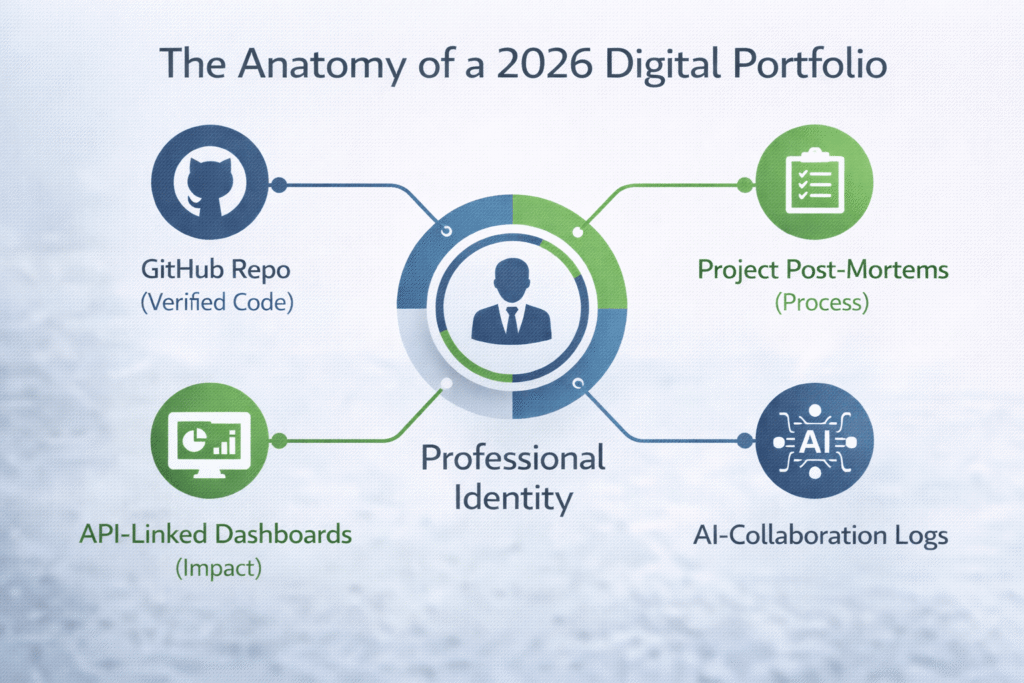
The technical “stack” of a 2026 portfolio typically includes Verified Artifacts. For a software engineer, this involves GitHub Insights showing contribution consistency and code quality. For a marketer, it might be an interactive dashboard showcasing campaign conversion rates validated by third-party analytics. For a project manager, it involves Gantt charts and post-mortem documents that illustrate the resolution of complex bottlenecks. These artifacts serve as the “hard evidence” that AI filters use to move a candidate from the “Qualified” to the “Shortlisted” phase.
Beyond the hard skills, your 2026 portfolio must also technically demonstrate your AI-collaboration literacy. Employers are looking for evidence that you can leverage large language models (LLMs) and specialized AI tools to augment your output. Documenting your “Human-in-the-loop” process—how you used AI to generate a baseline and where your unique human expertise refined the final product—is a high-value signal. It proves that you aren’t just a technician, but an orchestrator of technology, a role that is increasingly in demand as low-level tasks continue to be automated.
Finally, the 2026 portfolio is technically optimized for “Discoverability SEO.” You are no longer just waiting for someone to click your link; you are ensuring that your work is discoverable by the web-crawlers used by headhunters. This involves the strategic use of metadata, structured project descriptions, and links to industry-specific validation nodes (like Polywork or specialized talent networks). In a world of infinite digital noise, a portfolio that is technically invisible to a search algorithm is, for all intents and purposes, non-existent.
Proof-of-Work: Beyond the Static Resume
In 2026, the static, one-page PDF resume is technically obsolete. While it may still exist as a formal requirement in the final stages of a hire, it no longer serves as the primary “hook” for talent acquisition. The resume describes what you did; the Proof-of-Work (PoW) demonstrates it. This shift has forced candidates to move toward a more “evidence-based” self-marketing strategy, where every claim of expertise is backed by a verifiable digital link. This level of transparency has significantly reduced “resume padding” and has made the hiring process more efficient for both parties.
The technical advantage of PoW is its ability to showcase problem-solving methodology. Recruiters in 2026 are less interested in the fact that a project was finished and more interested in the technical hurdles that were overcome during its execution. By documenting the “middle phase” of a project—the failures, the pivots, and the iterations—you provide a window into your cognitive style. This is a far more powerful signal of long-term success than a list of bullet points on a piece of paper, as it proves resilience and adaptability in a rapidly changing technical environment.
Furthermore, PoW allows for “Continuous Evaluation.” In the legacy model, a candidate was only evaluated during the interview window. In the 2026 model, your public-facing work serves as a 24/7 audition. Many high-level roles are now filled through “passive scouting,” where AI tools identify top performers based on their public contributions to open-source projects, industry forums, or specialized communities. If you aren’t building a trail of digital evidence, you are technically excluding yourself from the most lucrative “hidden” job market.
The “Artifact” Model: Moving from Description to Demonstration
The Artifact Model is the technical cornerstone of Proof-of-Work in 2026. Instead of saying “I am an expert in data visualization,” you present an interactive dashboard that the recruiter can manipulate. These artifacts serve as modular units of competence that can be easily parsed by both humans and machines. They provide “instant verification” of your claims, removing the need for time-consuming and often inaccurate technical screenings or take-home tests that candidates have grown to despise.
Documenting these artifacts requires a shift in how you view your daily work. Every major task you complete should technically be viewed as a potential artifact for your portfolio. This involves capturing “before and after” states, documenting the tools and prompts used, and summarizing the measurable impact of the work. In 2026, the best candidates are those who spend 80% of their time doing the work and 20% of their time engineering the evidence of that work, ensuring that their professional ceiling remains as high as their technical ability allows.
The 2026 Hiring Funnel: Degrees vs. Verified Skills
The modern hiring funnel has been technically inverted. In the 2020 model, the degree was the primary “top-of-funnel” filter used to exclude 90% of applicants. In 2026, the initial filter is Skill-Based Validation. AI systems now prioritize candidates who possess specific, verified digital credentials—often earned through micro-certifications or demonstrated via portfolio artifacts—before ever checking the “Education” section. This technical realignment has led to a more diverse and capable workforce, as it values competence over access.
The following table illustrates the technical shift in candidate evaluation between the legacy era and the current 2026 standards:
| Feature | The Legacy Resume (2020) | The Dynamic Profile (2026) |
| Primary Signal | Institutional Pedigree (Degrees) | Verified Skills & Portfolio Artifacts |
| Validation | Reference Checks (Manual) | API-Based & Social Validation (Automated) |
| Update Frequency | Static (Yearly/Bi-yearly) | Real-time / Activity-stream based |
| ATS Preference | Keyword Density | Proof-of-Work & Output Consistency |
| Format | PDF / Word Doc | Interactive Web Node / Repo Link |
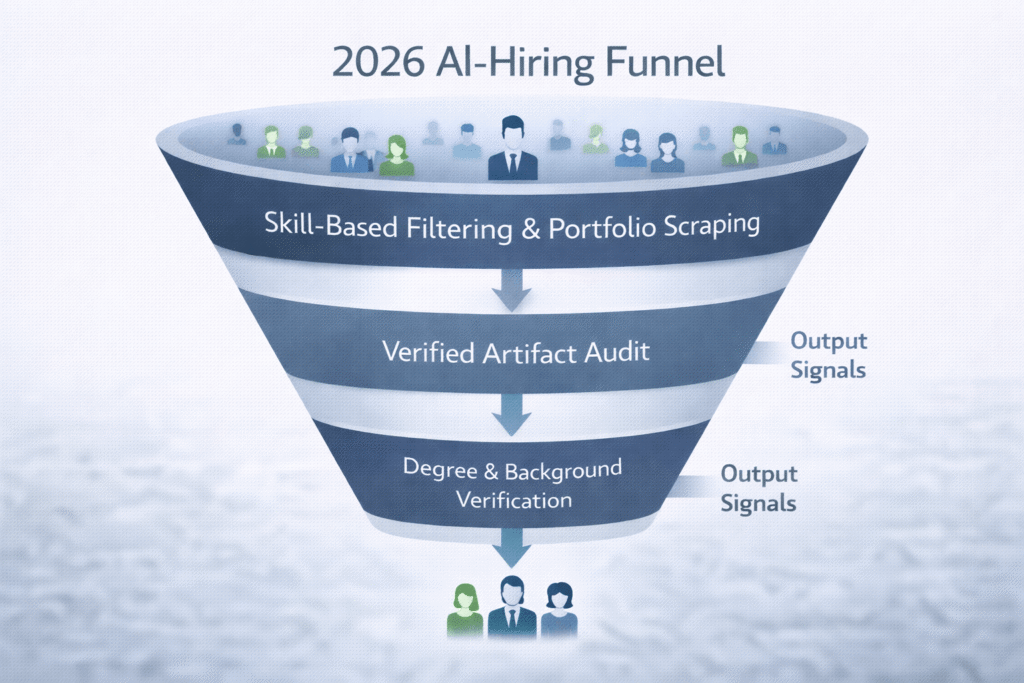
Because the 2026 funnel is so heavily weighted toward skills, the “ROI of the Degree” has come under intense technical scrutiny. Candidates are increasingly opting for “hybrid paths,” where they might pursue a degree for its networking and foundational benefits while simultaneously building a “Skills Stack” through alternative certifications. This allows them to pass the few remaining legacy filters while dominating the skills-based filters. In 2026, the most successful professionals are those who recognize that while the degree may get you through the door, it is the verified skills in your portfolio that determine how far you climb within the room.
The Degree Decoupling: When Academic Credentials Still Matter
Despite the portfolio revolution, it is a technical fallacy to say that degrees are entirely irrelevant in 2026. There are several “Protected Industries” where the academic degree remains a legal and technical prerequisite for practice. In fields such as Medicine, Law, structural Engineering, and certain facets of Academic Research, the degree serves as a certified warrant of safety and ethics. In these sectors, the “Skills-First” approach is a complement to—not a replacement for—institutional training, ensuring that the practitioner has mastered the foundational theory before applying it in high-stakes environments.
However, even in these traditional fields, the “Portfolio-Hybrid” model is taking hold. A 2026 medical residency applicant, for instance, is increasingly expected to showcase a portfolio of research publications or clinical case studies alongside their MD. A junior lawyer’s “Degree Floor” is now supplemented by a “Digital Ceiling” of verified clerkships, published legal analyses, or successful participation in high-level moot courts documented via digital badges. The degree provides the legal right to practice, but the portfolio provides the competitive edge needed to secure the most prestigious placements.
The ultimate takeaway for 2026 is that the degree has been “decoupled” from the promise of a job. It is now seen as a long-term intellectual investment rather than a short-term vocational guarantee. For those in creative, technical, or managerial fields, the degree is the “floor”—it proves you have a certain level of discipline and theoretical background. But your portfolio is the “ceiling”—it represents your actual market value and your ability to execute in the real world. Navigating 2026 successfully requires balancing both: using the degree for foundational depth and the portfolio for technical breadth and immediate relevance.
FAQ: Optimizing Your Digital Presence for AI-ATS
How often should I technically update my digital portfolio in 2026?
In 2026, your portfolio should be treated like a stream, not a pond. High-level AI-ATS tools look for “activity consistency.” Updating your portfolio at least once a month with a new “artifact” or a project update is the standard. If your portfolio hasn’t seen activity in six months, the 2026 algorithms may technically flag you as a “passive” or “low-growth” candidate, lowering your rank in proactive headhunting searches.
What is the role of LinkedIn in a portfolio-first 2026 market?
LinkedIn has evolved into the primary distribution node for your portfolio. In 2026, you don’t just list your job titles; you attach “Media Artifacts” to every role. The LinkedIn algorithm is technically tuned to favor “Social Proof,” so having colleagues “Endorse” specific artifacts or projects provides a layer of third-party validation that AI recruiters weigh heavily during the initial screening phase.
Do non-creative roles (Sales, Management, HR) really need a digital portfolio in 2026?
Yes. This is the biggest misconception of the current era. A Sales professional’s portfolio should include verified quota attainment charts (anonymized) and “Playbooks” they’ve developed. A Manager’s portfolio should showcase “Team Growth Metrics” and post-mortems of successful organizational restructures. If you are in a non-creative role, your portfolio is your “Evidence of Impact” ledger; without it, you are just making unsubstantiated claims in a data-driven world.
How do I technically validate my skills if my work is under a Non-Disclosure Agreement (NDA)?
In 2026, the standard for NDA-bound work is the “Sanitized Case Study.” You should create artifacts that focus on the methodology and the abstract results without revealing proprietary data. For example, instead of showing a specific client’s code, you show a “Genericized Architecture” that solves a similar problem, explaining the technical trade-offs you made. This proves your competence to a recruiter without violating your legal obligations.
Which is more important in 2026: a wide range of skills or deep specialization?
The 2026 market favors the “T-Shaped Professional.” Your portfolio should technically demonstrate a broad understanding of your field (the horizontal bar) but show “Spikes of Mastery” in one or two specific areas (the vertical bar). AI filters are great at finding specialists, but human hiring managers still value the ability to understand how your specific task fits into the larger business ecosystem.
How does the 2026 ATS handle “Interactive” portfolios like those built in Notion or Framer?
Modern ATS systems are now technically capable of web-scraping “Dynamic Content.” As long as your portfolio is not gated behind a complex login or an unusual script that blocks crawlers, the ATS can parse the text and even “see” the presence of media files. However, it is always a best practice to provide a “Raw Text” summary of your portfolio links in your application to ensure that no data is lost if the AI encounters a rendering issue.
What is “SEO for Careers,” and why does it matter for my 2026 portfolio?
Career SEO is the practice of using industry-standard taxonomies in your project descriptions. In 2026, AI recruiters use specific “Skill Clusters” to find talent. If you use creative but non-standard titles for your skills, you will be technically invisible to the search. Researching the “Hot Skills” of 2026 in your niche and ensuring those terms appear naturally in your project artifacts is the most effective way to stay at the top of the automated funnel.