

The Supplemental Nutrition Assistance Program (SNAP) enters 2026 with significantly tighter work requirements for adults, balanced by new, critical exemptions for vulnerable groups and updated benefit allotments to reflect the current cost of living.

The transition of the SNAP into the 2026 fiscal year marks one of the most aggressive pivots in the history of American social safety nets. Under the framework of the “One Big Beautiful Bill” (OBBBA) and subsequent federal budget reconciliations, the program has moved decisively away from the flexibility of the previous decade. This shift is characterized by a “compliance-first” philosophy, prioritizing workforce participation as a non-negotiable prerequisite for nutritional assistance. For the millions of households reliant on these benefits, the 2026 landscape is defined not by benefit amounts, but by the rigorous technical documentation required to maintain eligibility.
The legislative catalyst for this transformation was the final expiration of the 2025 waivers, which had temporarily shielded various demographics from strict work requirements during the post-pandemic economic realignment. As these protections vanished, the federal government implemented a centralized tracking system integrated with state-level labor departments, creating a real-time verification loop that identifies non-compliant households within 30 days of a missed work quota. This level of algorithmic oversight represents a significant escalation in the “integrity measures” used to manage the SNAP rolls, forcing beneficiaries to treat their benefit maintenance as a part-time administrative task.
Furthermore, the 2026 rules have significantly tightened the definition of “geographical waivers.” Previously, states could request exemptions for areas with high unemployment rates; however, the new federal standard requires a “demonstrated lack of entry-level labor” that is statistically difficult to prove in the current 2026 economic environment. Consequently, even in regions where the local economy is struggling, beneficiaries are increasingly being subjected to the standard work mandates. Navigating this new reality requires a sophisticated understanding of the specific exemptions and reporting protocols that now govern the program.
Expanding the ABAWD Definition: The 18-64 Age Shift
One of the most profound technical changes in 2026 is the finalized expansion of the “Able-Bodied Adult Without Dependents” (ABAWD) classification. Historically, work requirements were focused on a younger demographic, typically ending at age 50 or 54. However, the 2026 mandate has officially extended this definition to include adults up to age 64. This means that individuals in their late 50s and early 60s—many of whom may have been out of the workforce for years or are dealing with undiagnosed age-related health decline—are now legally required to prove 80 hours of monthly work activity to keep their benefits.
The expiration of the 2025 waivers marks a permanent shift toward a compliance-first model, where millions of older adults are now classified as ABAWDs for the first time in program history.
This “age shift” has created a systemic shock for the “Silver SNAP” population. Many of these individuals do not technically qualify for Social Security Disability Insurance (SSDI) but lack the physical stamina for the manual labor positions often available in the entry-level market. To remain eligible, these beneficiaries must now navigate a complex medical exemption process, which requires detailed “Medically Unfit for Work” certifications signed by licensed physicians. In the 2026 environment, a simple self-attestation of poor health is no longer sufficient; the documentation must be clinical, specific, and updated quarterly.
Additionally, the expansion to age 64 creates a technical overlap with early retirees who are not yet eligible for full Medicare or Social Security benefits. These individuals often find themselves in a “benefit gap” where they are too young for senior protections but too old to be competitive in the standard job market. For this demographic, the 2026 ABAWD rules are not just an administrative hurdle; they are a direct challenge to their nutritional security, necessitating a proactive engagement with state “Employment and Training” (E&T) programs to find approved volunteer or vocational paths that satisfy the 80-hour requirement.
The New Dependent Rule: Redefining Household Exemptions
The 2026 technical revisions have also fundamentally altered the “household composition” rules, specifically regarding the age of dependents. Previously, a parent was often exempt from individual work requirements if they had a child under the age of 18 in the home. Starting in 2026, the federal government has lowered this “exemption ceiling” to age 14. This change is based on the technical premise that children aged 15 and older are sufficiently independent to allow their parents to enter the workforce for at least 20 hours per week.
This shift has immediate implications for single-parent households. A parent with a 15-year-old child is now classified as an ABAWD if there are no other younger children in the home. This forces thousands of caregivers back into the labor market or into mandatory training programs to avoid the loss of household benefits. The technical burden here is two-fold: the parent must not only secure employment but must also coordinate after-school supervision for teenagers who may have previously relied on a parent’s presence, all while maintaining the strict 80-hour monthly documentation required by the state agency.
Furthermore, the 2026 rule excludes “shared custody” arrangements from providing a full exemption unless the child resides in the home for more than 50% of the month. This requires a precise technical reporting of residency schedules, often backed by legal custody documents. For households in flux, the loss of a dependent exemption can trigger a benefit reduction that occurs almost instantly, as the 2026 integrated systems update household statuses based on school enrollment and tax data. Understanding the exact date a child reaches the age of 14 is now a critical “compliance milestone” for SNAP recipients.
Documenting Compliance: Navigating the 80-Hour Monthly Mandate
In 2026, “work” for the purposes of SNAP eligibility has a very specific technical definition. The 80-hour monthly mandate can be met through a combination of paid employment, self-employment, or participation in an approved E&T program. However, the reporting mechanism has shifted from monthly self-reporting to “Verified Activity Logs.” For those in the “gig economy” or with irregular hours, this requires a meticulous collection of pay stubs, app-based earnings summaries, or signed logs from supervisors to ensure every hour is accounted for before the month-end deadline.
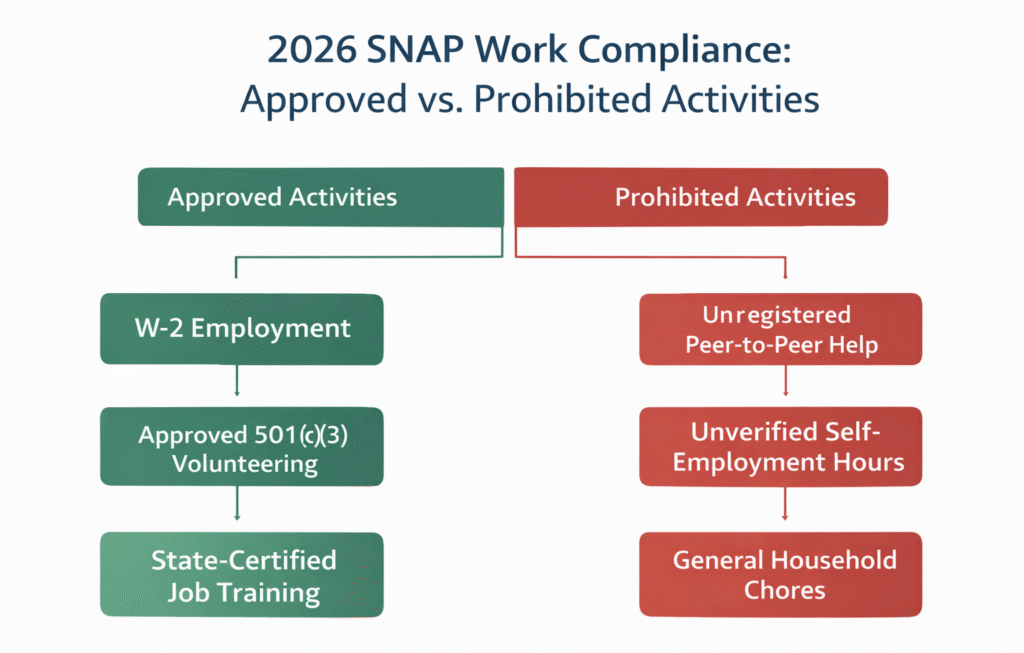
One of the more complex avenues for compliance is “In-Kind Work” or volunteering. In 2026, not all volunteer work qualifies. To satisfy the mandate, the volunteer site must be a registered 501(c)(3) nonprofit that has a formal “SNAP Work-Site Agreement” with the state agency. This technical requirement is designed to prevent fraudulent reporting but significantly limits the options for beneficiaries in rural areas where such partnerships are rare. Beneficiaries must verify that their chosen site is “compliance-ready” before committing their hours, or they risk those hours being rejected during the monthly audit.
Self-employment reporting has also become more rigorous. In 2026, the SSA and state agencies calculate work hours by dividing the individual’s net monthly income by the federal minimum wage. If the resulting number is less than 80, the beneficiary is considered non-compliant, regardless of the actual hours spent on the business. This “income-to-hour” ratio makes it difficult for new entrepreneurs or those in low-margin industries to maintain SNAP benefits during their startup phase. Strategic planning here often involves enrolling in a concurrent “Vocational Training” program to bridge the hour gap technically.
The “Three-Month Penalty”: Avoiding the 36-Month Disqualification
The most severe technical feature of the 2026 SNAP framework is the “3-in-36” rule. Under this mandate, an ABAWD who fails to meet the work requirements for three months within a 36-month period is automatically disqualified from the program. These three months do not need to be consecutive; a missed month in 2024, another in 2025, and a final one in 2026 will trigger the penalty. Once the “third strike” is recorded in the federal database, the individual is locked out of SNAP benefits until they can prove 30 days of consistent 80-hour work compliance or wait for the 36-month window to reset.
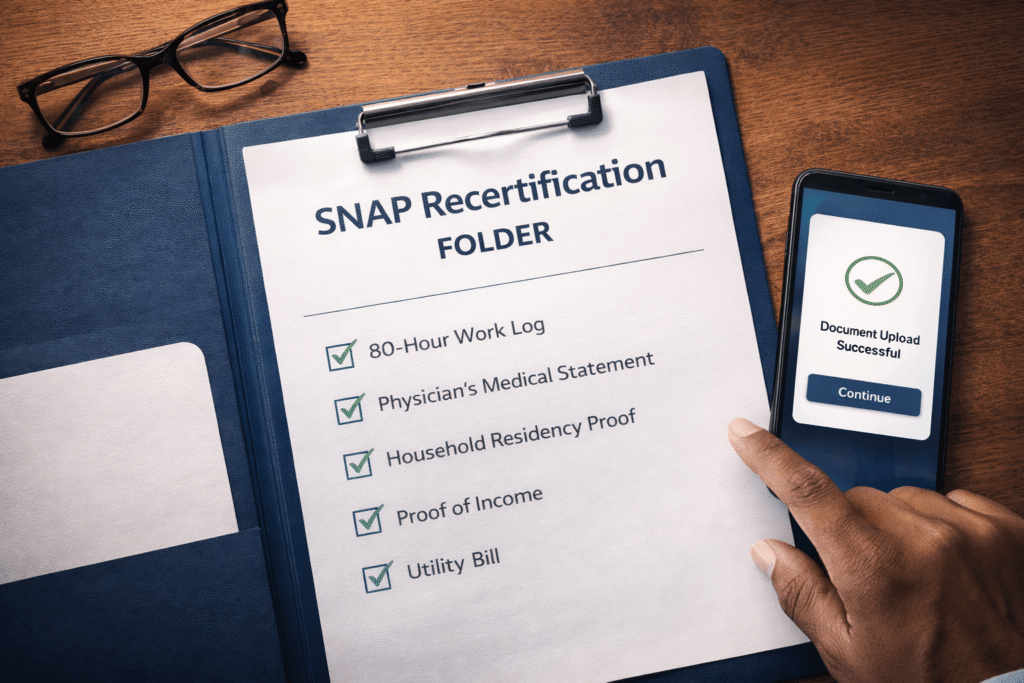
Avoiding this penalty requires a proactive “compliance buffer.” Strategic beneficiaries in 2026 are increasingly aiming for 85 or 90 hours per month to ensure that a minor administrative error or a sick day doesn’t push them below the 80-hour threshold. If a month is missed due to a genuine emergency, the technical process for an “Excusable Failure” must be initiated immediately. This involves submitting documentation—such as a hospital discharge summary or a utility shut-off notice—to the state caseworker within 10 days of the missed hours. Waiting until the end of the month to report an issue is often too late to stop the automated penalty clock.
The 2026 “Re-eligibility” process is equally demanding. If a beneficiary is disqualified, they cannot simply re-apply. They must technically “earn” their way back into the program by working 80 hours in a single month while not receiving benefits. This creates a “hunger gap” where the individual must sustain themselves without assistance while simultaneously maintaining a work schedule. Understanding the technical mechanics of the penalty clock is therefore the single most important factor in long-term SNAP participation in 2026; a single lapse in documentation can have multi-year financial consequences.
FAQ: Technical Clarifications for 2026
How does receiving Social Security Disability Insurance (SSDI) or Supplemental Security Income (SSI) interact with the 2026 SNAP work mandates?
Technically, individuals who have been officially determined as “disabled” by the Social Security Administration are exempt from the 2026 SNAP work requirements. However, the data synchronization between the SSA and SNAP state agencies is not always instantaneous. If you are an SSDI or SSI recipient but receive a “Work Requirement Notice” from your SNAP office, you must technically verify that your “Disability Indicator” is active in the SNAP system. Furthermore, individuals who are applying for disability but have not yet been approved are not automatically exempt; they must continue to meet work requirements or provide a separate medical certification from a doctor until their SSA claim is finalized.
Can a SNAP beneficiary maintain eligibility if they move between states with different work-site partnerships?
Portability in 2026 is technically complex. While your SNAP benefits can technically “follow” you to another state, your work compliance record does as well. If you have used two “non-compliant months” in Texas and move to Florida, you still only have one month remaining before the three-month penalty triggers. Additionally, you must re-register with the new state’s Employment and Training (E&T) system within 10 days of your move. The work-sites approved in your previous state may not be recognized in the new one, necessitating an immediate audit of local 501(c)(3) partnerships to ensure no lapse in documented hours occurs during the transition.
What is the technical process for appealing an “Automated Disqualification” triggered by the 2026 tracking system?
If you believe the tracking system has incorrectly flagged you for non-compliance, you must file a “Request for Fair Hearing” within 90 days of the notice. Technically, however, to keep your benefits during the appeal process, you must file the request within 10 to 15 days (depending on the state). During the hearing, the burden of proof is on the beneficiary to provide “contemporaneous records” that contradict the state’s data. This includes signed time-sheets, GPS logs from gig-work apps, or medical records. Because the 2026 system is algorithm-driven, “human error” at the data entry level is the most common grounds for a successful appeal, making precise personal record-keeping an essential defense.
About the Author

Vinícius Andrade writes about the practical side of personal growth — employee benefits, career moves, personal finance, and everyday wellbeing. He turns dense rules and jargon into steps anyone can act on, so readers spend less time decoding fine print and more time making decisions that actually improve their lives.
